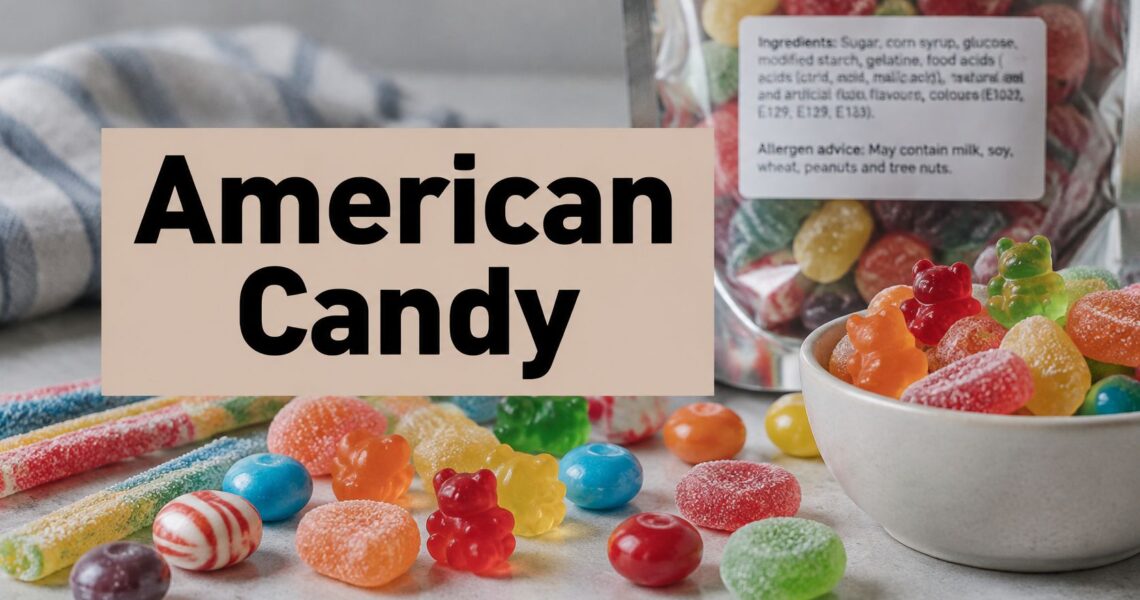
American Candy in Australia: Styles, Flavours and Labels
November 11, 2026Australia imported approximately 215,000 tonnes of confectionery in 2024, worth about US$1.3 billion, showing that American candy sits within a substantial market for imported sweets, not just a novelty corner of the shop. The useful question for Australian buyers isn't only which flavour sounds tempting. It's what the specific pack contains, how it differs from a local lolly and whether its label gives you the information you need before eating it, especially if you manage a food allergy. (IndexBox's overview of Australia's confectionery market)
Table of Contents
- Popular American Candy Styles at a Glance
- Flavour and Texture Differences That Matter
- Australian Label Rules for Imported Candy
- Country-of-Origin Wording and Sugar Content
- How to Verify an American Candy Pack Before Eating
- Check the Pack Before You Order American Candy
Popular American Candy Styles at a Glance
American candy is easier to compare by texture and eating experience than by brand. A brand may sell several kinds of sweets, so check the product type, not just a familiar name.
| Style | Typical examples | Texture | Flavour profile |
|---|---|---|---|
| Chewy fruit chews | Starburst-style chews, Laffy Taffy | Soft, chewy and stretchy | Fruity, sometimes tangy |
| Hard boiled sweets | Jolly Ranchers | Hard and glassy, dissolves slowly | Intense fruit |
| Sour candy | Warheads, Sour Patch Kids | Sugar-coated, sharp at first | Sour, then sweet |
| Gummies and jellies | Gummy bears and similar | Soft and springy | Fruit, usually mild |
| Licorice and twists | Twizzlers | Chewy, bendy rope | Mild fruit or vanilla |
| Popping candy | Pop Rocks | Fizzes on the tongue | Sweet fruit |
| Marshmallow treats | Peeps | Soft, sugary and airy | Sweet, vanilla-like |
If you like a long-lasting sweet, try a hard boiled candy such as Jolly Ranchers. Its firm texture makes it quite different from a lolly you chew and finish quickly.
Chewy fruit chews suit people who want a soft bite with some stretch. Starburst-style sweets lean towards compact fruit chews, while Laffy Taffy is known for a more pliable, taffy-like feel.
For a sharp opening followed by sweetness, choose sour candy. Warheads and Sour Patch Kids are familiar examples, though the sour coating, centre and chew can differ between products. Sour-coated gummies cross two styles: they're both chewy and sour, so the table describes their common form rather than every variation.
Gummies and jellies are soft and springy. They're a straightforward choice if you prefer fruit flavours without the glassy crunch of a boiled sweet or the firm pull of taffy.
Twizzlers represent licorice and twists, which are shaped like bendy ropes. Their chew and flavour can feel unlike Australian liquorice, so check the ingredients and description if you're expecting a strong liquorice taste.
With popping candy, the fizz is the defining feature; with marshmallow treats such as Peeps, it's the light, airy softness. If you're shopping online, decide on one or two textures you already enjoy, then check the exact product and pack details before ordering.
Flavour and Texture Differences That Matter
Start with texture when deciding whether an imported sweet is worth buying. Sour coatings, a fizzing sensation, a stretchy chew and a glassy hard-boiled texture each create a different experience. The label “American candy” doesn't tell you which one you'll get.
Flavour matters too. Some products pair fruit flavours with a more pronounced sour hit, while others offer an intense fruit taste in a hard sweet. Ingredient choices, including sweeteners or colourings, may also differ from those in a local lolly. Read the specific pack rather than assuming that two sweets with similar names or colours have the same recipe.
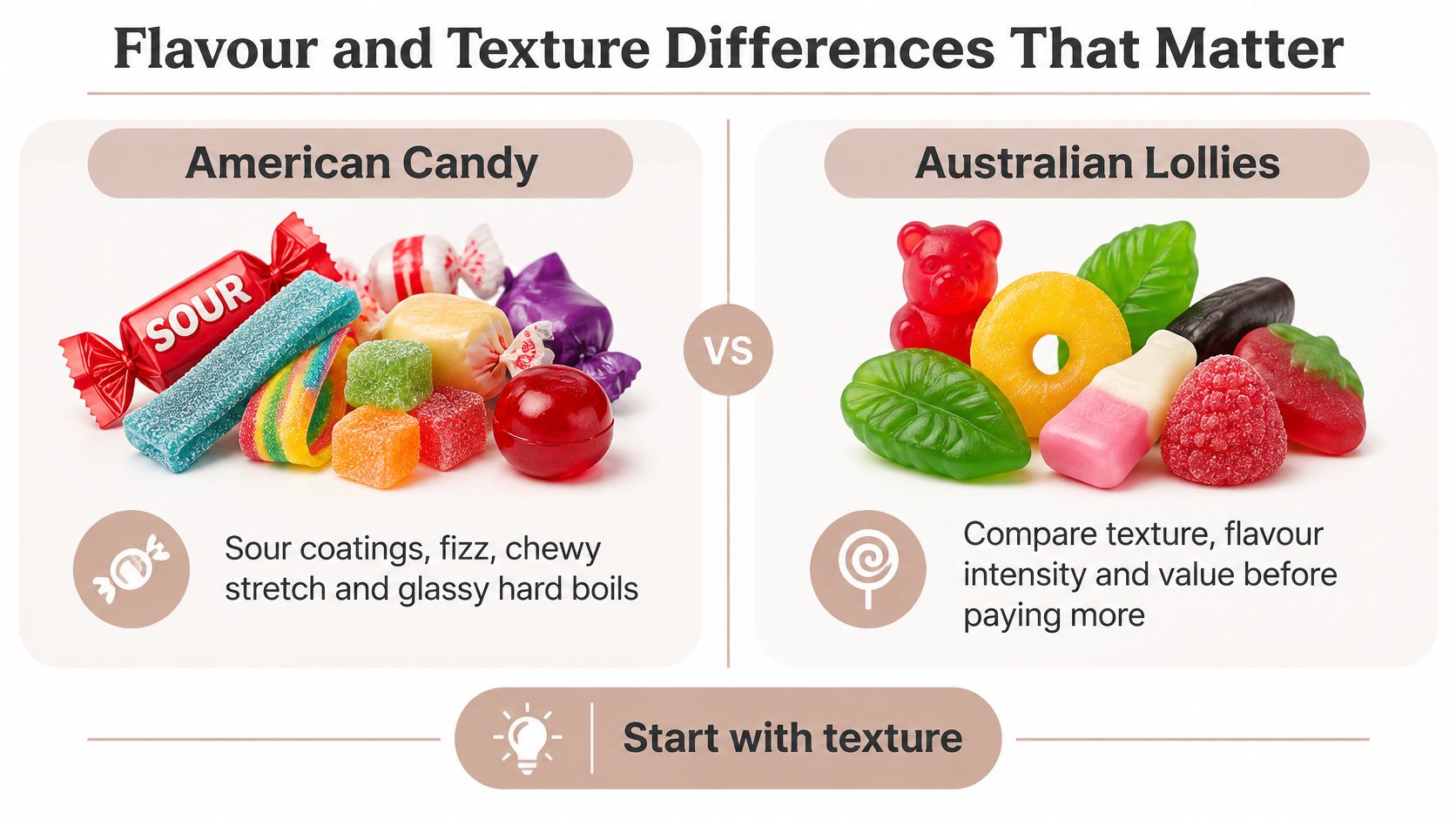
A useful comparison asks whether the imported sweet is meaningfully different, or whether a local substitute would do the job just as well. Score each product against these seven points:
- Novelty: Does it offer a flavour, shape or format you can't readily find locally?
- Texture: Is the chew, fizz or crunch the reason you want to try it?
- Flavour profile: Does the flavour sound distinct, or merely familiar?
- Ingredient differences: Are any ingredients important to your preferences or dietary needs?
- Australian label status: Can you read the local ingredient and allergen information?
- Shelf life: Will the product stay in good condition until you plan to eat it?
- Value per 100 g: Is the price justified by the amount and experience?
Take a sour chew. Its sharp coating and stretchy texture may set it apart from a local fruit chew, but its fruit flavour may be familiar and a local alternative may offer comparable value per 100 g. A hard boiled sweet can offer a distinctive glassy texture and intense fruit flavour; a local boiled lolly may perform just as well for shelf life and value.
Packaging and formulations can change between shipments, so a review of one version may not describe the pack you're considering. FSANZ's recall statistics include 28 undeclared-allergen confectionery recalls from 2021 to 2025, reinforcing why you should compare the actual pack rather than rely on its product name. Score a small pack against the seven points before committing to a full box.
Australian Label Rules for Imported Candy
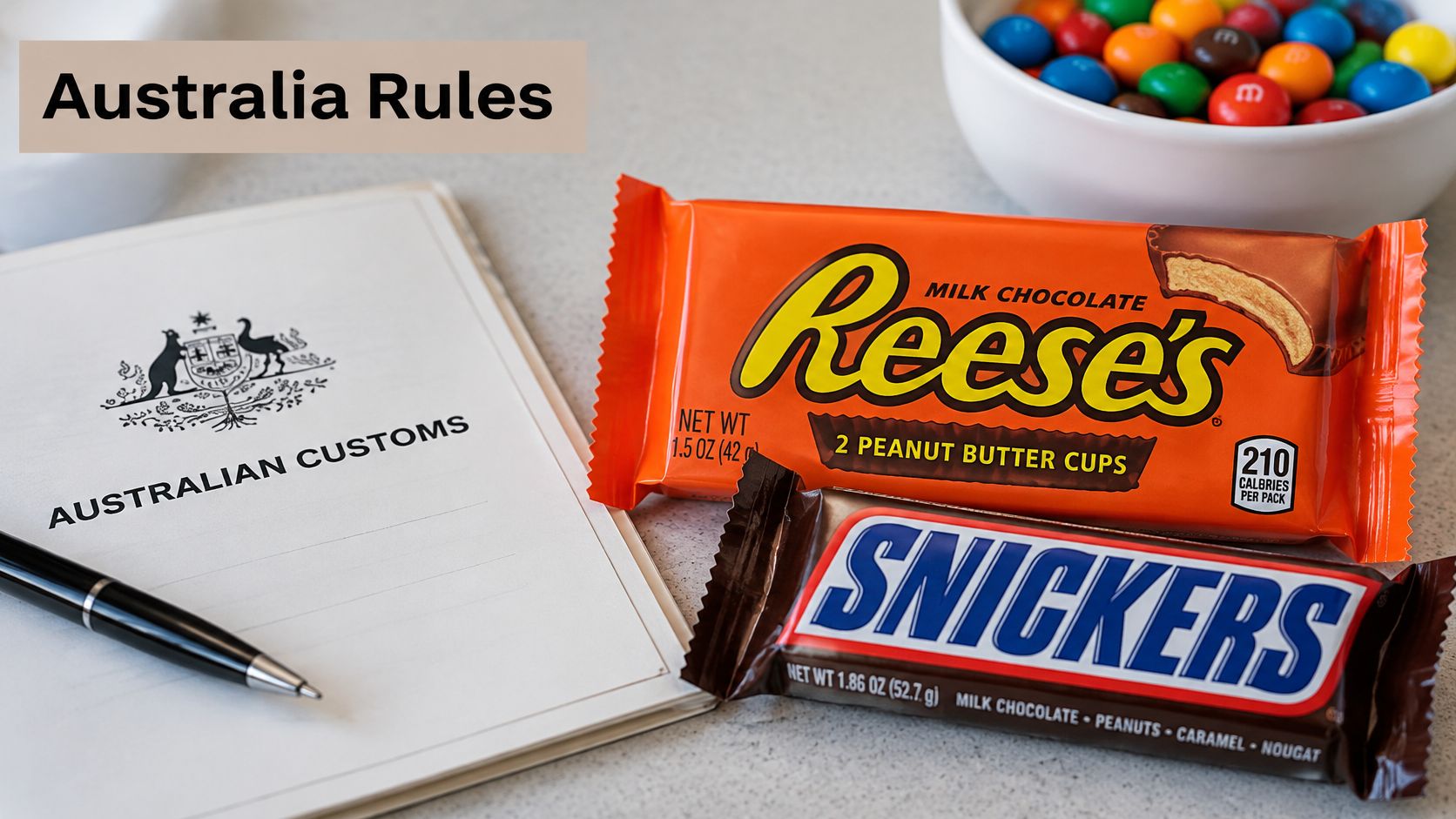
Imported candy sold in Australia must comply with the Australia New Zealand Food Standards Code. Importers remain responsible for compliance, and border controls are administered through the Department of Agriculture, Fisheries and Forestry's risk-based Imported Food Inspection Scheme. Keeping the original US packaging doesn't remove those obligations. (Food Standards Australia New Zealand's information on imported foods)
As a buyer, use the label to check what the product contains and how it should be stored or consumed. A sticker or translated insert can add Australian-compliant information, but read it rather than assuming the original US panel covers every local requirement.
| Label element | Australian requirement | What to check on a US pack |
|---|---|---|
| Ingredient list | Must describe the product as sold | Look for a sticker or translated list |
| Nutrition information panel | Required on most packaged food | Check serving size and sugar per 100 g |
| Allergen declaration | Plain English, with allergens bolded in the ingredients and repeated in a nearby Contains statement | Look for a clear Contains line |
| Country of origin | A statement identifies where the product was grown, produced, made or packed | Check that the wording doesn't imply Australian manufacture |
| Date marking | Check the product's date information before buying | Make sure there's enough shelf life for your plans |
Start with the ingredient list. It should describe the product as sold, so check whether an Australian sticker translates the US list and whether it appears to cover the candy's ingredients, including fillings or inclusions.
Next, find the nutrition information panel. Compare serving size and sugar on the label rather than assuming a US serving matches the amount you'd eat. If there's no Australian information, ask how the product's details are provided.
Read the allergen declaration closely. An ingredient list alone might not meet current Australian expectations for a nearby Contains statement. Check the origin statement and date marking too, especially if you're ordering online and can't inspect the physical pack.
Non-compliant stock can expose sellers to enforcement, seizure or recall, particularly when ingredients, colours, additives or allergen statements differ between US and Australian requirements. If a sticker or insert is absent, treat that as a reason to check further before buying.
Country-of-Origin Wording and Sugar Content
Confectionery sold in Australia is generally treated as a non-priority food for country-of-origin labelling. That normally means a text statement saying where the food was grown, produced, made or packed, rather than the more prescriptive origin box used for priority foods. The statement still needs to be truthful and supported by reasonable grounds. (The ACCC's guidance on country-of-origin food labelling)
Read the origin statement itself. Flag colours, brand names and packaging style can mislead, because American-style branding can sit on candy packed almost anywhere. A product made in the United States should be described in a way that reflects that, and where ingredients come from several countries, the wording may instead name where the product was packed or state that it comprises multiple origins. If the statement feels vague, ask the seller for the exact wording before you buy.
Sugar comparisons depend on reading the label just as carefully. Two packs can sit side by side on a shelf yet report sugar in different ways: per serving, per pack, or per 100 g.
Compare sugar on a like-for-like basis
Serving sizes on US packs may not match those on Australian products. To compare fairly, convert both figures to sugar per 100 g, using the same units and the pack's stated serving weight.
Take a hypothetical 43 g US pack containing 27 g of sugar in the whole pack. Divide 27 by 43, then multiply by 100: that is about 63 g of sugar per 100 g. If an Australian lolly lists 18 g per 100 g, compare 63 with 18. Comparing 27 g per pack against 18 g per 100 g would hide the gap, because the units differ. In this example, the US sweet carries about 3.5 times as much sugar per 100 g.
When selling or buying imported sweets, display the original nutrition panel alongside Australian-compliant label information where relevant. That lets shoppers compare serving size, sugar and allergens without having to interpret unfamiliar US conventions.
How to Verify an American Candy Pack Before Eating
A familiar product name can cover more than one pack version, so read the exact imported unit in your hand. FSANZ says the transition period for older allergen labels ended on 25 February 2026, which means older stock may still carry earlier formatting even when the product looks unchanged. (FSANZ's allergen information for food businesses) That is why label checks matter before eating, especially for imported confectionery.
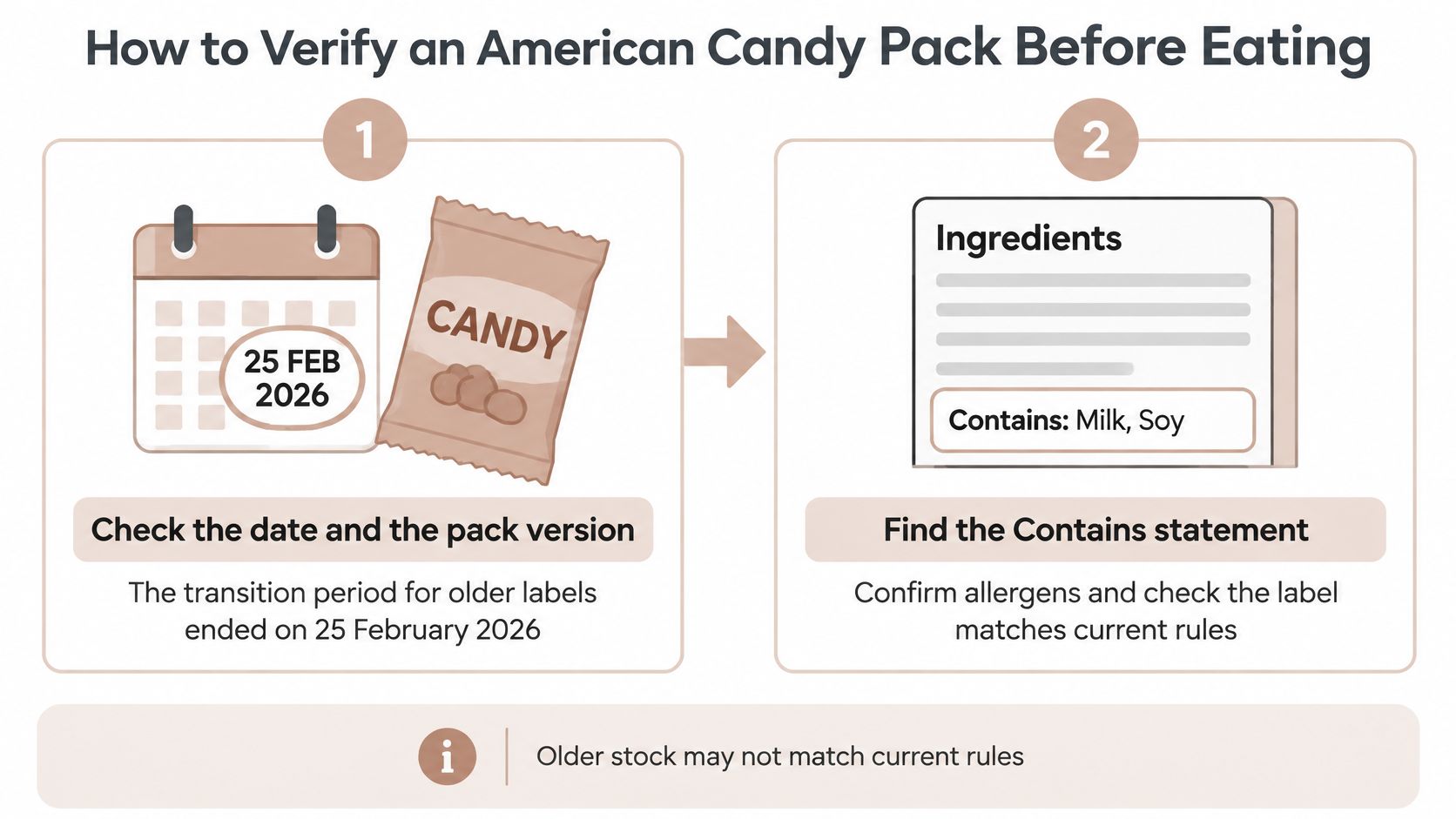
Work through the pack in this order:
Check the date and pack version. Find the date marking, any Australian sticker or insert, and signs that the label is the current version. A product you know from US social media may arrive in an older or relabelled pack.
Find the Contains statement. Look near the ingredient list for a clear statement naming the allergens present. If it is missing, smudged or hard to interpret, treat that as a stop sign rather than assuming the product is safe.
Read the ingredient list for bolded allergens. Australian allergen information should use plain English, with allergens emphasised in the ingredient list and repeated in the Contains statement. Check the whole list, including colours and flavourings, even if the front of pack looks familiar.
Break down compound ingredients. Chocolate, caramel, biscuit and cookie pieces can bring milk, soy, wheat, egg, peanuts or tree nuts into a sweet that sounds simple. Confirm how those components are declared instead of guessing from the product name.
Take may contain wording seriously. An advisory statement signals possible cross-contact during manufacture or packing. For someone with a food allergy, it deserves the same attention as a listed ingredient.
Keep the batch code and check recalls. Save the batch or lot detail until the pack is finished, so a later recall notice can be matched to one shipment rather than a broad product name.
A pack is easier to trust when the date is readable, the Australian label information looks current, the Contains line is clear and every ingredient can be traced to plain terms. If any of those pieces are unclear, pause before eating it, particularly when the candy is for a child, a gift or anyone label-sensitive.
Check the Pack Before You Order American Candy
Before ordering, use three quick checks:
- Choose the style: Confirm whether you want a chewy fruit sweet, a sour gummy, a hard boiled candy or another texture, then check the exact product rather than relying on its brand name.
- Read the Australian label information: Look for a nutrition panel and a clear Contains statement, then review the full ingredient list.
- Check the date and origin wording: Make sure the date suits your plans and the country-of-origin statement clearly describes where the product was made or packed.
A sticker or translated insert can provide important compliance information. If it's missing, ask what information accompanies the pack before buying. Keep the batch code and date until you've finished the product, so you can identify the exact pack if needed.
Cheap Smokers sells American candy and rare snacks, including hard-to-find items and gift boxes. Once you've chosen a style, check the exact product and its pack details against this list.
If you've picked a texture or flavour to try, browse the American candy and rare snacks available at Cheap Smokers, including hard-to-find items and gift boxes. Check the specific pack's label, date and allergen information before eating, and keep its batch code until you've finished it.