Chop Chop Tobacco for Sale: Why It Is Illegal
November 2, 2026Chop-chop is unlicensed or untaxed loose tobacco, and it isn’t a lawful product for sale in Australia, even when a listing looks like ordinary roll-your-own. A low price doesn’t turn it into a legitimate alternative to duty-paid tobacco.
The usual advice to compare prices by weight misses the first question: is the tobacco lawful to sell? Before comparing pouches, buyers need to understand what the seller is offering, how duty applies and whether the supply chain can be checked. Otherwise, an apparent saving can mean paying for an uncertain product that’s exposed to enforcement.
Table of Contents
- What Chop Chop Tobacco for Sale Really Means
- How Australian Excise Makes Untaxed Leaf Unlawful
- How Large Illicit Chop Chop Cultivation Has Been
- Why a Cheap Price Is Not a Real Saving
- Health and Quality Risks in Unregulated Leaf
- Why Illicit Use Rose as Smoking Fell
- Buy Duty-Paid Tobacco from a Checked Retailer
What Chop Chop Tobacco for Sale Really Means
A listing for chop chop tobacco for sale isn’t advertising a cheaper grade of ordinary rolling tobacco. In its illicit meaning, chop-chop is loose tobacco grown, produced or imported outside the required licensing and duty arrangements. The distinction is legal, not a description of how finely someone has cut the leaf.
Lawful roll-your-own tobacco is also loose leaf. Looking at its colour, cut or texture won’t tell you whether a manufacturer held the required licence or an importer paid customs duty. A seller’s description of tobacco as natural, local or premium doesn’t answer those questions either.
Think of two bags of flour that look identical. One comes through a documented commercial supply chain; the other comes from an unidentified shed. Their appearance doesn’t establish how they were produced or whether the seller has met the applicable rules.
Lawful rolling tobacco versus chop-chop
The useful comparison is between verifiable retail stock and tobacco whose legal origin can’t be established.
| Check | Lawful rolling tobacco | Chop-chop |
|---|---|---|
| Legal status | Manufactured or imported through lawful arrangements, with applicable excise or customs duty paid | Grown, made or sold without the required licence or without duty |
| Appearance | Loose leaf in compliant retail packaging | Usually unbranded loose leaf or plant matter |
| Retail quantity | Subject to the loose-tobacco retail quantity rule explained below | Bulk descriptions don’t establish a lawful retail unit |
| Traceability | Supplier can demonstrate licensed manufacture or lawful importation | No verifiable excise or provenance chain |
| Buyer exposure | A taxed retail product, with smoking risks still present | Enforcement exposure and uncertainty about the leaf and supplier |
Enforcement isn’t confined to growing sites. The Australian Taxation Office’s illicit tobacco guidance reports that its 2024–25 activity seized and destroyed 23,311 kg of illicit tobacco and 6,789,411 cigarettes, with associated estimated excise duty of $58 million.
What counts as a useful answer from a seller
A reassuring message isn’t documentary traceability. A seller needs to be able to explain the product’s provenance, lawful manufacture or importation, and duty treatment.
- Product identity: The description should identify what’s being sold, rather than substitute an informal nickname for a retail product.
- Supplier chain: There should be a business behind the stock that can account for its origin.
- Duty status: An invoice or catalogue entry shouldn’t be treated as proof that the applicable tax was paid.
An unbranded loose offer should be treated as non-compliant unless its duty-paid and licensing chain can be verified. Loose leaf is a product form. Chop-chop is not a lawful retail category.
How Australian Excise Makes Untaxed Leaf Unlawful
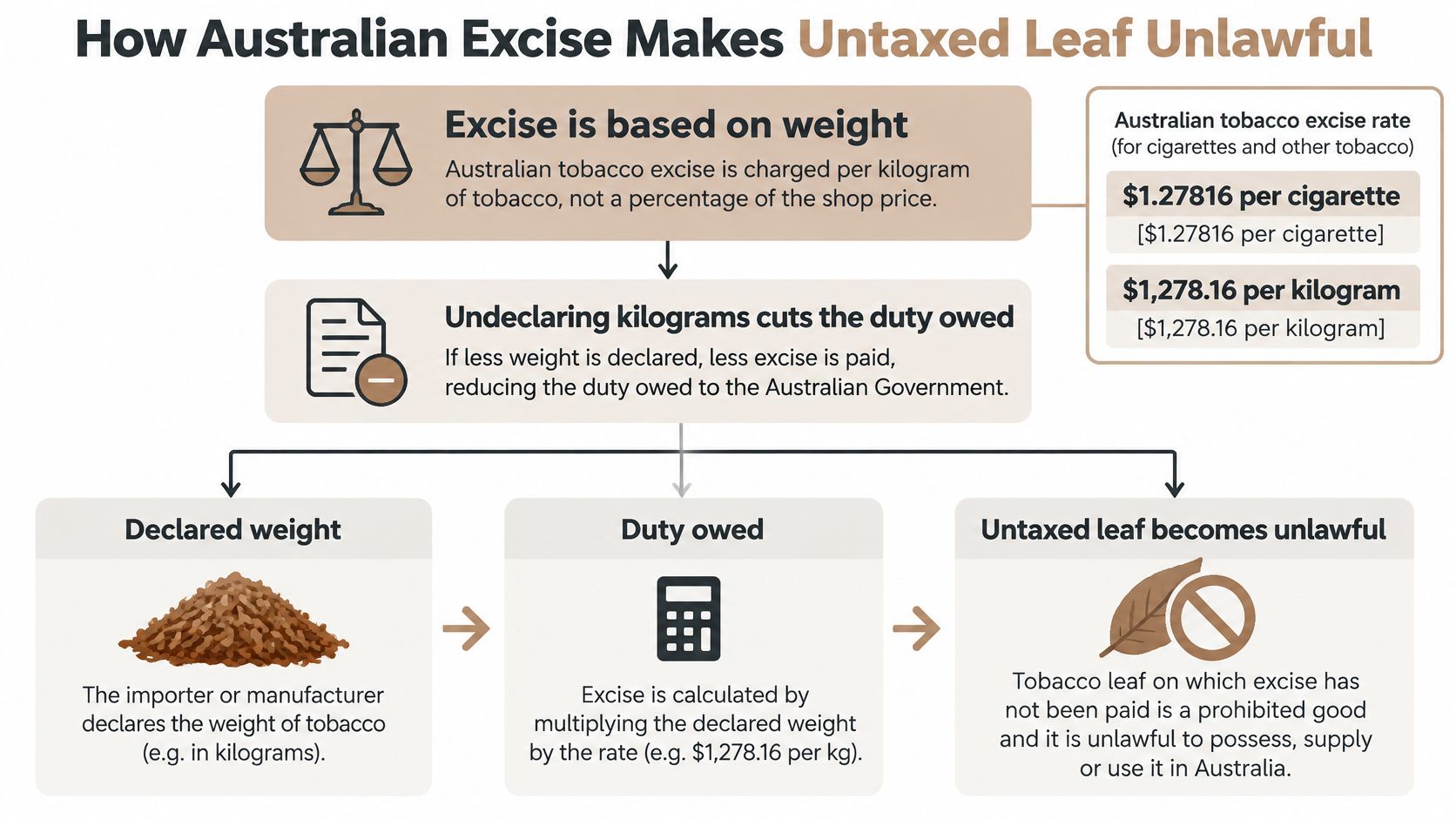
A low sticker price only changes the seller’s margin. Australian excise on loose tobacco works like a weighbridge charge: the payable duty follows the quantity of excisable tobacco, so under-declaring weight lowers the tax accounted for even when the pouch later sells at an ordinary retail price.
The ATO tobacco excise guidance gives relevant-period rates of $1,893.57 per kilogram for loose tobacco and cigars, and $1.27816 per cigarette for cigarettes containing no more than 0.8 g of tobacco; the same guidance states that loose pipe or cigarette tobacco must be sold in quantities of no more than 120 g.
Those are period-specific rates, and they still show why duty sits at the centre of a lawful tobacco price. A retailer can discount margin, freight or packaging. The weight-based duty stays fixed underneath the shelf price.
Follow the weight, not the advertised discount
For loose tobacco, start with the declared tobacco weight and multiply by the applicable duty rate. Retail margin, freight and other business costs sit on top of that calculation. A heavily discounted advertisement changes the seller’s take, while the tobacco weight still determines the duty that should have been accounted for.
The flowchart maps that weight-based process.
Read bulk descriptions carefully
A bulk catalogue description can mean several compliant retail packs grouped together. It can also mean one loose lot that fails the retail quantity rules. A pouch photo or a shopping-cart total doesn’t settle which version is being sold.
Practical rule: Ask what will actually arrive, including the individual retail packaging, rather than relying on the total weight in the listing title.
Before treating bulk stock as lawful, check:
- Declared weight: The stated quantity should match the tobacco supplied.
- Retail quantity: Loose pipe or cigarette tobacco needs to stay within the applicable retail pack limit.
- Duty treatment: An explanation supported by records carries more weight than a bare assurance that tax is included.
For a buyer, untaxed means tobacco outside the lawful duty system, with enforcement and seizure exposure. A receipt, an online checkout or a claim that everyone buys it creates no exception.
How Large Illicit Chop Chop Cultivation Has Been
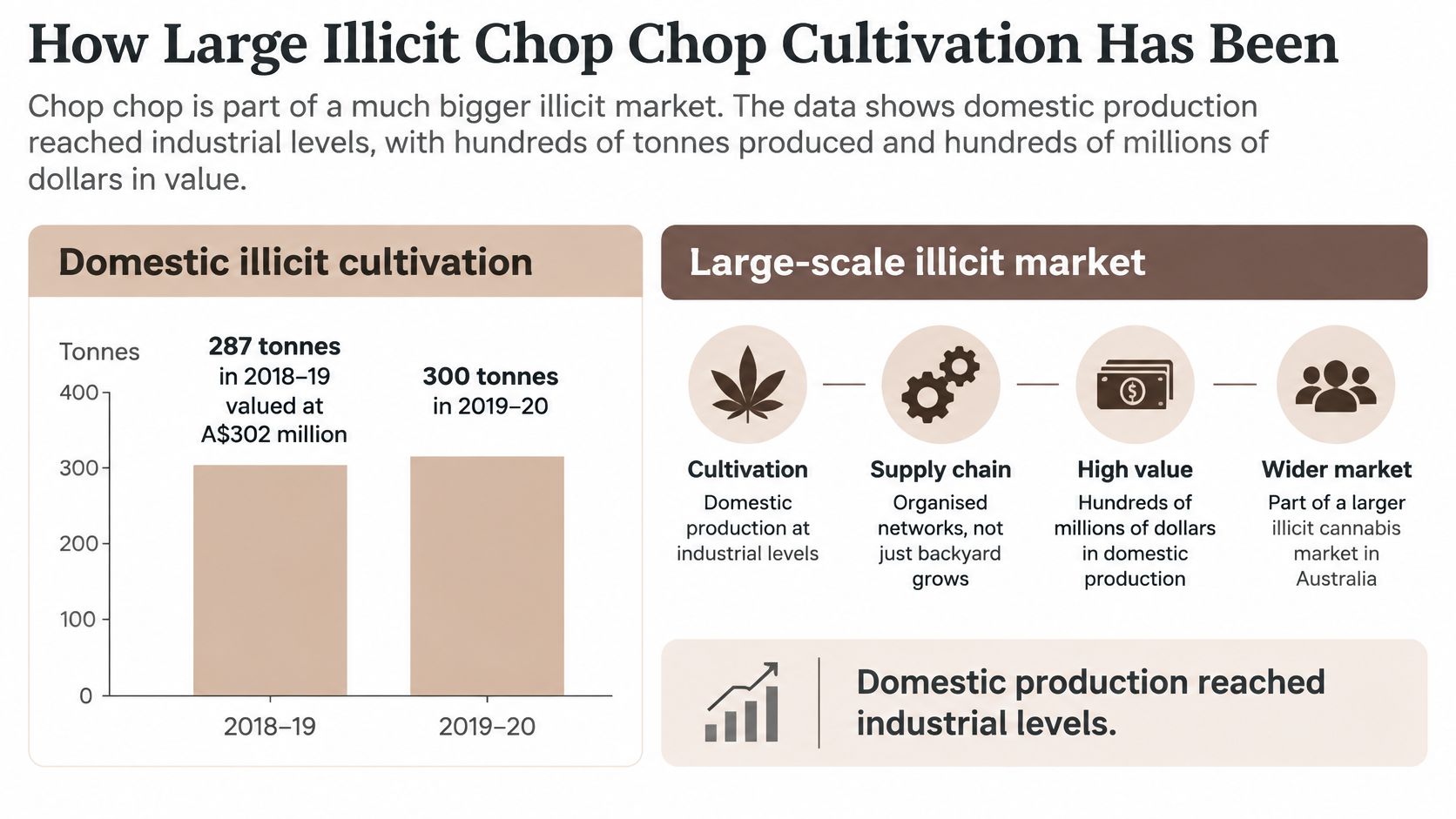
Illicit tobacco is grown in Australia at a scale comparable to a legitimate industry. The ATO’s estimates of illicit domestic chop-chop cultivation put total illicit tobacco at approximately 1,656 tonnes, or 18% of all tobacco for sale, in 2022–23, with illicit domestic production representing about A$400 million in evaded tax.
ATO estimates of illicit domestic chop-chop
| Year | Tonnes | Estimated value |
|---|---|---|
| 2018–19 | 287 | A$302 million |
| 2021–22 | 374 | A$598 million |
| 2022–23 | 302 | A$495 million |
| 2023–24 | 202 | A$370 million |
Two patterns stand out. Domestic output climbed to a peak of 374 tonnes, then fell back. And even the lowest year in the series still involves hundreds of tonnes and hundreds of millions of dollars. A declining line on a chart is still a large market.
These figures count domestic cultivation only. The broader illicit market also includes tobacco reaching buyers through other channels, so homegrown leaf and total illicit supply are different quantities. Treating them as one number flatters some years and understates the whole.
The chart gives a visual introduction to the scale of domestic cultivation.
A fall in estimated production isn’t legalisation
The table shows a rise to a peak followed by a decline. It doesn’t show illicit growing disappearing, and it doesn’t establish why the estimates changed. Growing conditions, enforcement effort and estimation methods each need separate examination before a cause can be assigned.
Estimated value needs the same care. Tonnes measure weight. Estimated value puts a dollar figure on that production. Evaded tax measures revenue the duty system never collected. Each number answers a different question:
- Cultivation estimates describe how much leaf was illicitly produced domestically.
- Estimated value converts that production into a monetary measure.
- Evaded tax describes revenue not collected under the duty system.
Mixing these measures makes the market look larger or smaller without explaining what was counted. A buyer who hears that the market shrank may still be looking at a listing connected to hundreds of tonnes of untaxed leaf.
The conclusion is narrower and firmer than any prediction about the market’s future: a falling national estimate doesn’t make a particular street deal or online listing lawful, and it doesn’t shift the risk off the buyer. At this scale, chop-chop isn’t a harmless backyard sideline. A cheap pouch looks like a small private transaction, yet the supply behind it sits inside a substantial market where the unpaid excise is the discount.
Why a Cheap Price Is Not a Real Saving
A lower sticker price proves only that the seller is asking for less money. It doesn’t prove equivalent contents, reliable delivery or a lawful transaction. Comparing chop-chop with compliant rolling tobacco as though they were interchangeable products leaves out the very costs that explain much of the price difference.
The Parliamentary Library’s brief on combating illicit tobacco places the 2024–25 illicit market value at $4.1–$6.9 billion, with estimated excise losses of $7.7–$11.8 billion, and reports that during 2025–26 the Australian Border Force seized more than 586.7 tonnes of loose-leaf tobacco, with total tobacco-duty evasion from border seizures estimated above $4.7 billion.
Compare the transaction, not just the pouch
Those market-value and excise-loss estimates measure different things. They shouldn’t be added together as though they were separate purchases. Their relevance to a buyer is that unpaid duty is central to the illicit price, not an incidental discount negotiated by a clever retailer.
A useful price comparison asks what the buyer receives and what recourse exists if something goes wrong.
- Usable quantity: If the contents don’t match the promised weight or some leaf is discarded, the advertised unit price isn’t the effective cost.
- Completed purchase: A failed delivery or seized consignment can leave the buyer out of pocket.
- Accountable seller: A seller who disappears may leave no practical route to resolving a complaint.
- Repeat availability: Today’s informal offer doesn’t establish a dependable future supply.
These are possible costs, not claims that every illicit purchase has the same outcome. They’re also costs an advertisement rarely spells out.
Price pressure is real, but the comparison still matters
Adults who smoke may be trying to manage a tight household budget. Acknowledging that pressure doesn’t require pretending that undocumented tobacco offers the same transaction as traceable retail stock.
Use a rolling-tobacco price comparison to organise questions about quantities and advertised costs, not as proof of any product’s duty status. Price information and compliance evidence serve different purposes.
Cheap describes the sticker. It doesn’t establish the financial, legal or quality-adjusted cost.
More enforcement can also interrupt informal supply, although seizure totals alone don’t predict whether a particular seller will disappear. A buyer shouldn’t treat a low quote as a standing offer or assume that a successful previous purchase guarantees the next one.
Health and Quality Risks in Unregulated Leaf
Say an adult smoker sees an unbranded bag advertised as a premium blend. The seller promises a satisfying smoke and a lower price, but provides no dependable product identity. The buyer isn’t just choosing between prices; they’re being asked to accept claims about contents they can’t independently establish.
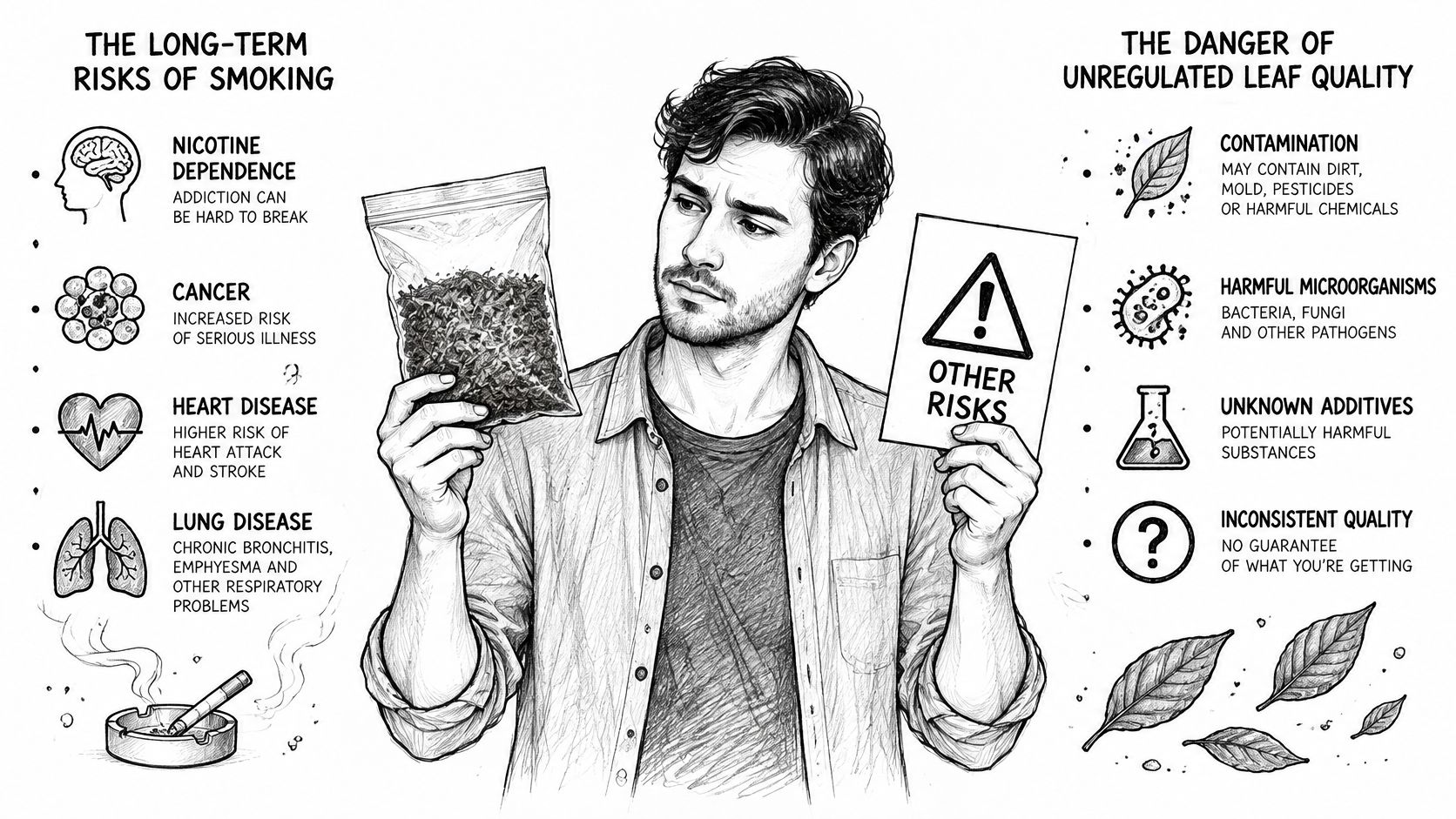
The image below separates the general harms of smoking from the additional uncertainty surrounding unregulated leaf.
Legal tobacco isn’t safe tobacco
Duty-paid does not mean harmless. Smoking carries risks including nicotine dependence, cancer, heart disease and lung disease. Switching from factory-made cigarettes to loose tobacco doesn’t remove the harms of smoking.
The separate issue with undocumented leaf is uncertainty. Without a verifiable product and supply chain, buyers can’t rely on the seller’s claims about handling, storage, consistency or ingredients. That doesn’t justify claiming that every bag contains a particular contaminant.
It’s like being offered a drink from an unmarked jerry can because it costs less than bottled water. The price is visible; the contents aren’t established. The analogy concerns missing information, not a claim that lawful tobacco is comparable to safe drinking water.
Don’t mistake a sensory impression for evidence
A strong smell, harsh smoke or a seller’s strength description doesn’t authenticate a blend. Nor does it provide a dependable measure of nicotine exposure. Trying the product isn’t a substitute for knowing what it is.
- Blend claims: Words such as smooth or premium don’t establish composition or legal origin.
- Strength labels: A marketing description shouldn’t be interpreted as a personal dose measurement.
- Contamination claims: Mould, soil or other specific findings shouldn’t be asserted without documented evidence about the product concerned.
A guide to Golden Virginia variants and buying considerations can help explain named-product terminology. It can’t authenticate an unbranded bag or turn a flavour comparison into a health assessment.
Keep the health question separate from the seller’s sales pitch when viewing tobacco-related media. https://www.youtube.com/embed/X4k12miYJ4M
The sensible conclusion isn’t to learn how to inspect or prepare questionable leaf. It’s to avoid treating an unknown product as an equivalent substitute. Traceability can help establish retail compliance, but not smoking remains the option that avoids smoking-related exposure.
Why Illicit Use Rose as Smoking Fell
Smoking can fall across Australia while illicit tobacco use rises among people who continue to smoke. Those statements describe different populations, so they aren’t contradictory.
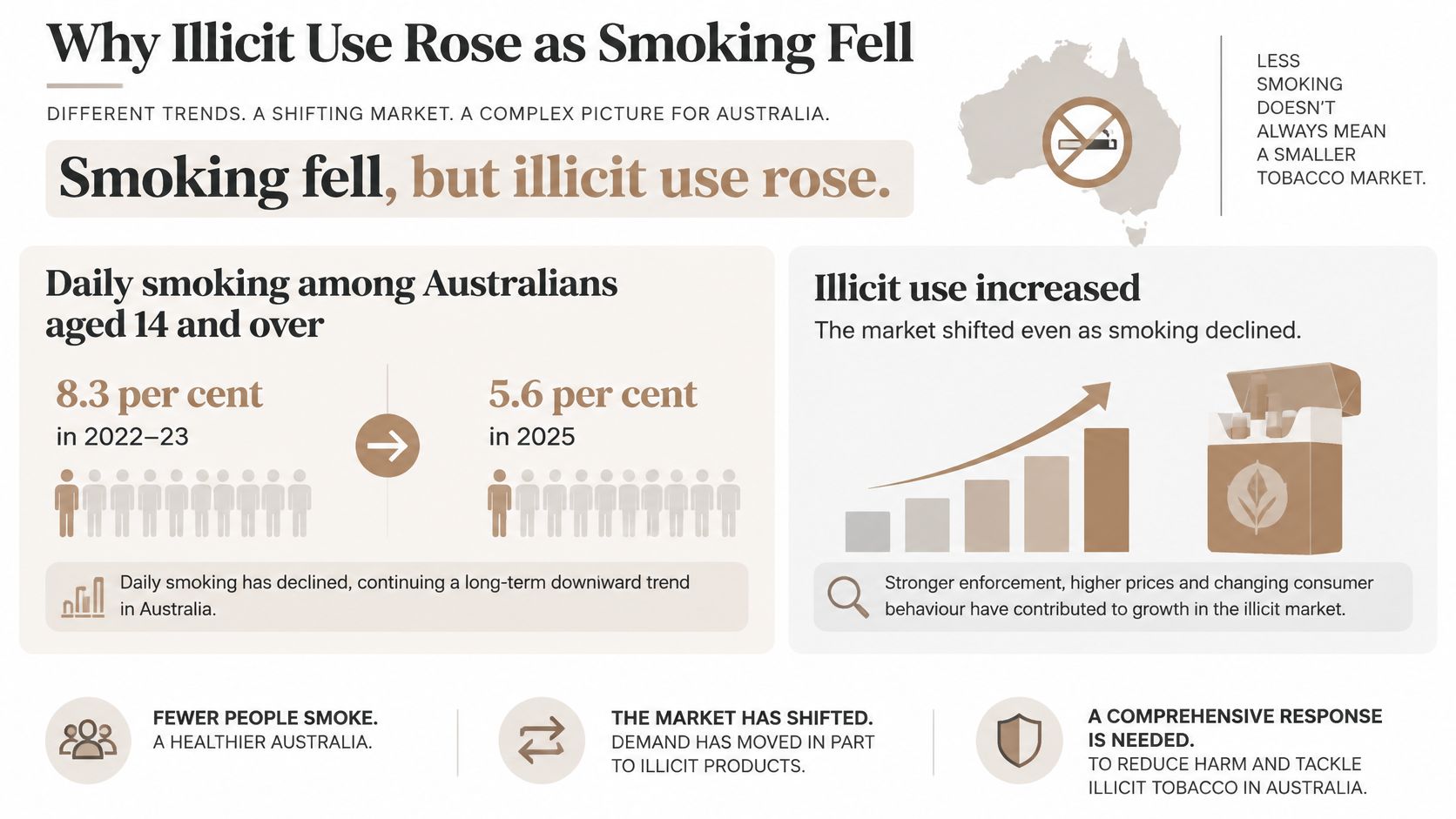
According to Cancer Council’s reporting of the National Drug Strategy Household Survey, daily smoking among Australians aged 14 and over fell from 8.3% in 2022–23 to 5.6% in 2025, while recent illicit-tobacco use among people who currently smoke increased from 16.7% to 34.0%; the same reporting says 57% of people who purchased branded illicit tobacco bought it from a tobacconist.
Different denominators explain the apparent paradox
The daily-smoking measure concerns the wider population in the stated age group. The illicit-use measure concerns people who currently smoke. A smaller smoking population can therefore include a larger proportion reporting illicit use.
The visual below highlights that contrast without making the measures interchangeable.
The product distinction matters too. Unbranded loose chop-chop isn’t identical to branded illicit cigarettes. A finding about where people bought branded illicit products shouldn’t be presented as a finding about every loose-tobacco buyer.
| Product description | What the description doesn’t establish |
|---|---|
| Unbranded loose tobacco | Licensed origin, duty payment or consistent contents |
| Branded cigarettes | Lawful importation, compliant packaging or paid duty |
| Tobacco sold at a shop counter | Compliance of each individual product |
A retail counter isn’t a compliance certificate
People often associate illicit supply with anonymous social-media accounts or cash transactions in car parks. The reported purchasing channel challenges that assumption. A familiar storefront can’t replace scrutiny of the stock.
Retailers need to keep product compliance and age verification as separate responsibilities. Checking a customer’s age doesn’t establish that the tobacco is lawful, just as lawful stock doesn’t remove the need to check the customer’s eligibility.
These prevalence measures also don’t settle why buyers changed their behaviour. Price pressure may be relevant, but the figures alone don’t isolate excise, availability, enforcement or personal circumstances as the cause.
The trend helps explain interest in cheaper tobacco searches. It doesn’t create a lawful product category called chop-chop or make an informal listing compliant.
Buy Duty-Paid Tobacco from a Checked Retailer
For adults who already smoke, the practical filter is straightforward: avoid undocumented loose leaf and choose only stock whose identity, packaging and duty treatment can be established. A retailer’s website, shopfront and age checks are useful parts of the purchasing process, but none independently proves the legal status of every listing.
At Cheap Smokers, customers can order through our website, call us or visit our physical tobacco store. Online purchases can also be collected the same day. Our store and ordering guide explains the available purchasing routes.
Treat catalogue details as information, not certification
Our catalogue includes premium rolling tobacco in 50 g, 100 g, 250 g and 1000 g sizes, with 100 g Premium Rolling Tobacco RYO 8 mg listed at $42.53, alongside Australian and overseas cigarette brands including Ascot, Benson & Hedges, Dunhill, Marlboro and Winfield, plus cigars and accessories.
That is catalogue information, not independent confirmation of duty-paid status. Larger quantity descriptions need clarification about the individual retail units supplied. Likewise, a product name containing a strength label shouldn’t be treated as a verified measure of the nicotine a person will absorb.
A listed price alone can’t establish compliance. It would be misleading to present an inexpensive listing as a verified taxed-shelf comparison without checking the underlying documentation.
Make the documentation part of the decision
Before paying, use a concrete checklist rather than asking only whether the tobacco is genuine.
- Manufacture or importation records: Establish the lawful source of the specific stock being purchased.
- Duty documentation: Confirm the applicable excise or customs treatment rather than inferring it from the receipt price.
- Retail requirements: Confirm applicable state or territory permission and the packaging arrangement for the order.
Buying boundary: If the seller can’t substantiate the stock’s lawful supply chain, don’t complete the purchase.
Tobacco purchasing is restricted to adults, and age verification should be part of the transaction. Smoking remains harmful regardless of the retailer, brand or price.
If your goal is a lawful pouch or carton, keep the decision focused on documented retail stock. Use the available ordering channel to clarify the product before payment, and walk away from any offer that amounts to undocumented chop chop tobacco for sale.
Cheap Smokers offers rolling tobacco, cigarettes and accessories, with website, phone and in-store ordering options. If you’re an adult who already smokes, visit Cheap Smokers to review the catalogue and clarify packaging and duty documentation before buying, rather than treating a low-priced loose-leaf offer as proof of a lawful saving.
[…] unsure how an unregulated tobacco product differs from legal retail tobacco, read this guide to why chop-chop tobacco is illegal. For tonight’s decision, keep the call simple: name the item and ask whether it can legally […]
[…] next to every other seller you've checked, treat that as information, not luck. Our guide on why chop chop tobacco is illegal covers the loose tobacco end of this market in […]