
Smoking & Vaping Accessories: Types, Rules and Disposal
November 8, 2026You're standing in a tobacconist, or scrolling late at night, trying to work out if the filter, coil or capsule in your cart fits what you use, is still legal to buy in Australia, and won't end up as a problem when it's finished. That's a common spot for adult smokers and vapers now, because smoking & vaping accessories look simple but follow different rules depending on what they do.
The clearest way through is to separate three questions. First, what does the item physically do? Second, is it allowed to be sold to you, and through which kind of retailer? Third, how do you store it safely and dispose of it when you're done? Put your intended purchase into one category first, and the rest becomes much easier to judge.
Table of Contents
- Smoking and Vaping Accessories at a Glance
- Rolling Papers, Filters and Lighters Explained
- Batteries, Coils and Compatibility
- Storing, Cleaning and Caring for Accessories
- Restricted Accessories and What You Can Buy Legally
- Disposing of Used Vapes and Accessories Safely
- Pre-Order Checks Before You Buy
Smoking and Vaping Accessories at a Glance
| Category | Typical examples | General purpose | Adult buying note |
|---|---|---|---|
| Rolling papers | Standard, slim and king-size papers | Wrap loose tobacco for hand-rolled cigarettes | Check packaging and current rules on flavoured products |
| Filter tips and tubes | Cellulose acetate, paper and charcoal filters | Filter smoke for user comfort | Ventilated filters do not reduce harm |
| Lighters and matches | Refillable lighters, butane refills, matches | Ignite products | Buy refills in sensible quantities and store safely |
| Grinders and rollers | Metal and plastic grinders, rolling machines | Break down and roll loose tobacco | Choose by tobacco type and volume |
| Storage and humidors | Airtight tins, jars, cigar humidors | Keep tobacco fresh | Humidity control matters most for cigars |
| Pipes and pipe tools | Briar pipes, tampers, cleaners | Smoke loose tobacco in a pipe | Needs regular cleaning |
| Vape batteries and devices | Batteries, chargers, refillable devices, disposables | Power the heating coil | Check battery certification and compatibility |
| Coils, pods and tanks | Replacement coils, refillable pods, tanks | Vaporise e-liquid | Match coil resistance to the device |
| Crush balls and flavour capsules | Crush balls for filters | Add menthol-style flavour | Banned from sale from 1 July 2025 |
How to read the table
The first six rows are mostly tobacco-use accessories. They help you prepare, light, smoke or store loose tobacco, cigarettes, cigars or pipe tobacco. The next two rows are vaping accessories. They form an electrical system rather than a burning one, so compatibility and battery safety matter more than paper size or burn rate.
A few items sit across both worlds in shoppers' minds, especially flavour-delivery products. A crush ball goes into a filter, so it looks like a simple add-on. Its job, though, is to change flavour, and that function is what regulators focus on.
Read the purpose column as a description of function only. "Filter smoke for user comfort" doesn't mean a filter makes smoking safe. "Vaporise e-liquid" describes heating, not a health claim.
Practical rule: Name the category before you judge the product. Legal status, safe storage and disposal all follow from that first decision.
Context also matters. The Australian Institute of Health and Welfare report on vaping and e-cigarettes reports that daily smoking among people aged 14 and over fell from 24% in 1991 to 8.3% in 2022–2023, with about 1.8 million daily smokers in 2022–2023. Demand for accessories remains, but it's concentrated among a smaller group of established adult smokers. That's why adult-only sale, clear labelling and accurate descriptions matter more, not less.
Rolling Papers, Filters and Lighters Explained
Many adults assume a ventilated filter is a safer filter. Tiny holes around the tipping paper let in air, the smoke feels lighter, and machine tests record lower yields. It feels logical to call that harm reduction. The evidence doesn't support it.
What papers and filters physically do
Rolling papers hold loose tobacco in a cylinder. Standard, slim and king-size formats change how much tobacco a roll holds, how tightly you can pack it and how it burns. A slim paper suits a smaller roll. A king-size paper holds more and usually burns for longer if it's packed evenly.
Filters sit at the mouth end. The Tobacco in Australia chapter on cigarette and filter construction describes filters commonly made from cellulose acetate, paper or charcoal, with porous plugwrap and tipping papers, and perforations in the tipping paper that dilute mainstream smoke during machine testing. That same review concludes ventilated filters provide no demonstrated harm reduction compared with unventilated filters and may have contributed to increased rates of some lung cancers.
Why the gap between machine and person? Smokers compensate without thinking about it. They inhale more, take additional puffs, or cover ventilation holes with fingers or lips. The diluted reading disappears once a real person wants their usual nicotine and taste.
If you're comparing tubes as well as loose tips, our practical guide to cigarette filter tubes covers format choices in more detail. Keep the same distinction in mind there. Tube length, filter material and pack count are specifications. They aren't safety ratings.
Australian cigarettes also include reduced-fire-risk design. That involves bands of lower-permeability paper and set government testing, but it still doesn't make a lit cigarette safe to leave unattended. Treat burn features as fire behaviour, not as permission to relax around bedding, paper or fuel.
Lighters and reading a listing
Lighters are simpler. You choose between disposable and refillable, check the flame type suits cigarettes, cigars or a pipe, and store butane away from heat and children. Don't stockpile large amounts of refill fuel at home. Buy what you'll use in a reasonable period and keep it upright in a cool cupboard.
When you read any listing for papers, filters or tubes, split it into two columns in your head. On one side put physical specifications, such as filter material, ventilation, paper construction and pack format. On the other side put any claim about reduced toxicity or smoother equals safer. The first side helps you buy the right format. The second side is unsupported, and you should ignore it when you decide.
Batteries, Coils and Compatibility
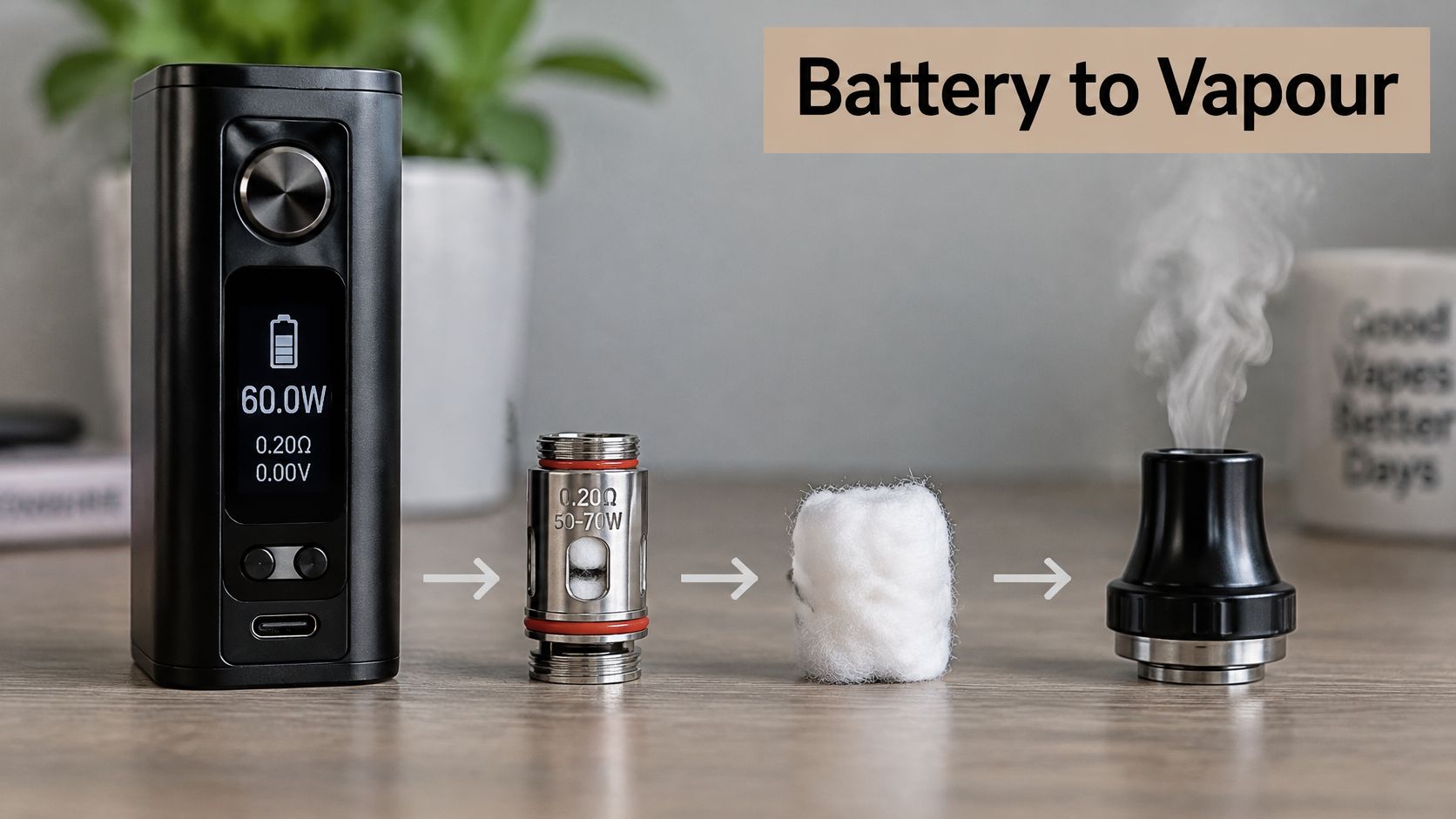
A vape works like a small kettle system. The battery supplies the power, the coil acts as the element, the wick feeds liquid to the element like a sponge, and the mouthpiece delivers the aerosol. If the sponge can't keep pace with the element, you get dry heating instead of steady vapour.
The diagram below shows how those parts connect in sequence.
Power, temperature and why matching matters
The Industrial Chemicals report on non-nicotine e-cigarette liquids reports operating coil temperatures of approximately 145–334 °C, with device power ranging from about 15 W in simpler products to as high as 350 W in advanced devices. Higher power can raise coil temperature and aerosol production, but only when liquid delivery, resistance and thermal protection keep pace.
That's the cause and effect shoppers miss. A low-resistance coil fitted to a device or setting it wasn't designed for can overheat. A pod that clicks into place can still be a poor fit if its coil resistance or connection differs from what the device expects. Poor wicking produces a burnt taste, rough aerosol and a coil that fails early.
Say you buy replacement coils because the thread looks the same. They screw in, the device fires, and then every puff tastes scorched. The cause usually isn't bad luck. It's a mismatch between power output, coil resistance and how fast the wick can supply liquid.
The short video below walks through the heating process so you can see why each part depends on the others.
Compatibility checklist before you order
- Confirm the exact device model: Check that replacement coils, pods and chargers are explicitly listed as compatible with it, not just similar in size.
- Match coil resistance: Stay within the resistance range specified for your device and its recommended power range.
- Check battery documentation: Look for lithium batteries whose sellers can show transport and safety test records, such as UN/DOT 38.3 or IEC 62133-2, rather than taking "rechargeable" as proof of testing.
- Check safety features: Products sold in Australia should meet applicable electrical requirements, and built-in protection against overheating and short circuits is worth asking about before you buy.
- Don't treat chargers as interchangeable: Use the charger type specified for the battery, and replace damaged cables or swollen batteries rather than testing them again.
If a seller can't tell you which device a coil or pod fits, don't guess with your own device. Compatibility is a specification, not a sales opinion.
Storing, Cleaning and Caring for Accessories
Good storage prevents most everyday problems, from stale tobacco to a battery short circuit. The right method depends on whether the item should stay humid, stay dry, or stay electrically isolated.
Tobacco, papers and pipes
Keep cigars in a cigar humidor with a steady humidity and a seal that closes properly. A plain tin won't hold that environment, so wrappers dry out and crack. Check the seal and humidifying element regularly, and don't store flavoured products against premium cigars if you don't want aromas to transfer.
Loose rolling and pipe tobacco belongs in an airtight tin or jar away from heat and direct sun. Rolling papers need the opposite care to cigars. Keep them flat and dry, because humidity makes them curl, stick or tear when you roll.
Pipes need cleaning after they've cooled. Empty the bowl, run a pipe cleaner through the stem until it comes out mostly clean, and let the pipe rest before you use it again. Use a tamper to pack tobacco evenly rather than pressing with your fingers. For holders used with roll-your-owns, see our notes on cigarette holder care for cleaning and handling basics.
Fuel, batteries and replacement parts
- Lighters and butane: Store away from children, heaters and car dashboards, and buy refills in sensible quantities.
- Vape batteries: Keep devices in a cool, dry place away from loose coins, keys and other metal that could cause a short circuit.
- Charging: Don't leave a charging device unattended on bedding or a couch, and stop using a battery that gets unusually hot.
- Coils and pods: Replace them according to the compatibility and usage notes for your device rather than waiting for a persistent burnt taste.
Keep a simple note on your phone with purchase dates for tobacco, coils and batteries. You'll know which stock to use first and which battery is oldest. That small habit prevents waste and stops you blaming a device when the problem is an expired coil or tired cell.
Restricted Accessories and What You Can Buy Legally
Legality in Australia doesn't depend only on what a product is called. It applies to the product, its flavour and its packaging, and to the function the item performs. An accessory can look harmless because it contains no tobacco, yet still be regulated if its job is to change taste or delivery.
| Item | Status in Australia | Why it matters |
|---|---|---|
| Crush balls | Banned from sale from 1 July 2025 | Adds flavour to the filter |
| Menthol, rum and clove flavours | Banned from sale from 1 July 2025 | Masks harshness and eases smoking |
| Ordinary rolling papers, filters and lighters | Not in the flavour and crush-ball ban; confirm current rules | Judged by function and packaging |
| Vapes and vape products | Restricted supply from 1 July 2024; conditions apply | Different rules to ordinary accessories |
| Vape products at participating pharmacies | Limited supply under specific conditions | Check each pharmacy's conditions before buying |
Flavour is the dividing line
The Australian Government page on tobacco changes sets out two timelines buyers should know: vape supply through general retail has been restricted since 1 July 2024, and from 1 July 2025 certain tobacco ingredients, flavours including menthol, rum and clove, and accessories such as crush balls are banned from sale. The government's public health explanation is that these features can mask tobacco's harshness, make smoking easier and make quitting harder.
Ordinary rolling papers, filters, lighters and storage products aren't in that flavour and crush-ball ban list. That doesn't mean every version is automatically compliant. A flavoured paper or a filter sold with a flavour capsule has a different function from a plain one, so check the current description and packaging before you order.
Consider a small capsule sold on its own. It isn't a cigarette and it isn't loose tobacco. Shoppers sometimes assume that means it sits outside tobacco rules. If you insert it into a filter and crush it to release menthol-style flavour, its function is flavour delivery. That's exactly the kind of product the ban targets.
Where vapes sit under the rules
Vape supply no longer works like a normal accessory purchase. Participating pharmacies can supply limited products under specific conditions, and any retailer listing vapes, pods or disposable e-cigarettes does so under its own conditions, not the same rules that cover papers and lighters. Read the conditions attached to a listing before assuming availability.
Conventional tobacco products are a separate matter. An Australian retailer can take orders online for cigarettes and rolling tobacco, and our guide to buying smokes online in Australia explains that ordering route. Treat vape listings as their own category with their own terms.
Rule of thumb: If an item's main job is to add flavour or change how smoke or vapour feels, check its legal status before you pay.
Disposing of Used Vapes and Accessories Safely
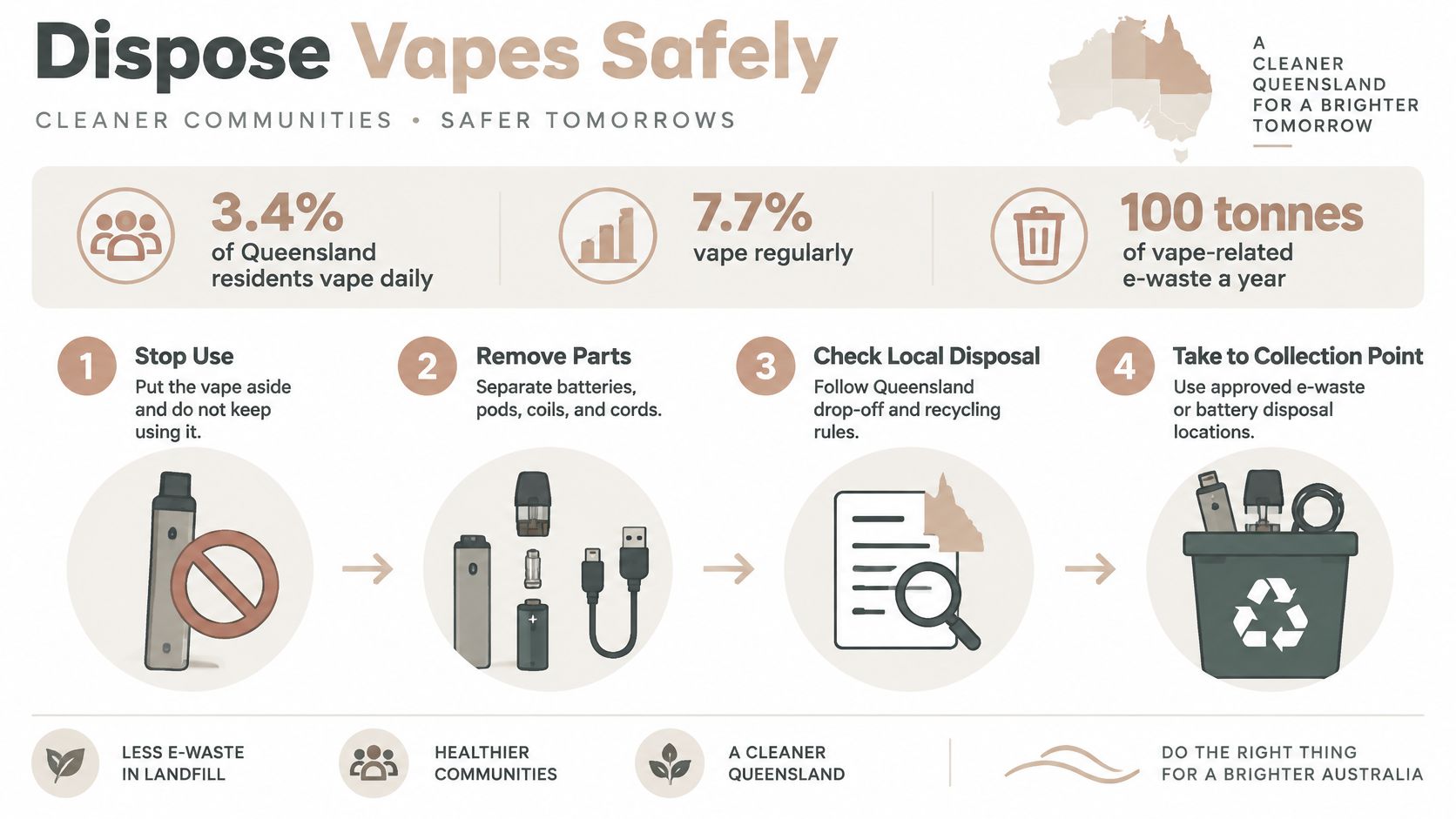
Disposal belongs in the buying decision, not just the drawer-clearing stage. When you pick up a device with a lithium-ion battery sealed inside, you are also taking on the job of getting that battery to a safe endpoint. Recent Queensland reporting in InDaily Queensland on discarded vapes found that 3.4% of residents vape daily and 7.7% vape regularly, while the state produces an estimated 100 tonnes of vape-related e-waste annually. Disposable vapes count as hazardous e-waste because they combine lithium-ion batteries, heavy metals and residual nicotine in one sealed unit.
The infographic below summarises the safe sequence for finished devices.
Safe disposal steps
- Stop using the unit: Put it aside and don't charge it again to squeeze out a final use.
- Keep it out of every household bin: Lithium batteries can ignite in trucks and sorting facilities, so don't use household, recycling or public bins.
- Don't dismantle it: Never puncture, crush or open a disposable to remove the battery yourself.
- Keep liquid out of drains: Don't pour leftover e-liquid into a sink, toilet or stormwater drain.
- Store it safely while you wait: Use a cool, dry, non-flammable container away from children, heat and loose metal.
- Check local acceptance: Contact your council or local drop-off point and ask specifically whether they accept vapes, because ordinary battery bins may not accept nicotine-contaminated products.
Australia has no national kerbside recycling program for disposable vapes, so the right answer is local. Search your council's e-waste page, then call if vapes aren't named. A spent device works like a small fuel canister: the battery inside makes it useful in your hand and risky in a compactor truck. That is why a supermarket battery collection tube can still be the wrong destination even though your device contains a battery.
Some councils and local drop-off schemes run dedicated vape collections, where professionals dismantle the devices to recover batteries, metals and other materials. That controlled dismantling is the opposite of opening a unit at your kitchen bench.
Separate non-electronic accessories from battery devices. Used papers, plain cardboard packaging and spent filters follow ordinary household waste rules in your area. Pods, coils and cords that are contaminated or electronic should go with the collection route you confirm for the device, not loose in recycling.
Pre-Order Checks Before You Buy
Run these checks in order before you add smoking & vaping accessories or tobacco to a cart. A product that fails one check doesn't pass because the others look fine. Pause there instead of justifying it with the next.
Identity, age and legal status
- Age confirmation: Expect an age confirmation prompt and age verification during checkout. Don't share an adult account with anyone underage.
- Exact product identity: Confirm product name, format and pack size. Rolling tobacco is commonly sold in 100 g, 250 g and 1000 g quantities in our range, while many cigarettes come as cartons of ten packets of twenty.
- Restricted status: Check the item against the legal status categories, especially anything flavoured or designed to add flavour.
- Sales route: Confirm no vape product is being routed through a tobacconist, vape shop or convenience store.
Category matters because each one follows a different path to the buyer. Our tobacco products can be ordered online for delivery anywhere in Australia, bought in store, or ordered online and picked up the same day. Check the eligibility and conditions shown at checkout rather than assuming every product follows the same route.
Claims, compatibility and delivery
Discard any description that promises reduced harm from a filter, paper or ventilation feature. Buy on material, size and format instead. If a listing mixes a clear specification with a health promise, trust only the specification and question the seller.
For vape items, write down your device model before you shop. Confirm coil resistance, pod fit, charger type and battery certification, including UN/DOT 38.3 and IEC 62133-2 where a lithium rechargeable battery is involved. Don't order a similar-looking part and hope the connection works.
Identify disposal before delivery. If you're buying a battery device, find your council drop-off or collection option while the order is in transit. You'll know where the finished unit goes before it becomes drawer clutter.
Then check the practical terms. Look for the stated delivery timeframe, which is one to three days for most orders, and read the returns and refund policy before you pay. Confirm what happens if an item arrives damaged, and keep the order confirmation until you've inspected the parcel.
Finish with a one-line note for each item: product, category, legal status and disposal route. For example, "plain slim papers, tobacco accessory, not in flavour ban, household waste for used papers." Order only what passes every check. The habit takes two minutes and prevents the three most common mistakes: buying the wrong format, ordering a restricted flavour item, and owning a battery with no safe end point.
Ready to shop with those checks done? We stock cigarettes, cigars, tobacco accessories, rolling papers, pipes and grinders, plus American candy and snacks, with delivery anywhere in Australia and same-day in-store pickup for online tobacco orders. Visit Cheap Smokers to browse the current range and confirm adult checkout and delivery details before you order.