

Cigarette Filter Tips: Types, Sizes and How to Choose
November 8, 2026If a cigarette feels smoother to smoke, does that mean its filter has made it safer, or has it just changed the sensation? That distinction matters when you compare cigarette filter tips, because draw, taste and mouthfeel aren't measures of protection.
A useful comparison starts with construction and fit, then separates what the filter physically changes from the benefits a buyer might assume it provides. The same care applies to disposal: a filter that looks like cotton isn't necessarily a material that will harmlessly break down.
Table of Contents
- Cigarette Filter Tips at a Glance
- How a Filter Tip Works Inside a Cigarette
- Filter Varieties and What Each One Changes
- What a Filter Tip Cannot Do for Your Health
- How to Dispose of Filter Tips Responsibly
- Practical Factors and How to Choose
Cigarette Filter Tips at a Glance
A cigarette filter tip is the short cylinder of filtering material at the mouth end of a cigarette, usually made from cellulose acetate. It gives the cigarette its mouth-end feel and provides a pathway through which smoke passes before reaching the smoker.
Cellulose acetate is plastic, despite its soft, fibrous appearance, as explained in WWF Australia's report on ending cigarette-butt pollution. Don't confuse its appearance with cotton wool, paper or a readily biodegradable plant fibre.
Common cigarette tube and filter dimensions
The useful measurements are total length, filter length and circumference. A format name alone doesn't establish all of them, so use the manufacturer's specification rather than assuming that every product in a category has identical dimensions.
| Format | Total length | Filter length | Circumference |
|---|---|---|---|
| Standard king size | Manufacturer's stated king-size length | Check the filter specification on the pack | Check the tube or filter specification |
| Long tube | Manufacturer's stated long-format length | Check the filter specification on the pack | Confirm compatibility with the intended equipment |
Total length includes both the filter and the tobacco-containing section. Filter length measures only the mouth-end component. Circumference measures around the cylinder, not across it, which is why it shouldn't be confused with diameter.
Hand-rolled cigarettes have no fixed size, because the paper, loose filter and rolling method determine the finished dimensions.
Practical rule: Record total length and filter length separately. A longer cigarette doesn't automatically contain a longer filter.
For loose filters, also check whether the packet describes the filter itself or a complete empty tube. Before comparing varieties, note the dimensions of your usual cigarette or tube and keep the packaging as your reference.
How a Filter Tip Works Inside a Cigarette
Think of a drinking straw packed with a sponge. Air can still pass through, but the material inside changes how easily you can pull it through and provides surfaces on which particles and liquid droplets can collect.
The components below help distinguish the tobacco, paper and filtering material.
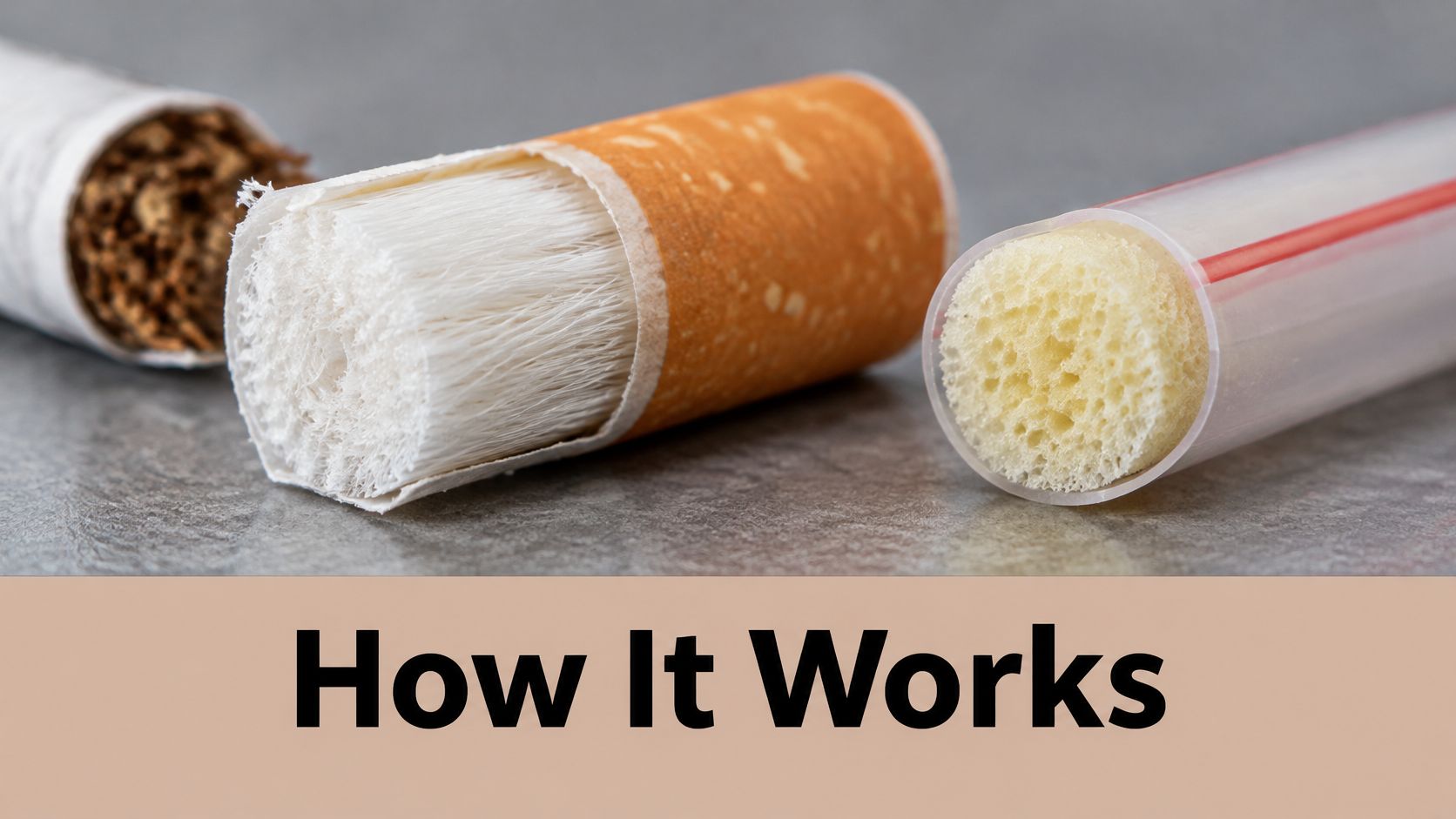
A cigarette filter uses a bundle of fine fibres rather than a household sponge. Smoke travels through the spaces between those fibres, and some particulate material and condensed liquid remain on them.
Draw resistance describes how hard you have to pull to move smoke through the cigarette. All else being equal, a longer or more densely packed filtering pathway can create more resistance, although tobacco packing and the rest of the cigarette also affect the result.
Airflow isn't the same as filtration
Some cigarette designs use ventilation holes in the tipping paper to admit outside air. In the straw analogy, that's like adding small openings along the side: what reaches your mouth includes air entering through those openings, not just material drawn from the far end.
Covering ventilation openings with lips or fingers changes that airflow. The effect is dilution, which shouldn't be confused with removing smoke constituents.
Use the component terminology alongside the following video.
A filter isn't a sealed barrier between burning tobacco and your lungs.
Smoke still passes through it. The filter influences the pathway and feel, while burning tobacco produces the smoke that enters that pathway.
Filter Varieties and What Each One Changes
Filter descriptions often mix construction, flavour and appearance. This comparison separates those categories so a familiar marketing term doesn't become a technical claim.
| Variant | What it can change | What it does not change |
|---|---|---|
| Plain white solid filter | Baseline draw and mouthfeel | Doesn't establish a health benefit |
| Charcoal-labelled filter | May describe a taste or odour characteristic, subject to documentation | Doesn't establish composition, nicotine yield or tar yield by its name alone |
| Menthol-flavoured product | Flavour and throat sensation | Doesn't establish a different filtering structure |
| Ventilated tipping paper | Airflow and smoke dilution through openings | Doesn't establish protection |
| Recessed, hollow or perforated filter | Geometry and mouth-end feel in products using those designs | Doesn't establish premium performance or Australian compliance |
Construction comes before the label
Under Australia's 2025 tobacco-product requirements, filters must have imitation-cork external tipping paper and a white, solid, smooth construction without the specified internal irregularities, and unique filters are banned, according to the Australian Government's guide to tobacco-product requirements. The guide also specifies testing under AS 4830-2007, with each cigarette type undergoing 40 replicated tests across 10 layers of filter paper.
A plain white filter is therefore a construction description, not a promise about performance. The cork-like outer appearance comes from the tipping paper rather than the white filter material beneath it.
A charcoal-labelled filter needs a more careful reading. The label alone doesn't establish what the filter contains, how it's arranged or what it captures; those questions require manufacturer documentation.
Menthol describes a flavour or cooling sensation, not proof of a different filter architecture. Nor should an overseas or older menthol listing be treated as evidence that a product meets current Australian requirements.
Distinguish ventilation from unusual geometry
Ventilation concerns openings that admit air through tipping paper. That's a different issue from a recessed mouth end, hollow centre or perforated filter structure, so photographs and short catalogue descriptions aren't enough to resolve every construction question.
Recessed or hollow products may be legacy or imported stock, or may raise compliance concerns. Their unusual shape isn't evidence that they're technically superior.
For the distinction between loose filters and complete tubes, our practical guide to cigarette filter tubes provides additional product context.
Treat variety names as descriptions to verify, not performance guarantees. A colour, flavour or premium-sounding term can't substitute for a clear specification.
What a Filter Tip Cannot Do for Your Health
A charcoal label, lighter taste or less irritating puff can make a cigarette seem like a safer choice. That impression doesn't establish reduced harm.
The Australian Government's guidance on there being no safe smoking options states that filtered, low-tar and light cigarettes aren't safer, because smokers may compensate by inhaling more or smoking more cigarettes. It also states that there's no evidence filters or filter-blocking products help people quit or reduce smoking-related disease risk.
Mechanical changes aren't clinical outcomes
A filter can alter airflow, capture some particulate material and affect perceived harshness. Those are physical or sensory effects, not evidence that the smoker has reduced their likelihood of disease.
The distinction is particularly important with nicotine. You can't infer a person's nicotine exposure from filter length, firmness, colour or the comfort of a puff, and a filter isn't a treatment for nicotine dependence.
Health distinction: Less harsh doesn't mean less harmful.
A smoother experience can encourage deeper inhalation rather than the reduction in exposure a smoker intended. The sensation in the throat doesn't reliably describe what reaches the lungs or how someone changes their smoking behaviour.
Choose support rather than modifications
If your reason for comparing cigarette filter tips is to protect your health, changing the tip doesn't answer that need. Adding another filtering attachment or choosing a different mouth-end design shouldn't be treated as a quitting strategy.
Speak with a GP or Quitline about evidence-based quitting support, including suitable medicines and behavioural assistance. Tell them what you've tried, what triggers your smoking and whether withdrawal symptoms have made previous attempts difficult.
That conversation addresses dependence directly. It doesn't rely on the assumption that a more comfortable cigarette has become a safer one.
How to Dispose of Filter Tips Responsibly
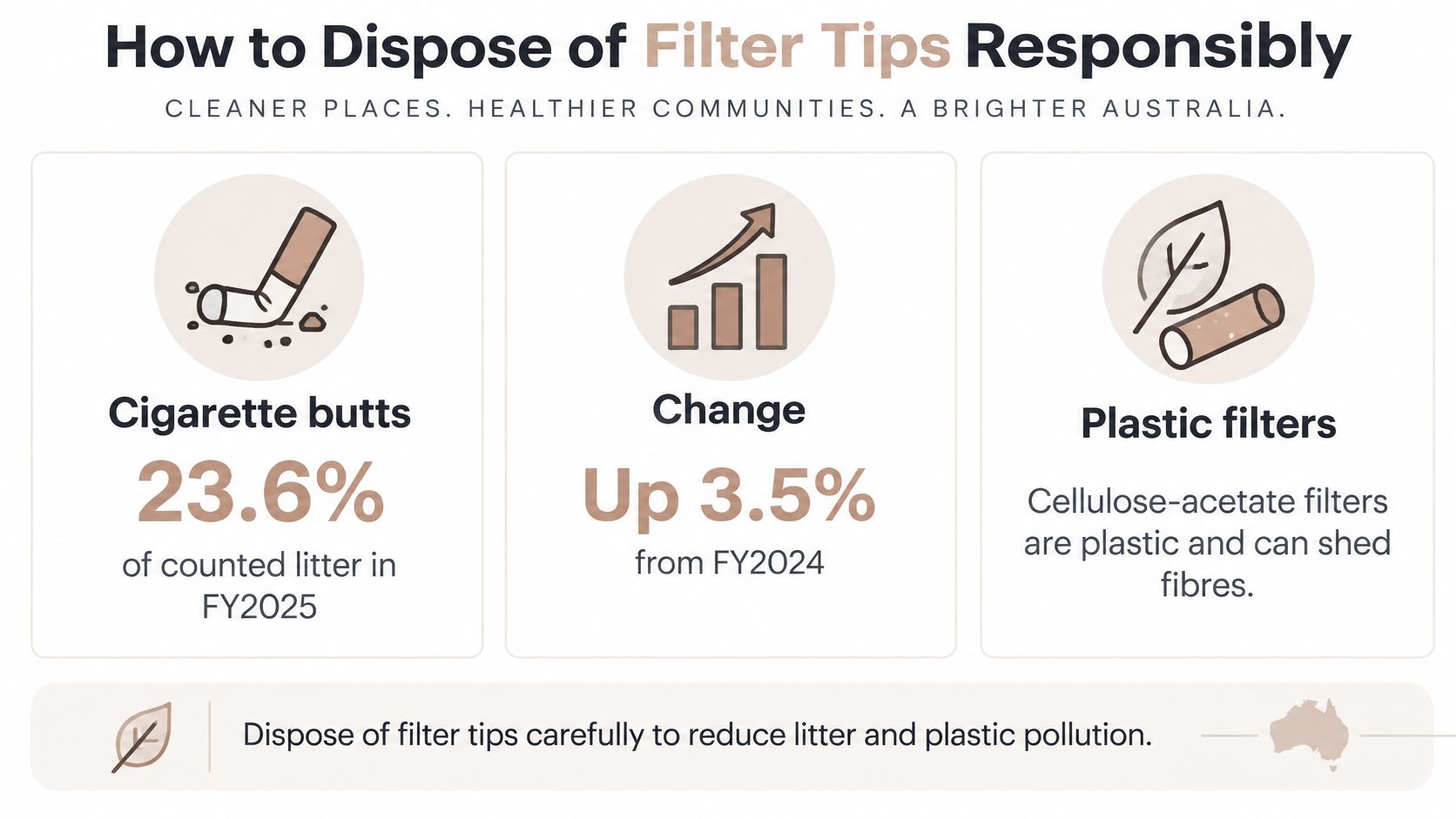
Cigarette butts accounted for 23.6% of counted litter in FY2025, up 3.5% from FY2024, according to Clean Up Australia's national litter fact sheet, which also identifies microfibre shedding and toxic-substance leaching from cellulose-acetate filters.
The figures below highlight why a small discarded tip still matters.
A compostable label isn't permission to litter
A biodegradability claim needs conditions and a recognised standard behind it. Streets, drains and waterways aren't controlled treatment facilities, and a used filter also contains residues from smoking.
The Australian Government's National Plastics Plan identifies cigarette filters as persistent plastic waste rather than an ordinary biodegradable disposal component. Don't place them in garden compost, recycling bins or stormwater drains.
Use a contained disposal routine
- Extinguish completely. Stub the cigarette out thoroughly in a suitable ashtray, or use water, and check that nothing is still smouldering.
- Use general waste. Once the butt is fully extinguished and cold, place it in a general waste bin rather than leaving it beside the bin.
- Keep it out of water systems. Don't flush it, sweep it into a gutter or drop it through a drain grate.
- Carry a portable ashtray. Keep the butt contained until you reach an appropriate bin, especially when walking or travelling.
When browsing smoking accessories, distinguish equipment that contains waste from claims about making the waste harmless. A holder or storage accessory only helps if you empty it responsibly.
No filter type makes littering acceptable. A consistent disposal habit matters more than the brand printed on the packet.
Practical Factors and How to Choose
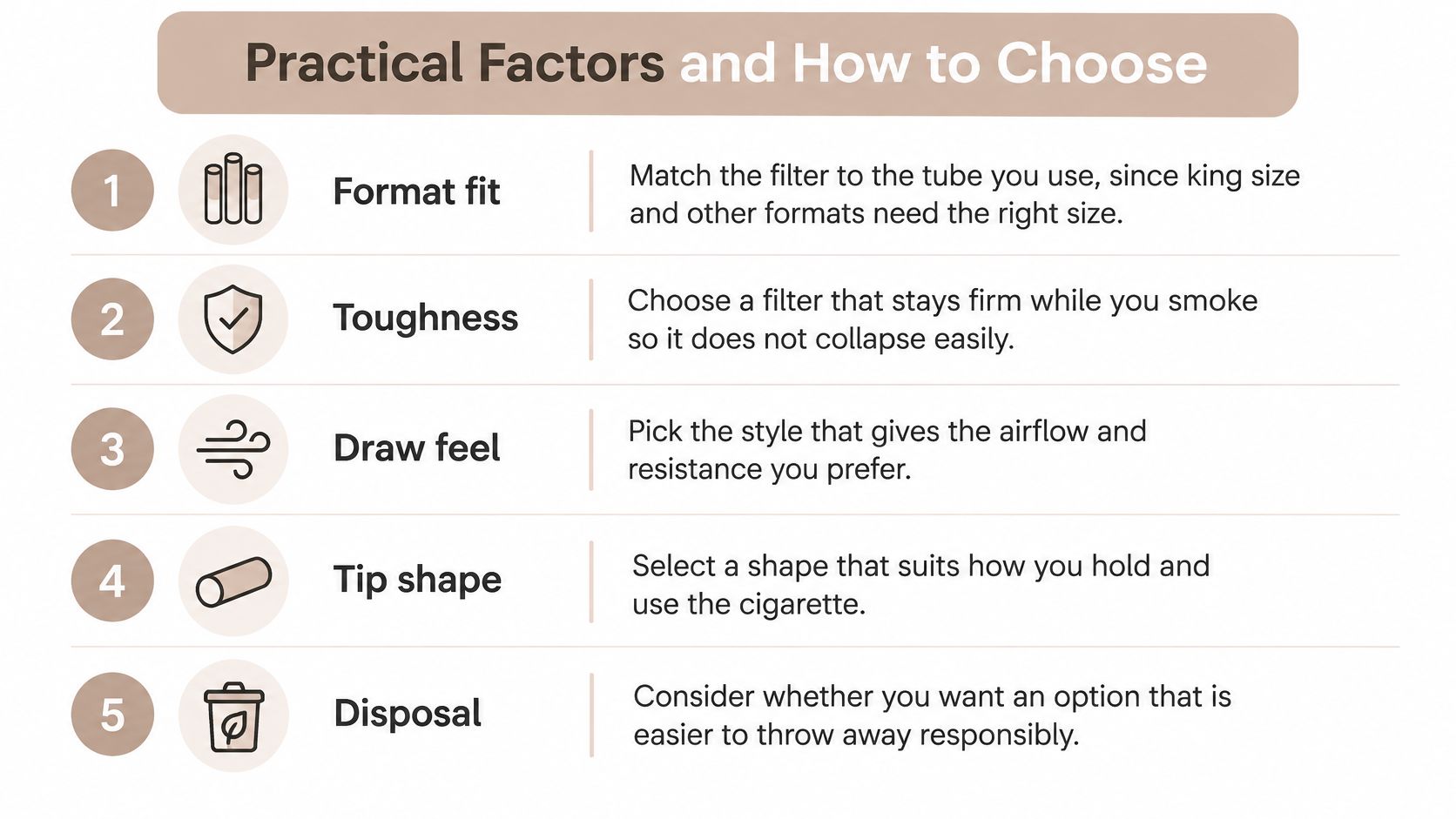
For an adult who continues to smoke, choosing a filter should be a specification check rather than a search for implied protection. Start with the equipment and format you already use, then separate personal preference from claims that require evidence.
The visual checklist is a starting point, but shape and firmness preferences still need to fit Australian product requirements.
Check fit before preference
- Format fit. Match the stated tube dimensions to your filling equipment, because a familiar format name doesn't establish compatibility with every machine.
- Filter length and draw. Compare products with documented filter specifications, remembering that tobacco density and paper also affect resistance.
- Taste and mouthfeel. Describe the sensation you're comparing, such as firmness at the mouth end, rather than translating a comfortable feel into a health claim.
- Stock consistency. Check the full product name and filter description each time, because a similar-looking pack or shortened listing may refer to a different variant.
- Compliance wording. Look for clear construction details and current Australian requirements rather than assuming that unusual geometry represents an upgrade.
- Purchase quantity. Avoid committing to a large quantity of an unfamiliar format before you've confirmed that it fits your equipment and matches its description.
A holder adds another fit check. Our guide to cigarette holders for rollies addresses that separate accessory category, which shouldn't be confused with the filter inside the cigarette.
Read the full listing
A useful listing distinguishes product name, format, filter description and quantity. If it omits dimensions that matter to your equipment, don't fill that gap by estimating from a photograph.
For a concrete catalogue example, we sell 200s Carton Pre-Filled Palmers Cigarettes Tobacco Charcoal Filter 12mg for $59.54. That product name identifies a listed variant, but it doesn't by itself document filter architecture or establish a health advantage.
Our purchases are restricted to adults, with an age-confirmation prompt and stated age verification during purchasing. Those purchasing checks are separate from checking whether a particular format suits your existing equipment.
Before buying: Write down the tube length, filter type and draw characteristics you're comparing, then check each listing against that note.
Keep the note factual: measured or manufacturer-stated dimensions, the exact filter description, and whether compatibility is confirmed. Compare a pair of listings against it before making a purchase, rather than choosing from colour names or assumptions.
At Cheap Smokers, we offer cigarettes, rolling tobacco and smoking accessories through online ordering and in-store purchasing. Adult customers can visit our catalogue to compare exact product names and formats, using a written specification checklist rather than treating filter labels as health claims.

[…] doesn't reveal its ventilation level through appearance alone. When comparing descriptions of cigarette filter tips, identify which specification the description […]