
Euro Blue Cigarettes Guide: Packs, Price and Age Rules
November 15, 2026If you've been told the blue pack is the gentler option, the advice is wrong in a way that matters. Blue is a colour printed on a box to separate one variant from another in the same range. It isn't a measure of what a smoker takes in, and no Australian regulator treats it as one.
The second piece of common advice fails for a different reason. Chasing the cheapest carton sounds sensible until you notice that a price without a date, a stated carton size and the delivery terms attached tells you almost nothing, and that an unusually low price on a low-profile brand is often a signal about the supply chain rather than a bargain.
This guide works through Euro Blue cigarettes in the order a careful buyer would: what the carton contains, what two Australian listings showed it costing, what the machine-measured numbers do and don't mean, how the pack sits beside the Red variant and beside loose tobacco, who is allowed to sell it to you, and how to check a pack and a seller before money changes hands.
Table of Contents
- What Euro Blue Is and How the Cartons Are Packed
- What a 200-Cigarette Carton Costs in Australia
- Tar, Nicotine and What the Blue Name Does Not Tell You
- Euro Blue, Euro Red and Hand-Rolled Alternatives
- Age Limits and Lawful Buying Channels in Australia
- Checking the Pack, the Seller and Your Decision
What Euro Blue Is and How the Cartons Are Packed
Euro Blue is a filtered cigarette sold in Australia as the lighter variant of the Euro line, and the fact worth memorising first is the count rather than the colour. One carton holds ten packets, each packet holds twenty cigarettes, and a single purchase puts 200 cigarettes in your hands.
The product's defining labels are simple enough to see side by side.
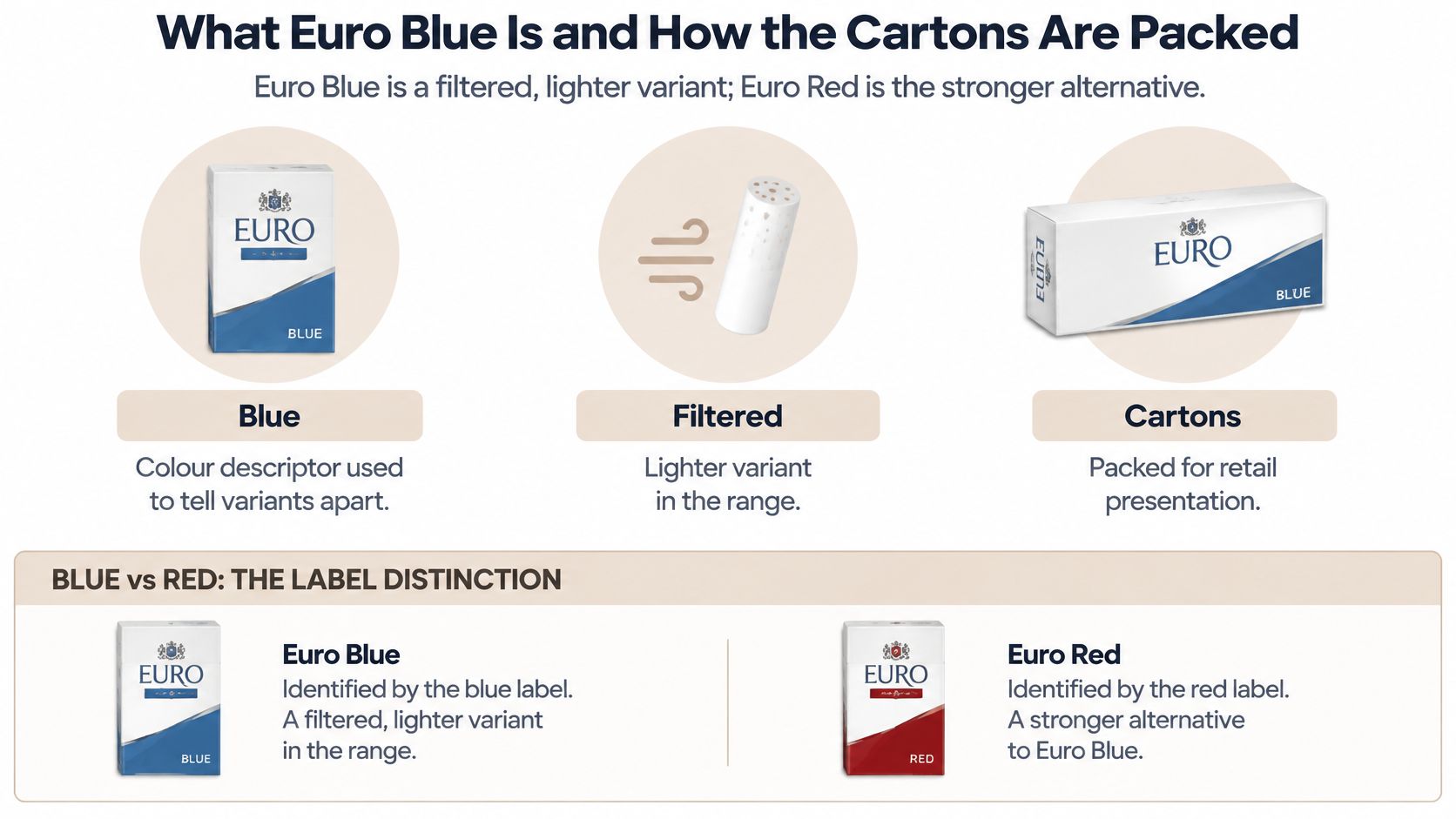
Blue Is a Label, Not a Grade
Colour names separate variants on a shelf. Euro Red is marketed as the stronger Euro option and Blue as the smoother, lighter alternative, which describes where each sits in the range rather than what either does to a person. Australian product information sets the line out that way, and notes that colour-based descriptors can't be read as evidence that the product is safe or materially less harmful (Smokers Connect Euro range).
The Carton Arithmetic, and How to Spot It on a Listing
A carton works the way a slab of cans does. The slab holds a fixed number of cans, so you count cans when you want to know how much you have, not slabs. Euro Blue runs the same way: ten sealed packets inside one box, twenty cigarettes inside each packet, 200 in total. Get that multiplication wrong and every price comparison built on top of it is wrong too.
| Attribute | Listed value |
|---|---|
| Product line | Filtered, lighter Euro variant |
| Cigarettes per packet | 20 |
| Packets per carton | 10 |
| Cigarettes per carton | 200 |
| Positioning against Euro Red | Blue is the lighter option; Red is marketed as stronger |
Tar and nicotine figures are absent from that table deliberately. No Australian public source carries an authoritative technical dossier for this variant, and the Tobacco in Australia chapter on cigarette construction is direct that retailer specifications shouldn't be treated as independently verified data. What you can check physically is the pack, the named importer, the health warnings and the plain-pack presentation. When a listing quotes precise yield figures that no public record backs, that gap in documentation is a compliance signal rather than reassurance.
Pack sizes across the market aren't uniform, so the guide to cigarette pack sizes is a useful cross-check whenever a listing uses a format you don't recognise.
One thing about the Red comparison needs saying plainly. Red is marketed as the stronger Euro variant, yet with no published yield figures for either variant the Blue-versus-Red strength gap cannot be quantified. Anyone quoting a precise number for that gap is quoting something no public record confirms.
What a 200-Cigarette Carton Costs in Australia
Carton prices get treated as fixed reference points. Two Australian listings for the identical 10 x 20 carton show why that fails. One records a regular price of A$170 with a sale price of A$155; another shows A$150 reduced to A$135.38, both for a carton of ten packets of twenty cigarettes (Best Smokes Online Euro listings).
| Listing | Original or regular price | Sale price | Per cigarette at sale price | Per packet at sale price |
|---|---|---|---|---|
| Listing A (regular price, sale) | A$170 | A$155 | about A$0.78 | A$15.50 |
| Listing B (reduced price) | A$150 | A$135.38 | about A$0.68 | about A$13.54 |
| Gap between sale prices | A$20.00 on the reference prices | A$19.62 (about 14.5% of A$135.38) | about A$0.10 | about A$1.96 |
Between the two sale prices sits a gap of A$19.62, roughly 14.5% of the lower figure. Divide each sale price by 200 and you get about A$0.78 and A$0.68 a cigarette; divide by ten packets and it is A$15.50 against roughly A$13.54. Same product, same format, two sellers, and the arithmetic already disagrees.
That disagreement is the lesson. A low listing tells you one seller's price on one day under one set of terms, nothing more. A smoker who treats a cheap carton tag as proof of a cheaper habit is making the same mistake as a smoker who treats a blue pack as proof of a milder cigarette: the number measures the transaction, and it says nothing about the product or the market around it.
Compare like with like: a carton price means nothing until the date, the carton size and the delivery or tax terms are fixed alongside it.
Two petrol stations a kilometre apart can post different numbers on different days. Comparing them without noting the day, the grade and the card surcharge tells you nothing about which is cheaper for you, and carton listings work the same way.
A Five-Step Method You Can Repeat on Any Listing
- Confirm the format. Check that the listing is a 10 x 20 carton, because a ten-pack of twenty and a bundle of five packs aren't the same purchase.
- Write the date next to the price. Promotions expire, and a price without a date can't be compared with anything later.
- Divide by 200. Per-cigarette cost is the only figure that survives a change of carton size.
- Add the terms. Delivery charges, minimum orders and any stated tax treatment belong in the total, not in a footnote you skip.
- Re-check on another day. If the number moved, the first price was a promotion rather than a market level.
Run those five steps on the two listings above and the A$19.62 gap stops looking like a bargain found or lost. It becomes what it always was: two different offers, made comparable only once the format, the date and the full cost sit on the page together.
Tar, Nicotine and What the Blue Name Does Not Tell You
The assumption worth testing is the one the packaging invites: that a blue cigarette delivers less. It doesn't follow, and the reason is mechanical rather than semantic.
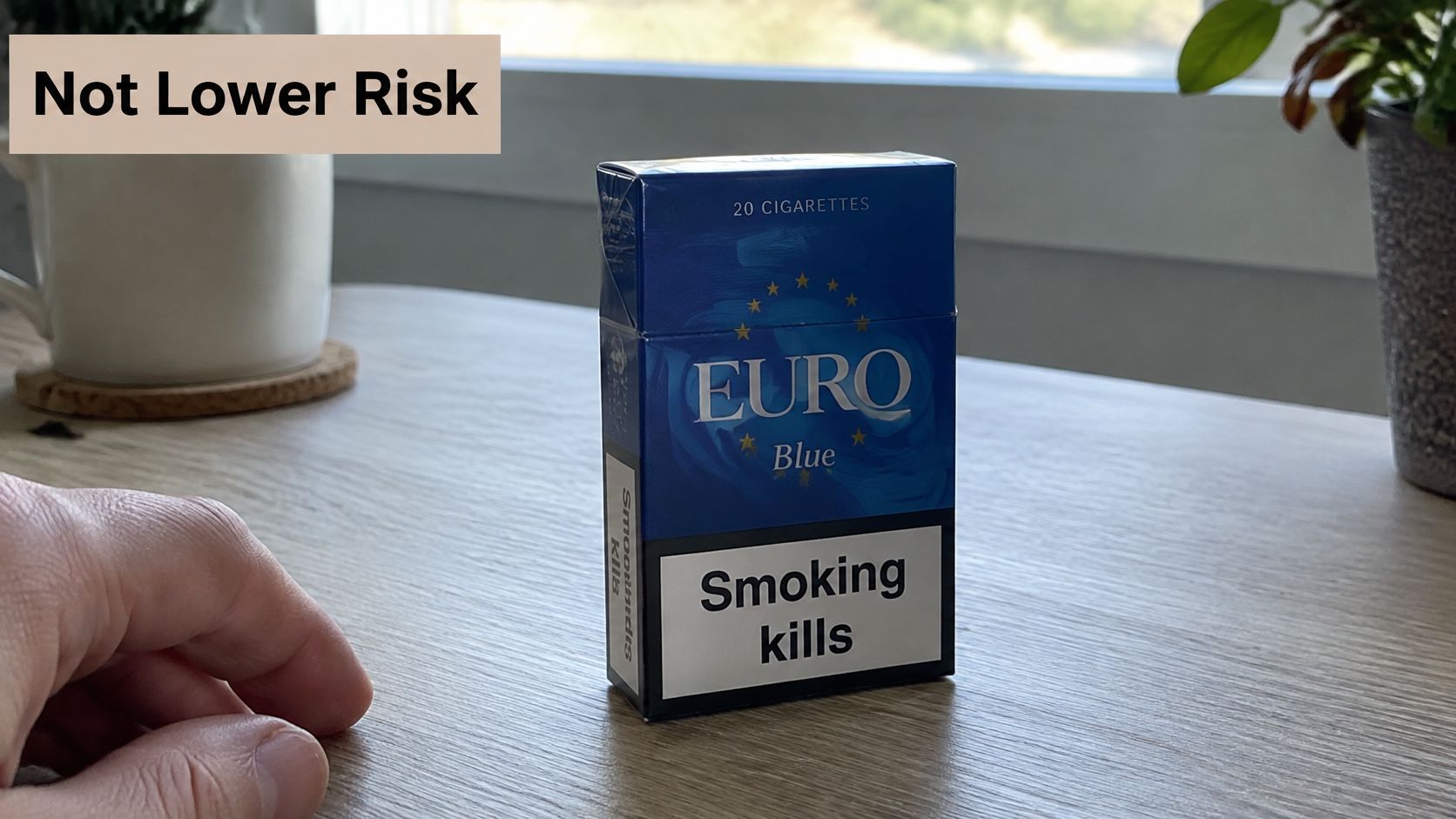
Euro Blue is a combustible cigarette, and that single fact outranks every descriptor on the box. Australian technical evidence defines tobacco-product emissions as the chemicals released during intended use, including cigarette smoke, and describes burning tobacco as generating a complex mixture rather than a single exposure that one headline yield can capture (Tobacco in Australia emissions chapter).
A published fuel-consumption figure is measured under controlled conditions. It still won't predict your commute, because gradient, traffic, load and how hard you press the pedal all intervene. Machine yields behave the same way: real measurements, poor predictors of an individual smoker.
What Filter Ventilation Changes and What It Leaves Alone
Ventilation holes in the filter dilute the smoke drawn into the testing machine, which lowers measured tar, nicotine and carbon monoxide. A person doesn't smoke like a machine. Puffs get deeper, longer or more frequent, or fingers and lips cover the holes and shut the dilution off entirely. Nicotine is addictive, which is why that compensation happens without a conscious decision, and manufacturers add processing ingredients to tobacco and to other cigarette components as part of normal production.
A machine number tells you what the test measured. It does not tell you what you inhale.
| Claim or label | What it establishes | What it does not establish |
|---|---|---|
| Blue colour name | A variant in the Euro range | Lower risk or a lower nicotine dose |
| Machine tar yield | A lab result under a standard test | Your personal tar intake |
| Machine nicotine yield | A lab result under a standard test | How much nicotine you absorb |
| Filter ventilation | Dilutes smoke in machine testing | Safer use, since puffing changes exposure |
| Light or smooth taste | A sensory profile | Reduced toxicant exposure |
Nothing in the available evidence sets Euro Blue's exact tar, nicotine or carbon monoxide output, its tobacco blend, its ventilation level or its batch consistency. The 6 mg and 0.5 mg figures belong to one listing's machine test and stop there. Read that gap as information in itself: a variant sold without documentation is telling you something about the supply behind it, and silence on the label is a compliance signal rather than a bonus.
For a buyer, the useful checks are pack markings, the batch code and the stated yields, recorded before the packet goes in the bin. The manufacturer or importer named on the pack is then the starting point for looking up ingredient and product information, because that name is what any enquiry or complaint traces back to.
Euro Blue, Euro Red and Hand-Rolled Alternatives
Comparing Euro Blue with its siblings and with loose tobacco comes down to knowing which differences are documented and which are just wording on a box.
Euro Red is the range's stronger sibling, and that's where the paperwork stops. The available evidence includes no verified Australian yield data for Red, so the honest answer to "how much stronger is Red" is that no defensible number exists. Sort the range this way instead: colour tells you where a variant sits in the line, while yield, blend, draw resistance and the quantity of tobacco in the tube are what a smoker meets.
- Euro Blue. A factory-made, filtered cigarette sold as 20-stick packets inside a 200-stick carton, positioned as the lighter option in the range.
- Euro Red. The stronger sibling by marketing position. No verified Australian yield figures are available, so treat any quoted strength difference as unconfirmed.
- Roll-your-own. Loose tobacco where you set the quantity per paper and the paper changes the draw. That makes per-cigarette intake harder to predict, not lower.
Loose tobacco shifts the variables rather than the risk. If you're weighing the two formats, the comparison of rolling tobacco prices in Australia sets out the pack sizes and weights people usually choose between.
None of the three is a safer choice. Factory-made, Red-labelled or hand-rolled, all three burn tobacco, and the differences between them concern how the product is built and smoked, not what the smoke contains.
Age Limits and Lawful Buying Channels in Australia
The rule runs the same way across the country. You must be 18 to buy tobacco in every Australian state and territory, and the seller has to check your age before handing a product across a counter or sending it out. Buying on someone else's behalf doesn't sidestep it either. Supplying tobacco to a minor is an offence in its own right, whether the adult pays or the younger person does.
How Each Channel Applies the Age Check
| Buying channel | Age check | Legal checkpoint to confirm |
|---|---|---|
| Licensed tobacconist or convenience store | ID check at the counter | Current retailer licence where the state or territory requires one, plain packs on sale |
| Online retailer with delivery | Age confirmation at checkout and again on delivery | Named business, Australian address, published returns and privacy policies |
| Social media or informal seller | Usually none | No verifiable importer or licence, so not a safe option |
| Purchase for someone under 18 | Not permitted | Supplying tobacco to a minor is an offence |
In a shop, the check happens face to face and the licence sits behind the legal picture, since tobacco retailer licensing is administered by each state and territory rather than uniformly. Online, you'll confirm your age at checkout and often again when the parcel arrives, with the exact delivery terms set by the seller rather than by any national standard. If you're ordering for delivery, the walkthrough of buying smokes online in Australia explains how those checkout and delivery checks typically run.
Where a Cheap Carton Sits in a Changing Market
Official national data show the market itself is shifting under these rules. Exclusive manufactured-cigarette use fell from 74% of smokers in 2004 to 56% in 2022-23, while exclusive roll-your-own use rose from 5.7% in 2001 to 16% (AIHW tobacco data). Someone asking about a blue-labelled pack is often choosing between product types, not merely between colours.
That makes the channel the more important question, and it's the one most price-led advice skips. A low price from an informal seller can arrive with no age check at all, no traceable importer and no way to confirm what's inside the pack.
Checking the Pack, the Seller and Your Decision
A low-profile name on a pack isn't automatically a problem, and it isn't automatically fine. It's an unverified claim until you check it, and illicit products routinely skip plain packaging, health warnings, ingredient controls and tobacco tax measures.
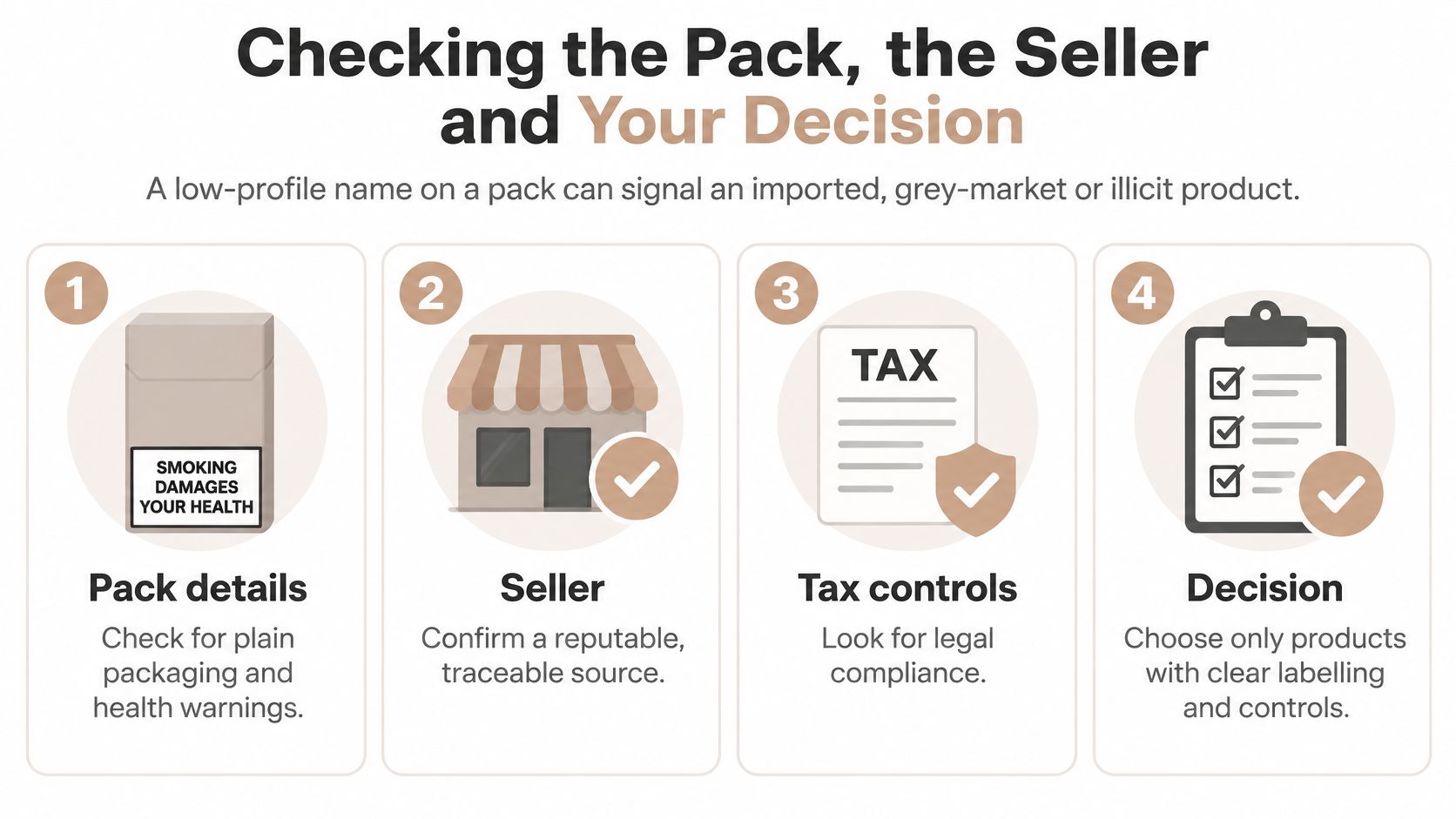
The scale isn't small. In 2022-23, 16.5% of Australian adults who smoked reported using illicitly traded tobacco, up from 10.1% in 2019, and one in five current smokers had seen a tobacco pack without plain packaging in the previous three months while 10.2% had bought one (Senate committee report on the illegal tobacco market).
Seven Checks Before You Pay
- Look for Australian health warnings and standardised plain packaging. Their absence is the clearest single sign the product isn't compliant.
- Find the importer or manufacturer named on the pack. A named, contactable company is what makes an ingredient or batch lookup possible at all.
- Confirm the seller is a lawful channel. Where your state or territory licenses tobacco retailers, a licence number or verifiable business identity should be available before payment.
- Treat an unusually low price as a question. Ask what accounts for it: lawful retail pricing, imported supply, or a channel that skips tax and packaging rules.
- Record the batch code, country of manufacture and pack markings. Photograph the pack before you open it, because that evidence disappears once it's empty.
- Match the product to the listing. Our catalogue lists Euro among brands such as Ascot, Bond Street, Chesterfield, Dunhill, Esse, Holiday, Marlboro and Winfield, so confirm the Blue variant and the pack count on the page you're reading, plus the returns and privacy terms, before you order.
- Walk away if the importer can't be named. No name means no accountability, and no accountability is the whole risk in one sentence.
Walk-away rule: if a listing can't tell you the carton size, the importer and the delivery terms, it isn't a cheaper version of a legal purchase. It's an unknown one.
The decision itself is simple to apply. If any check fails, don't buy, and take your business to a licensed retailer instead. If everything passes, keep the listing, the price and the date, so you can compare the next carton against a record rather than a memory.
Cheap Smokers stocks Euro Blue cigarettes in the 10-packet, 20-per-packet carton format described here, alongside brands such as Ascot, Bond Street, Chesterfield, Dunhill and Marlboro, with online ordering, Australia-wide delivery and in-store purchasing. Every purchase runs through an age confirmation prompt and age verification, so you can check the listing, confirm the pack count and see the current price before you commit. Visit Cheap Smokers to compare the carton against today's listed price.