Rolling Tobacco Prices Australia Compared
November 1, 2026At one retailer’s 2026 prices, Premium Rolling Tobacco RYO 12mg is $51.03 for 100g, about 51 cents a gram, and $318.09 for 1000g, about 32 cents a gram. Both tickets move when duty is indexed, so neither figure is a fixed national price.
That gap is the whole story behind rolling tobacco prices in Australia if you read it properly. The larger pouch costs far more at the till and far less per gram, and the difference between those two readings changes what counts as value. A buyer who sorts by the lowest shelf price will pick the small pouch every time. A buyer who divides price by weight reaches the opposite conclusion.
There’s a second trap underneath that one. Strength, brand and multipack formatting can all reorder the ranking without changing the weight on the packet, so cents per gram only works as a comparison when you’re holding the same strength and the same type of product. Change the strength and you’re comparing a different smoke, not a cheaper version of the one you already use.
The third trap is the one most price lists ignore. Legal pouches carry indexed federal excise, and that excise, not a retailer’s margin, explains most of the distance between a licensed shop’s ticket and any untaxed street price you’ve heard quoted. If you keep comparisons inside legal products, match strength first and calculate unit cost second, the shelf stops looking random and starts looking like a system you can read.
Table of Contents
- Rolling Tobacco Prices by Pack Size
- Strength and Brand Price Gaps
- When a Bigger Pouch Costs Less
- Pack Sizes for Real Buying Patterns
- Why Excise Sets Legal Pouch Prices
- Pick a Legal Pouch and Check the Total
Rolling Tobacco Prices by Pack Size
Start with one retailer’s displayed 2026 prices for a single product and strength, because that’s the only honest way to price rolling tobacco prices in Australia without inventing a national average. Premium Rolling Tobacco RYO 12mg gives you a clean ladder. The 100g pouch is $51.03, the 250g pouch is $93.56, and the 1000g pouch is $318.09. The shelf price rises steeply. The unit cost falls just as steeply, from about 51 cents a gram at 100g to about 37 cents a gram at 250g and about 32 cents a gram at 1000g.
Reading rule: Match the strength first, then calculate cents per gram, then ask whether the larger pouch is actually cheaper per unit, not just bigger.
That rule sounds obvious until you watch how most shoppers behave. Many people anchor on the total outlay, because $318.09 feels like a serious purchase and $51.03 feels manageable. Both feelings are understandable. Neither tells you what the tobacco costs per gram, which is the only figure that lets you compare a small pouch you can afford today against a large pouch that would stretch the week’s budget.
Premium RYO 12mg Prices and Cost per Gram
| Product | Pack size | Price |
|---|---|---|
| Premium Rolling Tobacco RYO 12mg | 100g | $51.03 |
| Premium Rolling Tobacco RYO 12mg | 250g | $93.56 |
| Premium Rolling Tobacco RYO 12mg | 1000g | $318.09 |
Read that table as a snapshot, not a promise. These are one legal Australian retailer’s displayed prices, and a ticket can change with stock availability, a multi-buy offer or the twice-yearly excise indexation that lands in March and September. You should always recheck the live price at checkout before you treat any figure here as the price you’ll pay. That’s not a disclaimer bolted on for safety. It’s how an indexed tax system reaches the shelf, in regular steps that lift every legal pouch whether or not Parliament has announced anything new.
The pack sizes themselves also need a plain explanation. This retailer stocks its premium roll-your-own line in 50g, 100g, 250g and 1000g sizes, so if a weight you expected to see isn’t in the table, you’re looking at an assortment gap in one catalogue, not a second hidden price list. Roll-your-own ranges aren’t standardised across every shop. One tobacconist might favour small pouches for walk-in trade while an online catalogue leans into larger formats for repeat buyers, and neither range defines what the national market must stock.
Why Unit Cost Matters to So Many Buyers
Unit cost isn’t a niche concern for a small group of hand rollers anymore. A peer-reviewed study using the International Tobacco Control Policy Evaluation Project Australia Survey reported that the share of Australian tobacco purchases involving any roll-your-own tobacco increased from 23.8% in 2007 to 43.9% in 2020. When roll-your-own accounts for close to half of purchases, a few cents a gram stops being a rounding detail. It becomes the main lever a regular buyer has, because the excise component is fixed by law and the retailer’s ticket is what it is on the day.
Notice what the three-pack ladder already tells you about behaviour. The jump from 100g to 250g does most of the work, dropping unit cost by roughly 14 cents a gram. The jump from 250g to 1000g adds a much smaller saving, roughly 6 cents a gram, for a much larger upfront commitment. That pattern, a big early gain followed by a flattening curve, is worth remembering because it determines where the practical sweet spot sits for different buyers. Bigger keeps getting cheaper per gram. It just stops getting cheaper quickly.
None of this means the lowest unit cost is automatically the right buy. A kilogram you can’t finish before it dries out isn’t a saving, and a pouch in a strength you don’t normally smoke isn’t a bargain either. Pack size is only one variable, and on its own it will mislead you the moment strength or brand enters the comparison. That’s where the next set of gaps matters, because two pouches of identical weight can sit well apart on price for reasons that have nothing to do with bulk.
Strength and Brand Price Gaps
Sort a catalogue by lowest ticket and you’ll misread it within the first two rows. At 100g, Premium Rolling Tobacco RYO 8mg is $42.53, about 43 cents a gram, while the 12mg version at the same weight is $51.03, about 51 cents a gram. That’s an 8 cents a gram gap on the same house line at the same size. It isn’t a bulk discount and it isn’t a sale. It’s a strength difference, and it only counts as a saving if 8mg is what you smoke.
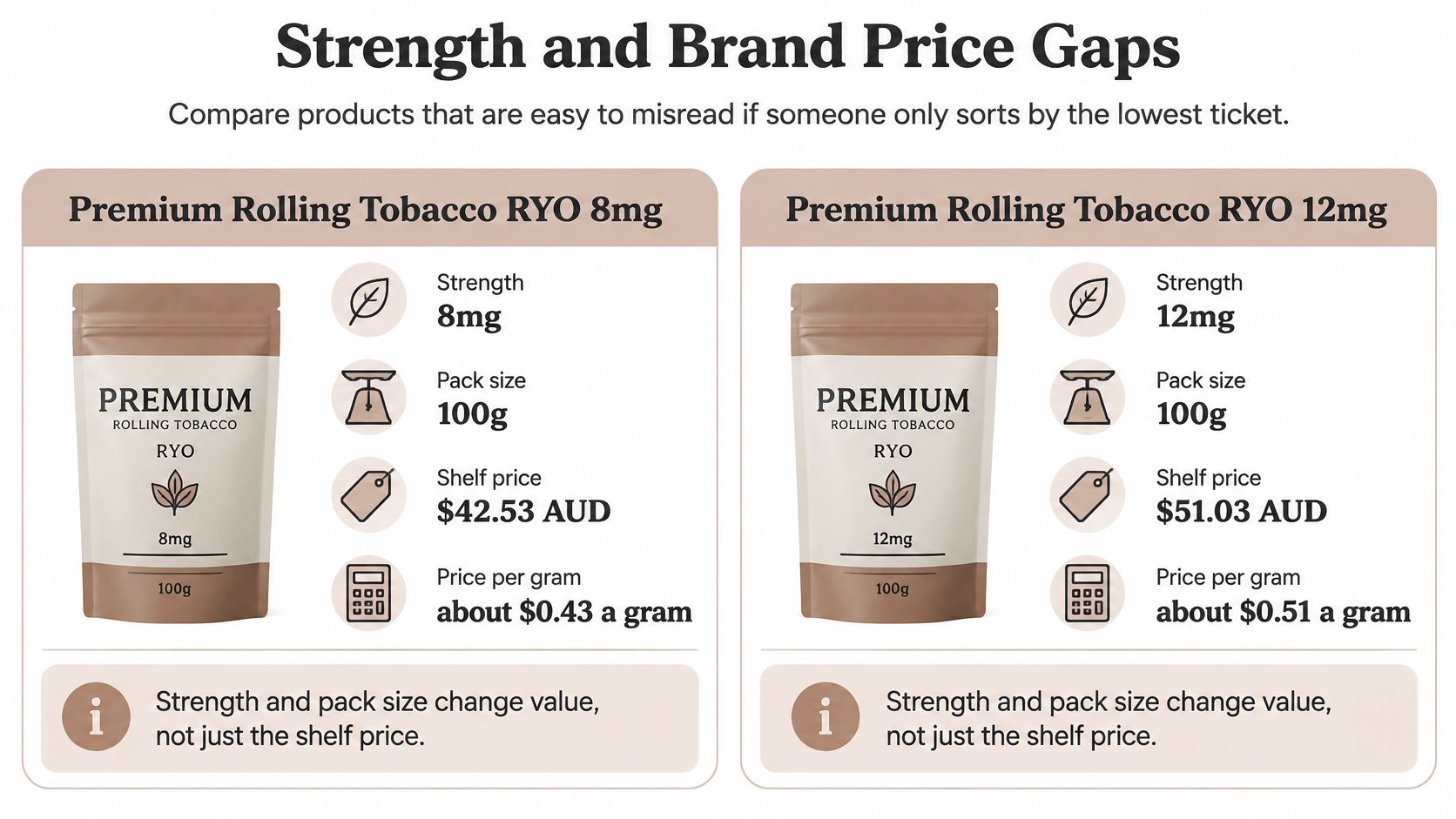
Treat that gap carefully. If you normally roll 12mg and you switch to 8mg purely for the lower ticket, you haven’t bought the same tobacco more cheaply. You’ve bought a different product and you’re likely to roll more of it, smoke it differently or go back to your usual strength within the week. Analysts call this a false equivalence. In plain terms, an 8mg saving is not interchangeable with stepping up to a kilogram of the 12mg you already use, even though both moves lower the number on a spreadsheet.
Strength and Brand Gaps at Current Tickets
| Comparison | Price | What the gap measures |
|---|---|---|
| 100g Premium RYO 8mg | $42.53 | Lower strength on the same house line |
| 100g Premium RYO 12mg | $51.03 | Higher strength at the same weight |
| Golden Virginia 500g | $261.02 | Named blend versus bulk house tobacco |
| 1000g Premium RYO 12mg | $318.09 | Large house pouch, not a branded 500g |
Now put a named blend beside the house line and the picture flips again. Golden Virginia 500g is $261.02, which works out to about 52 cents a gram. Set that against the house 12mg kilogram at about 32 cents a gram and the branded mid-to-large pack costs roughly 20 cents a gram more than the biggest house pouch. In fact, its unit cost sits slightly above even the small 100g house pouch. Brand and blend have completely wiped out the bulk discount you’d normally expect at 500g.
That’s not an error in the catalogue. Both Australian and overseas tobacco brands sit in the same legal range, and a familiar imported name carries its own positioning, blend and supply chain. If you want to understand what you’re paying for with that name, the guide to Golden Virginia variants, flavour and buying choices walks through the variants before you commit to a 500g outlay. The point for price purposes is simpler. A recognised blend can price like a small pouch per gram even when the pack itself is large, because you’re paying for that specific tobacco, not for weight alone.
The cheapest 100g pouch is not the cheapest tobacco if a heavier pouch of the strength you already use costs far less per gram.
Hold that sentence against both contrasts and you can see why a single sorted list fails. The 8mg 100g pouch wins on ticket price and loses as a like-for-like comparison if you’re a 12mg smoker. The Golden Virginia 500g looks like a bulk buy and prices like a premium small format. Neither product is mispriced. The shopper’s method is what produces the wrong answer, because sorting by total price treats strength and brand as if they were free variables you can swap without consequence.
So work in a fixed order and don’t let the ticket reorder it for you. Match your nicotine strength first, then decide whether you want a house line or a named blend, then calculate cents per gram within that shortlist. Keep one more caution in view while you do it. Listings can show original and sale prices side by side, so the gaps above describe current displayed tickets, not a permanent ranking. A promotion on one line can narrow a brand gap for a week and then disappear, which is another reason to run the per-gram maths on the price in front of you rather than memorising a league table.
When a Bigger Pouch Costs Less
Step up the house 12mg line and watch where the saving happens. Moving from 100g at about 51 cents a gram to 250g at about 37 cents a gram saves roughly 14 cents a gram. Moving again from 250g to the 1000g pouch at about 32 cents a gram saves only about 6 cents a gram more. The first step does most of the work. The second step still helps, but you’re committing an extra $224.53 over the 250g ticket to chase a much smaller unit gain.
That flattening curve changes how you should think about bulk. If your goal is the lowest possible unit cost and you know you’ll use a kilogram while it’s fresh, the maths points one way. If your goal is most of the saving for a fraction of the outlay, the 250g pouch is where the efficiency sits. Buyers who assume each size up delivers the same proportional discount will overspend upfront for gains that shrink at every step.
The Multipack That Is Not a Bulk Discount
Now test the assumption that anything labelled bulk must be cheaper. The 50g (Bulk Buy x5) Premium Rolling Tobacco RYO is $130.98 for 250g in total, which works out to about 52 cents a gram. That’s more per gram than the single 250g pouch at about 37 cents and slightly more than the 100g single at about 51 cents. Five small pouches give you the convenience of opening one at a time. They don’t give you a bulk unit price, whatever the label suggests at a glance.
This is the clearest example in the whole range of format beating weight. Total grams alone would put the bundle level with the 250g pouch. Unit cost puts it at the expensive end of the line, because you’re paying small-pouch pricing five times over. If freshness in small batches is what you want, that’s a legitimate reason to buy it. If saving money is the reason, the numbers argue against it, and no amount of bundle language changes the division.
A named blend makes the same point from the other direction. Before you assume a 500g pack of anything beats a smaller house pouch, check the live ticket on the Golden Virginia 500g product page and run its per-gram cost against the house sizes. Weight is a useful first filter. It is never a substitute for the calculation.
The Separate Lever in Your Cart
There’s one more lever, and it sits at checkout rather than on the shelf. Adding 2 or more items to the cart gets 10% off. That can change the ranking in ways pack size alone can’t, because two 250g pouches with a multi-buy discount applied may beat a single awkward size once you divide the discounted total by the combined weight. It can also reward pairing a pouch with papers or another item you’d buy anyway, rather than forcing you into a kilogram for the sake of unit cost.
Don’t take that stacking for granted, though. Confirm at checkout that the 10% still applies alongside any sale price already shown on the product page, because promotions don’t always combine. Check the cart total after the discount lands, not the product page ticket you started from.
Three variability checks will keep you honest here:
- Indexation lifts every row together: When duty rises in March or September, small and large pouches move up, so yesterday’s per-gram gap needs today’s prices.
- A sale can shrink a brand gap: A discounted named blend can temporarily sit closer to house pricing than its usual ticket suggests.
- A multipack can cost more per gram: Several small pouches bundled together may price above one large pouch of the same total weight.
End every comparison the same way. Calculate cents per gram on the actual cart total after any multi-buy discount, using the combined weight you’re really buying. The biggest number on the shelf, the lowest ticket and the word bulk are all shortcuts. The division is the answer.
Pack Sizes for Real Buying Patterns
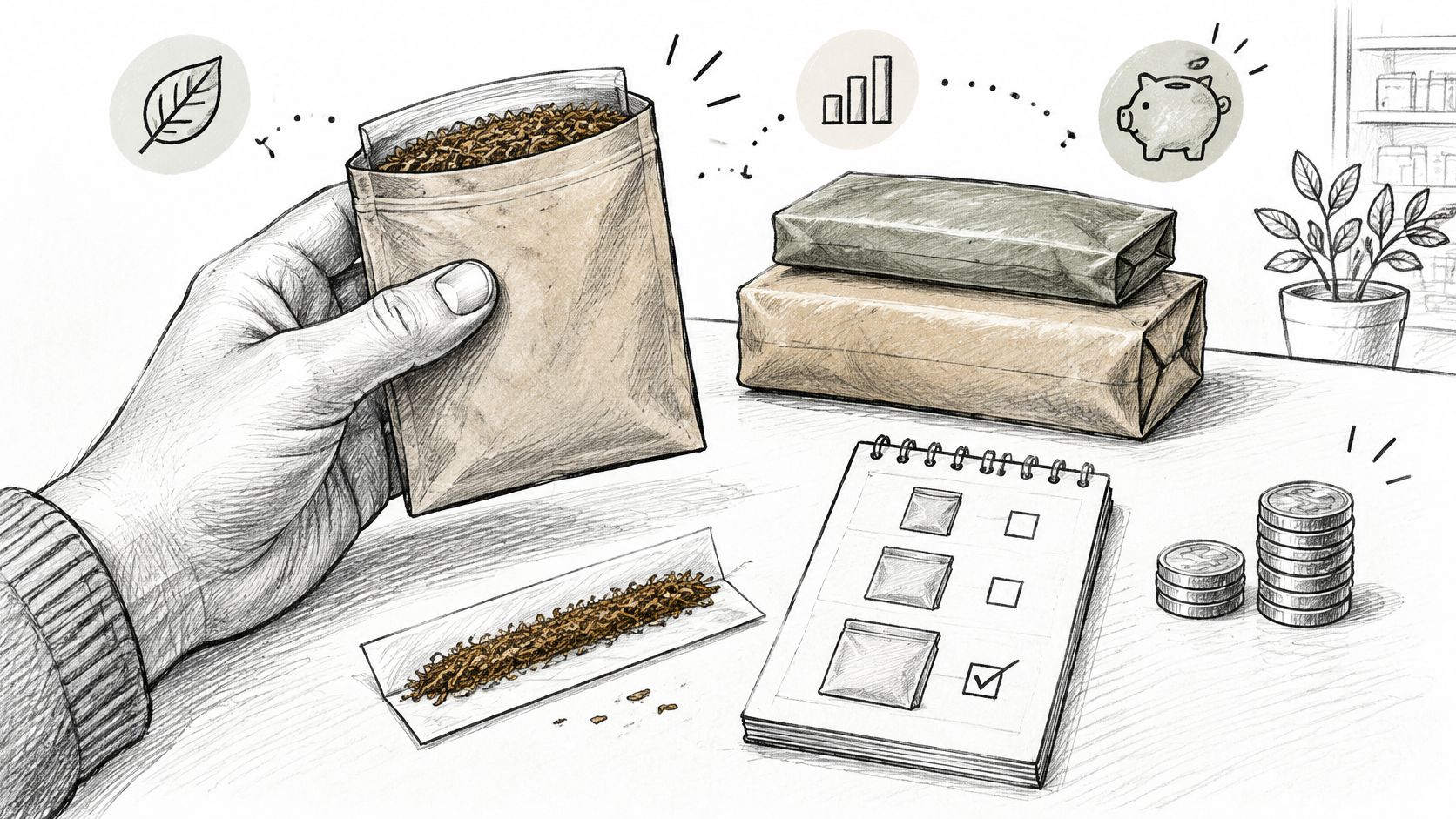
Unit cost tells you what’s efficient. It doesn’t tell you what you’ll get through, and buying for a rolling pattern you don’t have is how a cheap-per-gram pouch turns into dry tobacco at the back of a drawer. Four common patterns cover most adult roll-your-own buyers, and each one points to a different pouch.
Light or Occasional Use
Say you roll occasionally, share a pouch socially or you’re trying a strength to see whether it suits you. A 100g pouch limits how much you have open at once, keeps the upfront cost contained and means a strength that doesn’t suit you isn’t a kilogram-sized mistake. You’ll pay the highest cents per gram on the house ladder, and that’s fine, because you’re buying a smaller commitment rather than chasing efficiency. Choose 8mg or 12mg to match what you already smoke, not whichever ticket is lower. Put one 100g pouch in the strength you normally use in your cart.
Steady Weekly Use
For a regular roller with a predictable weekly habit, the 250g 12mg pouch at $93.56 is the practical middle of this range. Most of the unit-cost drop has already happened by this size, so you’re capturing the largest single saving without tying up several hundred dollars or storing a kilogram of leaf. It also turns over fast enough that freshness rarely becomes the problem it can be with a very large pack in a light-use household. Put the 250g pouch in your usual strength in your cart, and add a second item only if the multi-buy saving applies.
A Known Blend in Bulk
Some households already know the blend, know the strength and know roughly how quickly a large pack disappears. For that buyer, the 1000g pouch at $318.09 carries the lowest cents per gram in this set, provided the upfront cost is acceptable and you can store it sealed, cool and away from heat so it doesn’t dry out before you finish it. Australia-wide delivery matters here, because a local tobacconist may not stock kilogram formats at all. Put the 1000g pouch in your cart only if your recent usage says you’ll finish it while it’s still in good condition.
One format doesn’t belong in any of these scenarios if saving money is your aim. The five-by-50g bundle, listed as the 50g Bulk Buy x5 Premium Rolling Tobacco RYO, prices like a small pouch spread across five packs. Buy it for portioning if that suits you. Don’t buy it expecting a bulk rate.
A Named Blend by Choice
The fourth pattern isn’t about volume at all. If you want the specific taste of a named blend such as Golden Virginia, you’re choosing flavour and familiarity and accepting large-pouch shelf prices at small-pouch rates per gram for a 500g pack. There’s nothing irrational about that preference. It just isn’t a value strategy, and you shouldn’t let the 500g weight convince you otherwise. Put the named blend in your cart because it’s the tobacco you want, with the per-gram premium understood before you pay.
Freshness draws the outer line around every scenario. A very light roller who buys a kilogram for the unit cost will likely watch the last third of it dry out, which erases the saving that justified the purchase. Match the pouch to the pace you can prove from your own recent use, and let the per-gram ranking choose only between sizes you’ll realistically finish.
Why Excise Sets Legal Pouch Prices
Excise is the largest fixed component of a legal tobacco pouch’s price. Leaf, manufacturing, wholesale costs and retailer margin also contribute, but they sit around a tax set by government. The Australian Taxation Office publishes the current tobacco excise duty rates, which apply across legal sales rather than being set by an individual shop.
Roll-your-own tobacco once had a lower effective tax rate than manufactured cigarettes, giving hand rollers a tax-based price advantage. The 2017–18 Federal Budget set out a staged move towards equivalent taxation, using an equivalisation weight to calculate duty on tobacco by kilogram. That weight fell from 0.7 grams to 0.6 grams per cigarette equivalent, with annual reductions beginning on 1 September 2023 and the 0.6-gram measure applying fully from 1 September 2026.
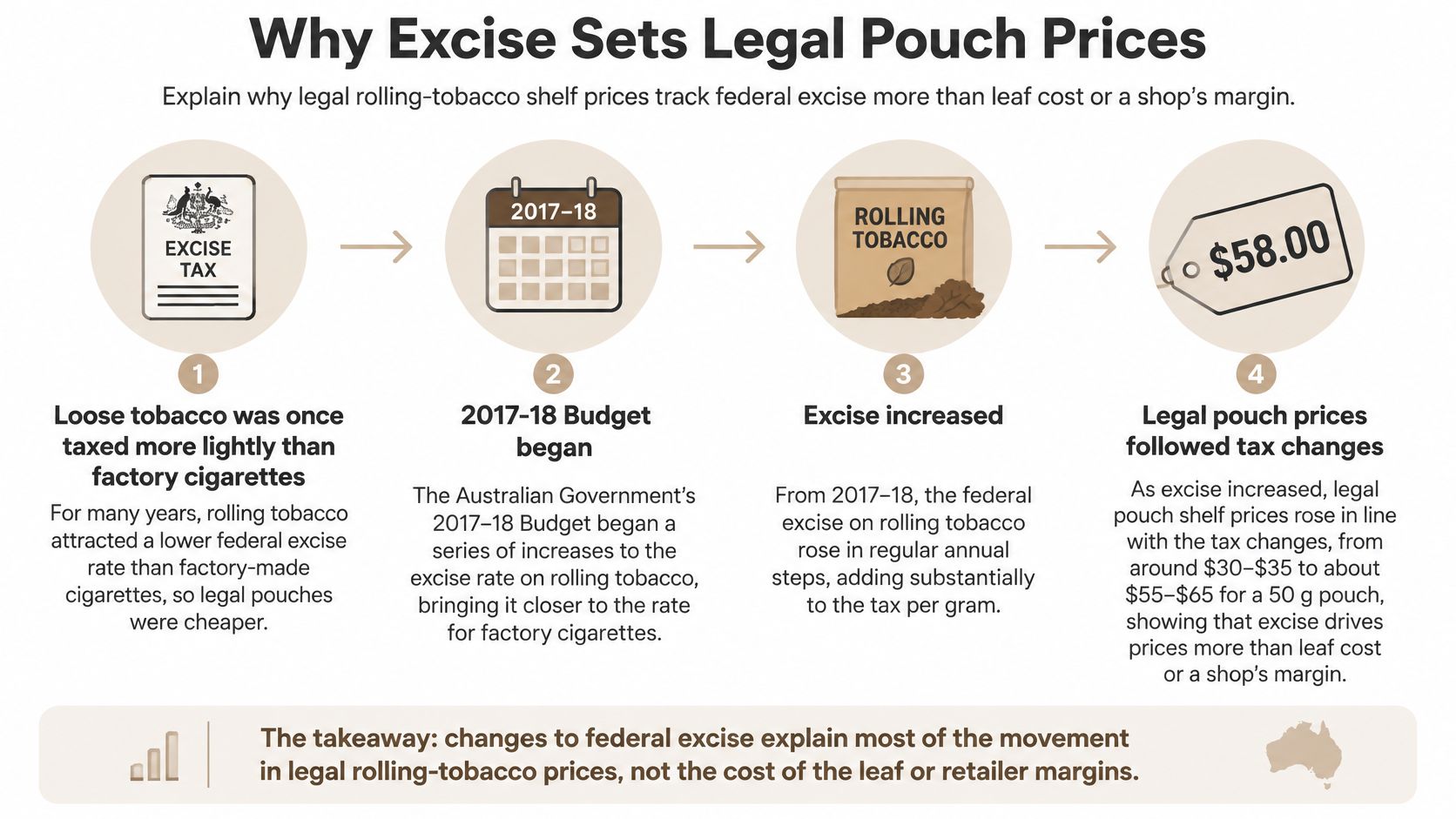
A lower equivalisation weight does not mean less duty. It means a kilogram of rolling tobacco represents more cigarette equivalents for tax purposes, increasing the duty calculated on that kilogram even though the tobacco itself has not changed. This is why a legal pouch can carry a high tax burden before wholesale and retail costs are added.
Indexation Moves Prices Without New Laws
Tobacco duty is indexed twice yearly, in March and September, according to Average Weekly Ordinary Time Earnings. As a result, duty can rise without a new parliamentary tax measure. Retail prices may then change as the higher tax moves through the wholesale chain.
This makes any printed price list temporary. Pack-size comparisons in cents per gram can remain useful after an excise increase, but the dollar amounts may not. A higher ticket between two purchases can reflect indexed duty rather than a wider retailer margin.
The Illicit Price Is Not a Benchmark
A much lower illicit price does not show what a legal retailer could charge without excess margin. The Australian Bureau of Statistics analysis of household consumption of illicit tobacco and nicotine products reports that legal tobacco prices have risen substantially since December 2016, driven by excise increases, while estimated illicit-tobacco prices remained relatively stable. Its 2025 estimates show illicit products represented less than 40% of household tobacco expenditure but approximately 80% of the quantity consumed. The gap points to a major price difference between taxed and untaxed supply.
The ABS analysis also reports that in 2022, disadvantaged Australian households that purchased tobacco allocated 6.3% of disposable income to it, compared with 2.7% in the most advantaged areas. That pressure can make an illicit price seem like a useful market comparison. It is not: a lower price can reflect duty being evaded, rather than a more efficient retailer or a smaller margin.
Legal roll-your-own can cost less per gram than small legal pouches and still be far more expensive than untaxed tobacco.
For legal purchases, compare cents per gram across pack sizes and strengths, then account for the product you want. An illicit price cannot show whether a 250g pouch offers better value than a 1000g pouch, or whether a blend carries a premium. It reflects a different supply chain, one that avoids the excise built into legal prices.
Pick a Legal Pouch and Check the Total
You’ve matched strength, weighed up brand and settled on a size that fits how fast you’ll use it. What remains is a short checkout routine that protects you from the three ways a good decision goes wrong at the last step, a moved price, a discount that doesn’t stack and a unit cost you calculated from the wrong total. Run these checks in order, on the live product page, every time you buy.
Step 1 Confirm the Live Ticket
Open the product page and confirm the current price, strength and pack weight together, not from memory and not from a screenshot you saved last month. Excise indexation lifts tickets in March and September, promotions start and end, and a listing can show an original price beside a sale price. The figure that matters is the one the cart will charge you today for the exact variant you’ve selected. If the strength selector has defaulted to a different option than the one you intended, this is the moment to catch it.
Step 2 Check the Multi-Buy in the Cart
If two or more items are going into your cart, verify whether the stated 10% off for 2 or more items applies alongside any sale price already displayed. Don’t assume the discounts stack, and don’t assume they don’t. Add the items, look at the cart total and confirm the reduction has landed before you judge the purchase. A multi-buy that applies can reorder your size choice, because two mid-sized pouches at a discounted combined total may beat the single large pouch you’d otherwise stretch to afford.
Step 3 Recalculate Cents per Gram on the Cart Total
Now do the division one final time using real numbers. Take the cart total for the tobacco after any discount and divide it by the combined grams you’re buying. That figure, not the product page ticket, is your legal unit cost for this order. Compare it against the alternative you nearly bought, a different size of the same strength, calculated the same way. If the gap between them is a cent or two per gram, let freshness and upfront cost decide. If the gap is large, let the maths decide.
Step 4 Complete the Age Check
Australian law requires buyers to be over 18 before purchase, and you must verify your age before making a purchase online because we must obey Australian law. Have your details ready before you start checkout so the verification step doesn’t stall an order you’ve already priced carefully. An age gate isn’t friction a retailer adds for its own amusement. It’s a legal condition of selling tobacco online, and its absence on any site you’re considering should end the transaction, not speed it up.
Cheap Smokers is one place to run all four checks in a single cart. We list Australian and overseas roll-your-own brands in the sizes covered here, from 100g trial pouches through to kilogram formats, and we offer delivery across Australia for buyers whose local tobacconist doesn’t stock the size or strength they use. The catalogue structure lets you hold strength constant while you move between pack sizes, which is exactly the comparison method this article has argued for.
Close with one action and one refusal. Discard any illicit price you’ve been quoted as a benchmark, because it measures evaded duty and nothing about the legal pouch in front of you. Then place the pouch that matches your strength and the pace you’ll use into your cart, run the four checks and complete the purchase once the discounted per-gram figure is the one you intended to pay. That’s the whole method. Strength first, legal comparisons only, unit cost on the final total, and no shortcut that skips the division.
If you’re ready to put the method to work, browse the roll-your-own range at Cheap Smokers, where you’ll find Premium Rolling Tobacco RYO in 8mg and 12mg alongside named blends such as Golden Virginia in sizes from 100g to 1000g, with delivery across Australia and age verification built into checkout. Pick your strength, divide the live cart total by the grams and order the pouch your own usage says you’ll finish fresh.
[…] a rolling-tobacco price comparison to organise questions about quantities and advertised costs, not as proof of any product’s […]
[…] Bulk buying can reduce packaging or freight cost per unit, but it doesn't remove excise per stick or per kilogram. Compare formats using the same calculation, including when you review rolling tobacco prices in Australia. […]