

Cigarette Holder for Rollies: How to Choose and Use One
August 24, 2026You're at the counter with a fresh rollie in your hand, and the holder you picked online either grips too loosely, jams the filter, or feels awkward the moment you take a draw. That's the usual mistake with a cigarette holder for rollies, people buy the look first and only learn later that fit, bore depth, and material decide whether it becomes part of the routine or ends up forgotten in a drawer.
Australian RYO smokers don't all roll the same cigarette, either. A slim rice-paper roll, a firmer 78mm hand-roll, and a thicker tobacco pack all behave differently at the mouth-end, so the holder has to suit the cigarette you smoke, not the one shown in product photos. The legal side matters too, because Australia now treats rollers, filter tips, and similar items as tobacco product accessories, not harmless novelty goods, and that changes what can be sold, how it can be described, and how tightly the design space is controlled under the Commonwealth framework (Australian Government tobacco product requirements).
Table of Contents
- Why Fit Matters More Than Style for Rollies
- Comparing Holder Styles and Materials
- Matching a Holder to Your RYO Format
- What Holders Change About the Smoke
- Cleaning and Caring for Your Holder
- Choosing the Right Cigarette Holder for Rollies
Why Fit Matters More Than Style for Rollies
A lot of smokers buy a holder because it looks neat, then discover it doesn't suit the cigarette they roll every day. That's especially common with Australian RYO, where one person rolls a tight slim with rice paper, another uses a broader hand-roll with a denser cut, and a third wants a longer mouth-end for comfort. The holder only earns its keep if it grips cleanly, seals properly, and doesn't change the cigarette so much that every draw feels off.
The three fit checks that decide whether a holder works
The first check is internal diameter. If the holder bore is too wide, the rollie sits loosely and can wobble or fall through. If it's too narrow, the paper crushes, the filter jams, or you end up forcing the cigarette into a shape it wasn't rolled for.
The second is grip depth. A shallow grip often feels fine in the hand, then slips once the paper softens from moisture. A deeper mouth-end usually holds better, but it can make a short rollie look and feel swallowed, which many smokers dislike.
The third is seal tightness. You want snug contact without crushing the paper tube. That balance matters more than styling, because even a premium-looking holder is useless if it can't take the cigarette you already know how to roll.
A practical way to think about it is simple. If your usual rollie already feels compact and uniform, choose a holder with a slightly forgiving entrance. If your rolls vary from smoke to smoke, avoid ultra-precise fittings that only work with one exact diameter.
The market shape in Australia reinforces that point. Rollies aren't a fringe buy, so accessories that ignore local rolling habits are a poor fit for the core audience, not just the catalogue. For a product example that shows how retail pages often present the category without solving fit, see this RYO-related listing.
Practical rule: if the cigarette has to be pushed, twisted, or squeezed to enter the holder, the holder's wrong for daily use.
Comparing Holder Styles and Materials
A cigarette holder for rollies only works well if the style and material suit the way you smoke. That means fit first, then comfort, then how much upkeep you are willing to do. A holder that looks polished but chokes the draw or chews up soft paper is a poor buy.
Straight tube holders are the simplest option. They feel familiar, stay light, and suit smokers who want a plain accessory that does one job. Tapered cone holders give a little more forgiveness when the rollie is uneven, which helps if your hand-rolls are not identical every time. Ejector styles suit people who dislike clearing out spent tobacco by hand, while filter-insert holders suit smokers who want more control over the mouth-end and do not mind extra cleaning.
Material changes the experience just as much as shape. Silicone grips well and feels soft, but repeated heat can leave it looking worn. Anodised aluminium feels solid and carries well, though it shows tar staining and fingerprints. Borosilicate glass is easy to clean and looks neat, but it needs care because it breaks when dropped. Hardwood has a warm hand-feel and a more classic look, yet it absorbs moisture and needs proper maintenance. Acrylic composites sit in the middle. They are usually light, inexpensive, and easy to replace, but they do not feel as refined as better-made options.
| Holder Materials Comparison | Heat Resistance | Cleaning Ease | Durability | Grip Quality | Best For |
|---|---|---|---|---|---|
| Silicone | Moderate | Good | Moderate | Excellent | Everyday use, softer feel |
| Anodised aluminium | Good | Moderate | Good | Good | Durable carry piece |
| Borosilicate glass | Good | Excellent | Low to moderate | Fair | Clean taste, careful users |
| Hardwood | Moderate | Moderate | Moderate | Very good | Premium feel, occasional use |
| Acrylic composites | Moderate | Good | Moderate | Fair to good | Budget-friendly replacement |
The finish matters less than the fit and airflow. Australian filter research showed that smokers’ perceptions can shift when the mouth-end changes, even if the smoke itself has not been proved safer. That is why a holder should be judged on whether it still draws like your usual rollie, not on how refined it looks (Australian filter study).
The best holder on paper can still be the wrong holder in the hand if it alters the draw or turns cleaning into a chore.
Matching a Holder to Your RYO Format
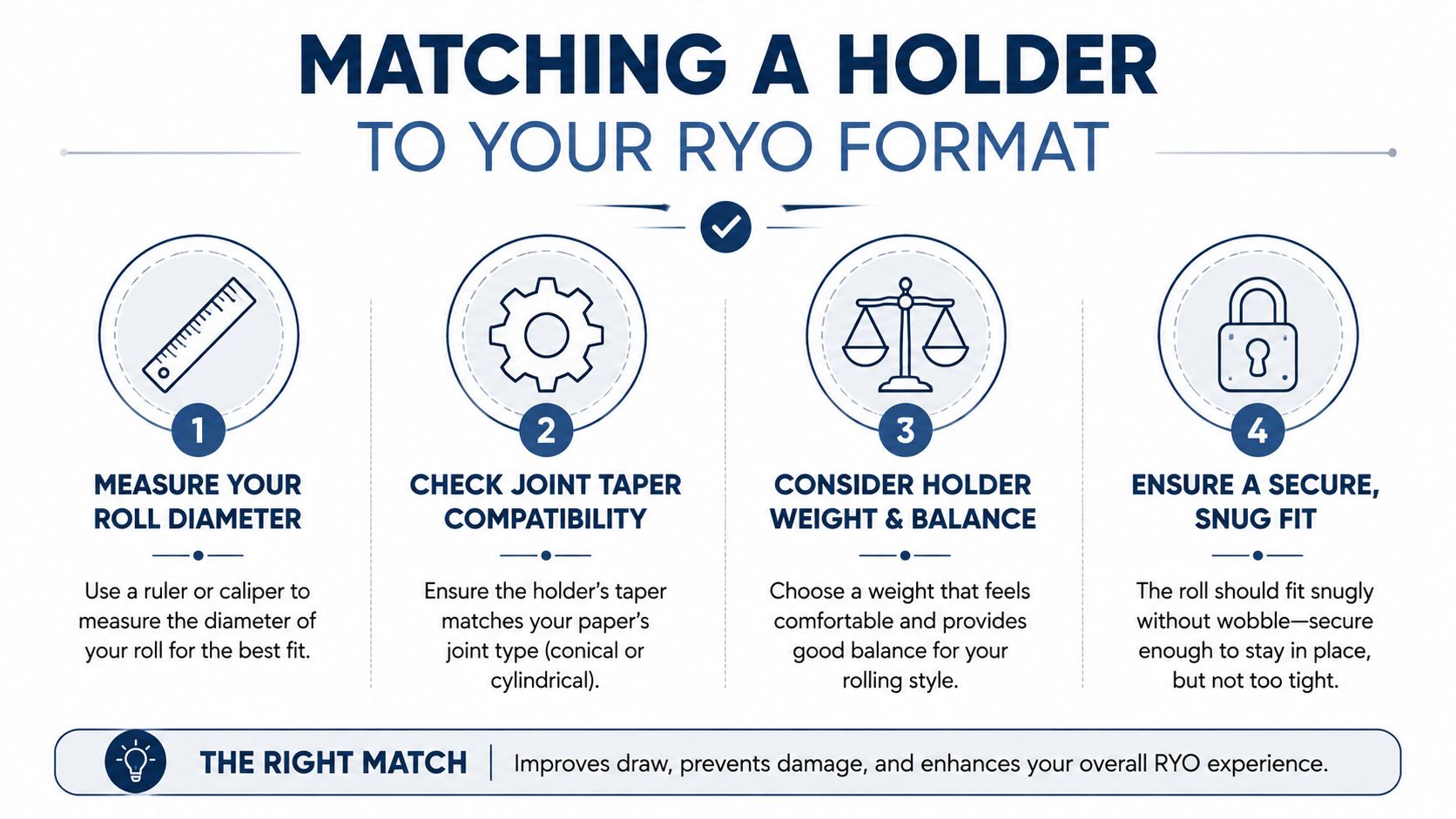
The easiest way to choose a cigarette holder for rollies is to start with the roll you already make, not with the accessory shelf. A holder that suits a 70mm slim doesn’t automatically suit a broader hand-roll, and a setup that feels fine with one paper type can feel too tight or too loose with another. Australian smokers who roll their own know this instinctively, because the cigarette itself isn’t standardised the way factory-made sticks are.
Start with the roll you actually smoke
If your usual roll is slim and neat, look for a holder with a tighter entrance and enough bore depth to support the paper without crushing it. If you roll with a thicker cut or use a fuller tube, a slightly wider mouth-end is usually easier to live with. The point is to match the holder to the roll’s natural diameter, not force every cigarette into one idealised size.
Paper choice matters too. Thin rice papers tend to make tighter rolls, so the fit has to be more precise. Thicker unbleached or hemp papers give a bit more tolerance, which can help if your rolls aren’t perfectly uniform every time.
Check compatibility before you buy
One of the most useful quick checks is to compare the cigarette against the holder opening before you commit. If you can, bring a freshly rolled cigarette with you and test the fit in store. If you’re buying online, a seller’s return policy matters more than flashy product photos, because the wrong taper or bore size is obvious the first time you try it.
If you use a filter tip, watch the transition point carefully. Some holders handle standard ends nicely but feel awkward with slightly wider activated charcoal filters, because the mouth-end needs a stepped or tapered profile rather than a straight tube. That’s the practical detail many product pages skip.
For browsing RYO-related options by category rather than guessing from pictures, this RYO category page is the sort of starting point people often use before narrowing down the exact accessory.
If the holder only works when you change how you roll, it’s not the right holder. The accessory should adapt to your habit, not rewrite it.
What Holders Change About the Smoke

A holder can change how a smoke feels without changing the underlying risk in any meaningful way. That distinction matters in Australia, where mouth-end design has long shaped what smokers expect from a cigarette. People notice those differences quickly, even when the tobacco itself is unchanged.
The practical changes are tactile
A holder can make the cigarette feel cooler in the mouth, and it can keep ash, tar residue, and damp paper off your fingers and lips. That is the clearest benefit. Smokers who dislike stained fingertips or a soggy filter usually notice it straight away, while others barely care.
Draw resistance is the other change you feel. A narrow bore can make the pull firmer, while a more open holder feels looser and may preserve flavour better for some smokers. That does not make one option safer than another, it just changes the mouthfeel enough to matter.
What it does not do
A holder is not a harm-reduction device in the way many people hope. Australian Cancer Council guidance says decades of research show roll-your-own smokers are just as likely to develop lung cancer and other smoking-related diseases. That does not change because the cigarette sits inside a cleaner-looking tube.
Condensation is the other limit. A holder can collect moisture and residue over a session, which dulls taste and needs cleaning. Some smokers mistake that softened sensation for a cleaner smoke, but that is perception, not proof of reduced exposure.
For many people, the biggest difference is convenience, not health. The cleaner finish, better grip, and reduced mess are real. The mistake is turning those comfort gains into a safety story they are not qualified to tell.
Cleaning and Caring for Your Holder

A dirty holder changes the draw first and the taste second. Tar builds up in the airway, moisture sticks to the walls, and the fit starts to feel sticky instead of snug. If you smoke daily, you need a routine, not an occasional rinse when the mouth-end starts looking brown.
Clean by material, not by habit
Metal holders handle the toughest cleaning. Isopropyl alcohol and a pipe cleaner do the heavy lifting here, because metal tolerates a firmer scrub without complaint. If residue collects in the bore, a twisted paper strip can clear the last bit of buildup.
Acrylic holders need gentler treatment. Warm soapy water usually works, and harsh heat is a bad idea because it can warp the material. Let them dry fully before use.
Wooden holders need the most restraint. Wipe them with a damp cloth, keep water exposure light, and use conditioning oil only occasionally. Wooden parts crack when they’re soaked and then dried too fast.
Meerschaum is the most delicate of the common materials. Hand washing only, no soaking, no aggressive scrubbing. If you own one, treat it like a piece you want to keep for years, not a throwaway accessory.
Fix the small problems before they become big ones
Loose friction fittings often respond to a tiny rubber O-ring, which restores the snugness without making the cigarette hard to insert. If the airway clogs, don’t force the draw harder, clean it. Staining in metal is mostly cosmetic, but if you ignore it long enough, taste starts to suffer.
A holder that tastes stale is already overdue for cleaning, even if it still looks usable.
Daily users should clean regularly, because residue builds faster than you might think. Occasional smokers can get away with less frequent maintenance, but they still need to dry the holder completely before storage. A dry case or pouch helps with wooden holders in particular, and it keeps metal from tarnishing prematurely.
Choosing the Right Cigarette Holder for Rollies
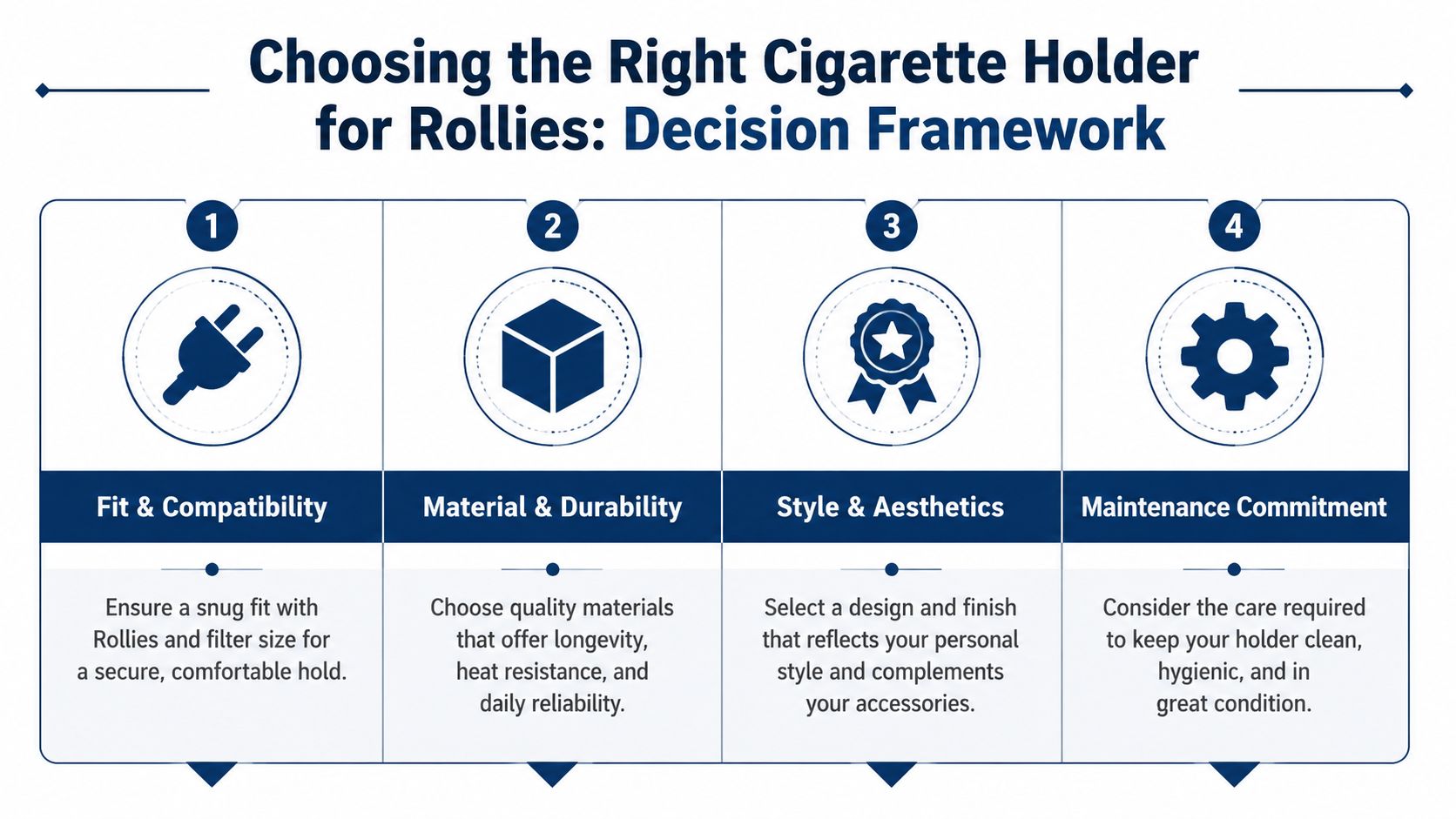
A good cigarette holder for rollies starts with the cigarette itself. The fit has to suit the diameter, paper type, and length you roll. If the bore is too tight, the paper creases. If it is too loose, the roll wobbles and draws poorly.
That is why I tell buyers to start with fit and compatibility, then choose material and durability for the way they smoke. A daily-carry metal holder needs different treatment from a wooden one that stays at home. Cleaning habits matter too, because a holder that is ignored will change taste and airflow before it wears out.
The mistakes are usually simple. People buy on looks alone. They choose a holder that suits short cigarettes, then try to force longer rollies through it. They also ignore how paper thickness and packing style affect the final fit.
If you want a steadier roll diameter, pair the holder with consistent tobacco such as 100 g Premium Rolling Tobacco (12 mg). Consistency in the tobacco makes the sizing test much clearer.
The easiest test is still the best one. Try the holder with a freshly rolled cigarette before you commit. In person, bring your own roll and check the fit there. Online, read the sizing notes carefully, confirm the return terms, and make sure the product suits your regular RYO setup before you buy. Australian accessory rules can affect what is stocked, so a holder that looks right on paper may not be the one that suits the way you roll. For a practical place to compare smoking accessories, visit Cheap Smokers.