

Cigarette Pack Sizes in Australia: What Changed in 2025
November 7, 2026If every legal pack now holds the same number of cigarettes, why do listings still show 20s, 25s, 30s and 200s side by side, and why doesn't the same count mean the same price per cigarette? That gap between a standard count and a standard cost is where most confusion about cigarette pack sizes starts.
Australia changed the question in 2025. You're no longer choosing mainly between different pack counts. You're checking whether a listing matches the current legal format, converting that format into a total, and then deciding whether the price for that total suits how much you'll smoke.
Older counts haven't vanished from search results, shelf labels or memory. Some are legacy formats, some describe cartons rather than packs, and some use shorthand that looks like a pack size when it's really a carton total. Read the unit first, the count second and the price third. That order prevents most mistakes.
Table of Contents
- Current Legal Pack and Carton Sizes in Australia
- How to Convert Packs, Cartons and Pouches into Cigarette Totals
- Old Pack Sizes and the 2025 Transition
- Why Pack Size Does Not Settle the Cost Per Cigarette
- Reading Pack Counts and Specifications on Product Listings
- Choose the Format That Fits and Buy Within the Legal Range
Current Legal Pack and Carton Sizes in Australia
Use this table as your first check. Find the format named in a listing, compare its count or weight with the legal quantity, and flag anything that doesn't match.
Legal cigarette and tobacco formats in Australia from 1 July 2025
| Format | Legal quantity | Rule | Notes |
|---|---|---|---|
| Cigarette pack | 20 cigarettes | Standard retail unit | All sticks have equal length and width |
| Carton | 10 packs (200 cigarettes) | Standard carton | A carton is defined as 10 packs holding 200 cigarettes |
| Filtered or little-cigar pack | 20 units | Standard pack count | Applies to products sold from 1 July 2025 |
| Roll-your-own pouch | 30 grams | Standard pouch weight | Cigarette yield depends on roll weight |
What Each Row Means
A cigarette pack is the retail unit you'll carry and open. It holds 20 cigarettes, so a listing that calls something a pack but gives a different current count needs a closer check. Don't assume a larger number means a larger legal pack. It may describe several packs, a carton or old stock.
A carton isn't a vague bulk box. The 2025 rules define a carton as 10 packs, and because each pack holds 20, the carton holds 200 cigarettes. That's why you'll see listings written as 10 packets x 20s or 200s carton. Both forms should lead to the same total if they're describing the standard carton.
Filtered and little-cigar products follow their own pack rule, and the Australian Department of Health tobacco changes page states that from 1 July 2025, filtered and little-cigar packs sold in Australia must contain 20 cigars. Treat that 20 units figure as the pack count for those products, not as a cigarette count.
Roll-your-own tobacco works by weight, not sticks. From 1 July 2025, roll-your-own tobacco sold in Australia must be packaged in 30-gram pouches, a requirement published by the Australian Department of Health. A pouch therefore doesn't promise a fixed number of cigarettes. How many you roll depends on how much tobacco you put in each one.
How to Use the Table
Start with the noun in the listing. If it says pack, expect 20. If it says carton, expect 10 packs and 200 in total. If it says pouch, look for grams rather than sticks.
Then check the number beside that noun. A pack described as 25, a pouch described at a different standard weight, or a carton that doesn't break down into packs of 20 doesn't match the table. That doesn't tell you the full story by itself, because transition stock and overseas descriptions can linger online. It does tell you to pause and ask what unit is being sold and when it was supplied.
Practical rule: Match the name, count and weight together. A correct number attached to the wrong unit is still the wrong product description.
Keep this table open while you compare cigarette pack sizes. Once you've identified the legal format, the next job is arithmetic, turning packs and cartons into a total you can price fairly.
How to Convert Packs, Cartons and Pouches into Cigarette Totals
Conversion is simple once you refuse to mix units. Australia's 2025 rules standardise the retail unit at 20 cigarettes per pack, with a carton defined as 10 packs yielding 200 cigarettes, according to the Department of Health retailer FAQs on the 2025 changes. Work from the smallest named unit up to the total.
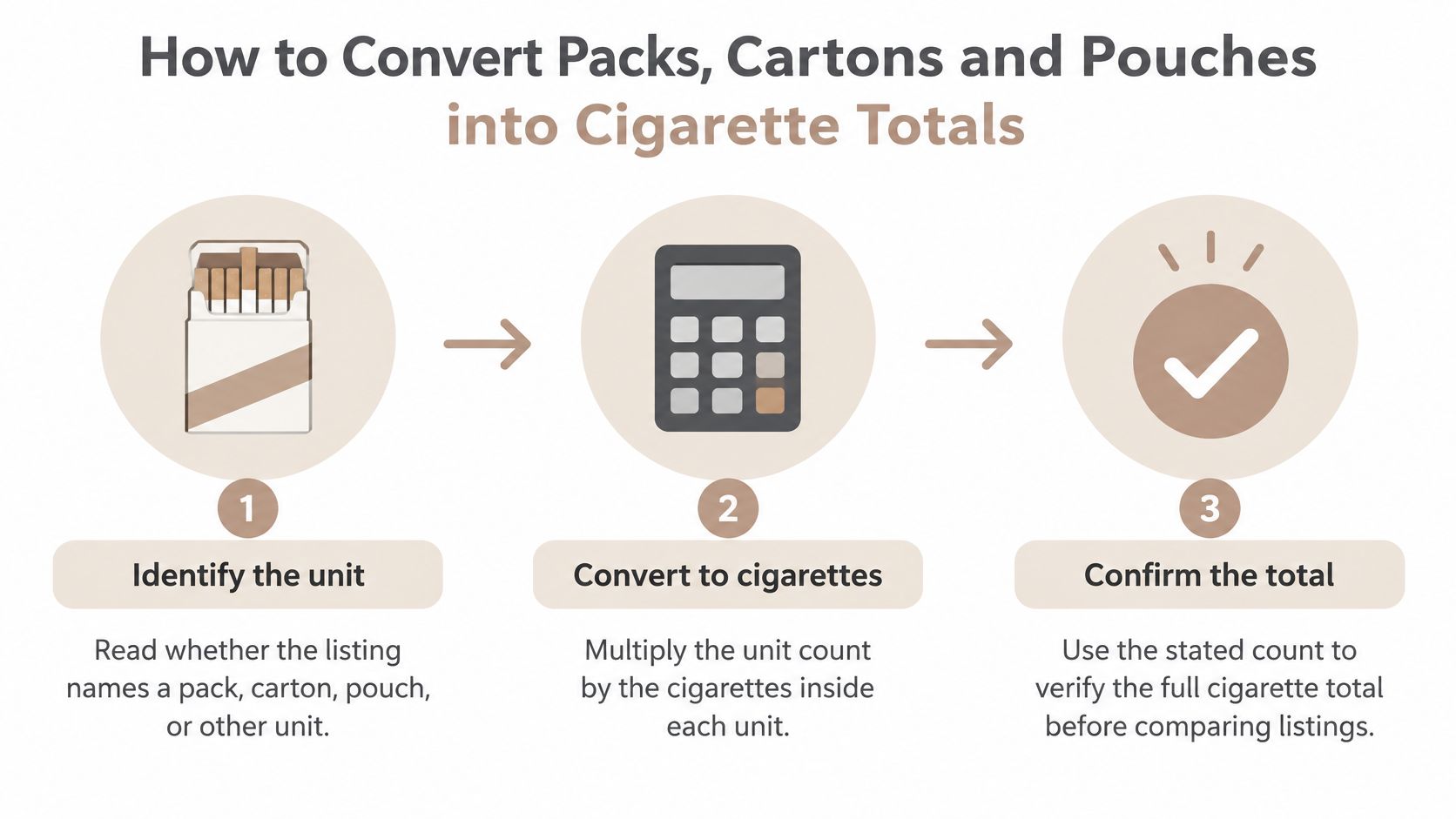
Six Steps That Prevent Miscounts
- Identify the unit first: Read whether the listing names a pack, carton, filtered or little-cigar pack, or pouch. Don't start with the biggest number on the page, because sellers often put the carton total in the title.
- Convert a carton by multiplication: Multiply 10 packs by 20 cigarettes to get 200 cigarettes. Two cartons therefore make 400 cigarettes, not 40 and not 200.
- Convert loose packs the same way: One pack totals 20 cigarettes. For a bundle, multiply the number of packs by 20, so three packs total 60 and five packs total 100.
- Treat a pouch as an estimate: A 30-gram pouch doesn't convert to one fixed cigarette count. Your roll weight and technique change the yield, so write any pouch total as your estimate, not as a guaranteed equivalent.
- Flag non-standard counts: Counts such as 21, 23, 25 or 30 in a pack listing don't match the current standard. Check whether you're looking at legacy stock, an old product page or a description copied from another market, and check the supply date before you rely on it.
- Confirm before you compare price: Count the packs, multiply, and only then divide the price by that total. Comparing a carton price with a single-pack price without converting both makes the cheaper looking option meaningless.
Say a listing says 200s carton and another says 10 packets x 20s. They're describing the same standard total in different shorthand. The first gives you the finished total, the second gives you the working. If a third listing just says 20s, that's one pack unless the page clearly states how many packs are included.
Pouches need extra care because weight can look deceptively precise. If you're comparing pouch prices with manufactured cigarettes, our guide to the price of a pouch of tobacco in Australia helps you keep the weight, your usual roll size and the total spend separate. Don't let a seller's suggested yield replace your own rolling pattern.
Before you buy, say the calculation out loud in plain form. Ten packs times twenty equals two hundred. If the listing's headline total doesn't match your multiplication, trust the arithmetic and ask which part of the description is wrong.
Old Pack Sizes and the 2025 Transition
The timing rule comes first. From 1 July 2025, every cigarette pack sold in Australia must contain exactly 20 cigarettes, each carton must contain 10 packs, and filtered or little-cigar packs must contain 20 units, under reforms described by the Australian Department of Health. Products supplied or sold after the full commencement date must comply.
Older counts did not vanish overnight. Packs of 25, 30 or 40 sticks can still turn up during the transition period, in old catalogue data, or in photos and titles that never got updated. Treat a legacy number in a listing as a description of stock that already exists, and confirm the details with the seller before you rely on the count.
Why Australia Had So Many Counts
Australia's market was unusually varied for decades. Packs containing 25 cigarettes appeared during the 1970s, while 30, 35, 40 and 50 cigarette packs entered progressively over the following two decades, and by the period covered in recent Australian research the legal market included packs of 20, 21, 22, 23, 25, 26, 30, 35, 40, 43 and 50 cigarettes. So called bonus formats such as 21s and 26s appeared particularly in value and super-value brands, where an extra stick or two positioned the pack as better value without turning it into a different kind of product, as documented in Australian research on pack size and pricing published in BMC Public Health.
That variety was not random. Count worked like a dial manufacturers could turn: a bigger pack changed the upfront price, the effective price per cigarette and how many cigarettes a smoker had immediately at hand. Once plain packaging removed most other ways to make one product look different from another, the count itself carried more of the signalling work.
If you meet numbers like 21 or 26 in an old listing today, read them as historical pack counts, not as current standard formats.
What the Market Looked Like After 2012
Plain packaging did not immediately reduce Australia to one count. In price-board observations after December 2012, packs of 20 remained the dominant format, packs of 22 represented 7.8% of observed products, packs of 25 represented 5.7%, packs of 23 represented 2.0%, packs of 26 represented 1.3%, and packs of 21 represented 0.2%, with only two packs of 30 recorded, according to Tobacco in Australia on factors influencing tobacco prices.
Legacy pack sizes in the Australian market
| Pack size | Status before the 2025 reset | Observed share after 2012 |
|---|---|---|
| 20 | Minimum legal factory-made pack | Dominant format |
| 21 | Legal, sold as a bonus format in value brands | 0.2% |
| 22 | Legal pack count | 7.8% |
| 23 | Legal pack count | 2.0% |
| 25 | Legal pack count | 5.7% |
| 26 | Legal, sold as a bonus format in value brands | 1.3% |
| 30 | Legal pack count | Two packs recorded |
| 35 | Legal pack count | No share reported in those observations |
| 40 | Legal pack count | No share reported in those observations |
| 43 | Legal pack count | No share reported in those observations |
| 50 | Legal pack count | No share reported in those observations |
Read the table as a map of what you may still encounter in old descriptions, not as a menu of formats you should expect to buy now. A legacy count still tells you how many cigarettes were in that pack, so you can convert an old bundle description directly. Five old packs of 25, for example, describe 125 cigarettes in total, even though that pack count isn't the current standard.
An old count in a listing is information about the pack that was described. It isn't proof that the same count is a current compliant retail format.
The 2025 reset therefore solves one problem and leaves another untouched. It removes pack count as a legal shopping choice for standard cigarettes, since every compliant pack now holds the same twenty. What it cannot do is make every brand, carton or pouch cost the same per cigarette, and it offers no answer to why two products with identical totals can carry very different prices.
Why Pack Size Does Not Settle the Cost Per Cigarette
Bigger used to look like an easy answer. Buy more sticks in one transaction, pay less for each stick, save money. That reasoning misses two things. A larger quantity also puts more cigarettes within easy reach, and standardising the count doesn't standardise brand pricing, retailer pricing or how much you'll smoke.

Australian buying patterns show why shoppers chased larger formats and roll-your-own tobacco when prices rose. An Australian longitudinal study of approximately 5,452 smokers with 11,534 observations from 2007 to 2020 found price-minimising behaviour increased over time, with roll-your-own purchasing rising from 23.8% to 43.9%, as reported in the study indexed on PubMed. That's evidence of people searching for a lower cost route, not proof that the largest quantity always produced the best financial outcome.
Do the Unit Price Calculation Properly
Divide the total price by the total number of cigarettes after you've converted the unit. A carton price divided by 200 gives a cost per cigarette. A single pack price divided by 20 gives a comparable figure. Only those two results belong side by side.
Don't compare headline prices across different totals. A carton will almost always look expensive beside a pack, and a pack will look cheap beside a carton, because you're not buying the same amount. The useful question is narrower. What does one cigarette cost in each option, and how much cash must you hand over today to get that rate?
If you're checking a specific brand, a current breakdown such as our Manchester cigarette pack and carton price guide is useful only after you've confirmed whether each price refers to a pack or a carton. Brand and variant still matter after standardisation. Two standard cartons can contain the same 200 cigarettes and cost different amounts.
Where the Pouch Comparison Breaks Down
A 30-gram pouch can't be divided as cleanly. You know the weight and the price, so you can calculate cost per gram. You don't know a universal cost per cigarette until you know how much tobacco goes into each cigarette you roll.
Use your own pattern if you're comparing a pouch with manufactured packs. If you roll lightly, your estimated yield will be higher. If you roll more heavily, it'll be lower. Either way, label the result as an estimate and don't compare it as though it were a printed pack count.
Standardisation hasn't removed affordability pressure. It's removed one set of size based strategies that smokers and manufacturers used to respond to that pressure. Before you choose the lowest unit price, ask whether buying that quantity matches what you'll smoke in the period you have in mind, or whether the saving depends on having many more cigarettes at hand.
Reading Pack Counts and Specifications on Product Listings
Counts tell you how many. Physical specifications help you check whether the thing described looks like a standard Australian pack at all. Government packaging guidance requires 20 cigarettes in rigid cardboard with a single flip-top lid hinged at the back, rectangular surfaces meeting at 90-degree angles, and closed dimensions of approximately 85 to 90 mm high, 55 to 60 mm wide, and 20 to 24 mm deep, according to the Department of Health guide to tobacco packaging requirements.
Physical pack specifications under Australian packaging rules
| Specification | Requirement |
|---|---|
| Cigarettes per pack | 20 |
| Lid | Single flip-top lid hinged at the back |
| Construction | Rigid cardboard with rectangular faces meeting at 90 degrees |
| Height (closed) | Approximately 85 to 90 mm |
| Width (closed) | Approximately 55 to 60 mm |
| Depth (closed) | Approximately 20 to 24 mm |
| Outer finish | Standardised dark-brown matte surfaces |

Those narrow dimensions aren't trivia. They create a predictable footprint for shelves, storage bins, shipping cartons and pick-and-pack work. For you as a buyer, they also explain why standard packs feel so uniform. Unusual geometry, decorative shaping or a novelty opening isn't a sign of a premium Australian variant. It's a reason to question whether the image matches the product being supplied.
Colour won't rescue you either. Outer surfaces are standardised, brand imagery and promotional text are prohibited, and health warnings are prominent. In a listing, rely on the permitted brand name, variant name and count, not on colour cues copied from overseas packaging.
A Five Point Listing Check
- Count the unit: Confirm whether the page is selling a pack, several packs or a carton, then match it against the legal table.
- Read the shorthand: 20s means 20 in the named pack, an old 25s description means 25 in that legacy pack, and 200s usually signals a carton total rather than one giant pack.
- Find the variant name: Check that the brand and variant in the title match the option you've selected, especially where several variants share one page.
- Match price to unit: Make sure the price beside the buy button belongs to the same quantity you've just converted, as shown in a listing such as Manchester Red 10 packets x 20s.
- Flag the mismatch: If the count, image and price point to different units, stop and clarify which one will be sent.
End with one direct question. Does this listing match the legal counts and the physical description, and if not, what unit is being sold?
Choose the Format That Fits and Buy Within the Legal Range
Choose from your smoking pattern, not from the largest number on the page. Three questions do most of the work. Is the unit within the current legal range, how many cigarettes does it hold in total, and does its unit price suit how much you'll smoke in the time you have?
Match the Format to the Pattern
A single pack suits a short, defined need. You pay for 20 cigarettes, carry 20 cigarettes and know exactly when that purchase is finished. It's the clearest format if you don't want a large quantity at home or you're trying a variant for the first time.
A carton suits a regular pattern you've already settled. You're buying the standard 200-cigarette unit, so compare its total and cost per cigarette with the single pack option using the conversion you've already done. Don't buy the carton just because the per-cigarette figure is lower if the quantity itself doesn't fit.
A 30-gram pouch suits a roll-your-own smoker who knows their own roll size. Compare pouches by weight and price per gram first. Then use your typical yield to estimate cost per rolled cigarette, and keep that estimate separate from the printed counts on manufactured packs.
Pick the quantity you'd choose if the price per cigarette were identical. Then check whether the real price changes that decision for a good reason.
When you're ready to browse by brand, Cheap Smokers lists brands including Benson & Hedges, Marlboro, Winfield and Palmers, among a wider catalogue you can search or browse by brand. Use the brand and variant names to narrow the list, then return to the format check before you look at price. That order stops a familiar brand name from hiding a unit mismatch.
Finish with the same checks every time, whatever cigarette pack sizes a search page throws at you. Identify the unit against the legal table, confirm how many packs are included if it's a carton, convert to a total, and choose the format that matches what you'll smoke. If any one of those answers is unclear, the listing hasn't earned your purchase yet.
Browse standard packs and 200-cigarette cartons by brand and variant at Cheap Smokers, then check each listing's unit, pack count and total before you compare its price per cigarette. Use the legal table and conversion steps above as you shop, and choose the format that fits your actual smoking pattern rather than the biggest headline number.