
Rolling Tobacco Brands Australia: Sizes and Buying Checks
November 21, 2026The proportion of Australian smokers who smoked roll-your-own cigarettes exclusively rose from 5.7% in 2001 to 16% in 2022–2023, according to the Australian Institute of Health and Welfare. That shift makes loose tobacco an important category to understand, but it doesn't establish which brand is preferable, which listing is lawful or which pack represents better value.
For adults comparing rolling tobacco brands in Australia, the useful starting point isn't a familiar name or a claimed strength. It's whether the product can be verified as legally supplied, followed by how much tobacco the listed pack contains. Brand, variant and price only become meaningful once those foundations are clear.
Table of Contents
- Rolling Tobacco Brands and Pack Sizes at a Glance
- Loose, Pre-Filled and Manufactured Tobacco Compared
- Brand Entries for Loose Rolling Tobacco
- What the 8mg and 12mg Strength Labels Mean
- Storage and Freshness for Loose Tobacco
- Pack Size Trade-Offs and Tobacco Content
- Buyer Checks for Legal Rolling Tobacco
- Choose a Legal Pack Size Before You Order
Rolling Tobacco Brands and Pack Sizes at a Glance
Loose rolling tobacco listings by product, strength and pack size
| Product line | Strength | Pack size | Tobacco content |
|---|---|---|---|
| Premium Rolling Tobacco RYO | 8mg | 100g | 0.10 kg |
| Premium Rolling Tobacco RYO | 8mg | 250g | 0.25 kg |
| Premium Rolling Tobacco RYO | 8mg | 1000g | 1.00 kg |
| Premium Rolling Tobacco RYO | 12mg | 100g | 0.10 kg |
| Premium Rolling Tobacco RYO | 12mg | 250g | 0.25 kg |
| Premium Rolling Tobacco RYO | 12mg | 1000g | 1.00 kg |
| Premium Rolling Tobacco RYO | Unconfirmed | 50g Bulk Buy x5 | 0.05 kg per pack, 0.25 kg for the bundle |
| Golden Virginia | Unconfirmed | 500g | 0.50 kg |
| Golden Virginia | Unconfirmed | 2kg | 2.00 kg |
The table records catalogue descriptions, not independent confirmation of the products' composition, packaging compliance or duty status. Unconfirmed means the listing doesn't state a strength. It doesn't mean the product has no strength, nor does it justify assigning a number from another product.
Expressing every quantity as tobacco-content kilograms removes a common source of confusion. A bundle describes the way packs are grouped for sale, whereas a weight describes the contents. Neither description, on its own, tells you whether the asking price is reasonable.
How to read the listings
- Keep the label attached to its product line. A strength description under Premium Rolling Tobacco RYO shouldn't be transferred to Golden Virginia or an unlabelled bundle. Matching numbers across different lines wouldn't establish matching composition or experience either.
- Treat availability as a snapshot. Confirm the selected variant, quantity and stock status on the live product page before paying. A category tile, search result and checkout description should identify the same item.
A useful comparison record has separate fields for the product line, displayed strength, individual pack weight and total order weight. Keeping those fields separate prevents a bundle from being mistaken for a single pouch. It also makes discrepancies easier to describe if the delivered order doesn't match the listing.
Practical rule: Compare the contents you're buying, not the size of the product photograph or the prominence of a bulk-buy label.
What the table doesn't establish
The listings don't provide a verified basis for ranking these products by taste, consistency, freshness or health risk. A product name isn't evidence of leaf origin, and a large listed quantity doesn't establish whether the order arrives as a single retail pouch or several compliant packs.
Before committing to a bulk quantity, confirm the retail pack configuration. That matters for checking the packaging on delivery and for planning how much tobacco would be exposed each time a pack is opened.
This lookup covers loose tobacco only. Pre-filled and manufactured cigarettes require different sale-unit comparisons, while the pack-lasting calculation uses loose tobacco weight rather than carton count.
Loose, Pre-Filled and Manufactured Tobacco Compared
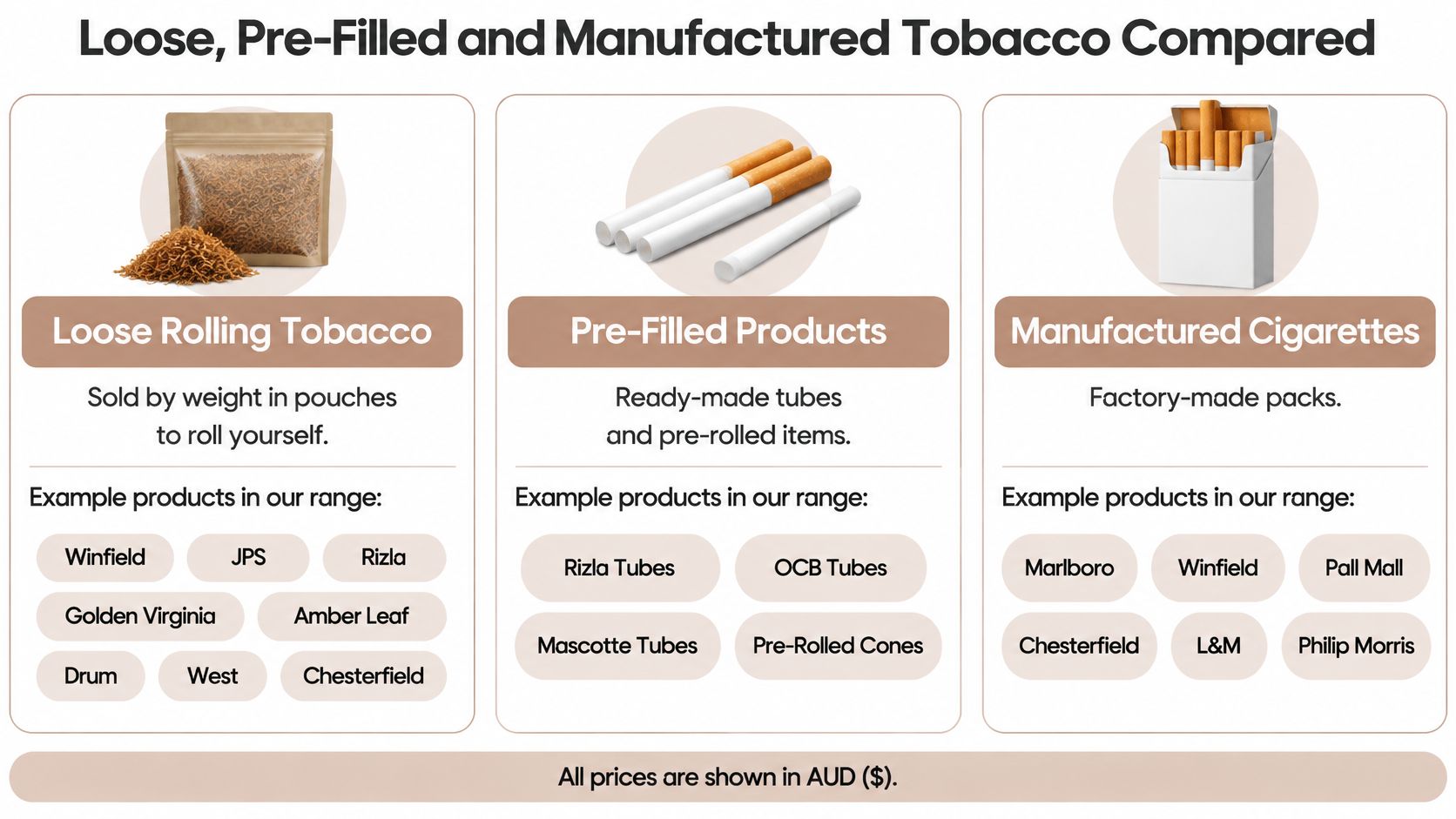
Identifying the format prevents an apparently straightforward brand comparison from becoming misleading. A pouch, a ready-filled carton and a carton of factory-made cigarettes aren't interchangeable units, even when the listings appear beside each other.
Tobacco formats and what each one covers
| Format | Sold as | Examples in the range |
|---|---|---|
| Loose rolling tobacco | Pouches or listed quantities sold by weight, including 50g, 100g, 250g and 1000g | Premium Rolling Tobacco RYO 8mg and 12mg; Golden Virginia 500g and 2kg |
| Pre-filled cigarettes | Ready-filled cartons | Palmers and Rollo, including blue, red, charcoal-filter and menthol variants |
| Manufactured cigarettes | Cartons of ten packets of twenty | Benson & Hedges, Winfield, Holiday, Marlboro |
| Cigars and cigarillos | Sale units and sizes unconfirmed | Described in site copy, but no individual listings established in this catalogue snapshot |
Compare like formats
With loose tobacco, the primary quantity is the declared tobacco weight. With pre-filled and manufactured products, the immediate comparison is the stated carton contents and exact variant. Don't infer the tobacco weight of a carton from its stick count.
The term pre-filled also deserves attention. Confirm what the seller means and what the carton contains rather than assuming it describes an empty tube, a loose-tobacco accessory or a particular manufacturing process. The product description should settle the format before price comparisons begin.
Cigars and cigarillos require their own product information. A general reference to a category doesn't establish an available size, quantity or brand, so assigning a sale unit would create detail the listings don't support.
Plain packaging isn't optional presentation
The Department of Health's plain-packaging guide for non-cigarette tobacco products specifies Pantone 448C, prescribed health warnings and controlled brand and variant presentation; for loose processed tobacco, it also specifies a largest pack dimension of at least 85 mm and a second-largest dimension of at least 55 mm.
Those requirements change how buyers should interpret product photography. A colourful promotional image isn't proof of the physical retail pack you'll receive. Equally, plain appearance is expected and shouldn't itself be treated as evidence of poor quality or illicit supply.
For a retailer, each variant needs its own packaging check. The pouch, warning panel, permitted wording and tobacco category must correspond to the actual item being supplied, not merely to a generic image used across a category.
The buyer checklist applies that packaging scrutiny alongside seller and purchase-channel checks across formats.
Brand Entries for Loose Rolling Tobacco
A brand entry is most useful when it separates what's stated from what remains unknown. Neither a recognisable name nor a house-line description supplies missing evidence about composition, provenance or legal compliance.
Market concentration adds another reason not to confuse brand familiarity with independent choice. Imperial Brands held 46.1% of Australia's loose-tobacco category by volume in 2023, according to Tobacco in Australia's industry analysis. That's a company-level market measure, not a quality ranking or a sales figure for either listing below.
Premium Rolling Tobacco RYO
What it is. Premium Rolling Tobacco RYO is the catalogue's house-line description for loose tobacco. The word premium forms part of the product name; it shouldn't be read as independent certification of quality.
Listed sizes. The entry covers two displayed strengths, 8mg and 12mg, each offered at 100g, 250g and 1000g. A separate 50g Bulk Buy x5 bundle sits alongside them, and its title doesn't establish which strength it contains.
Who might consider the format. For an existing adult smoker making a catalogue comparison, the 100g size limits the amount committed to an unfamiliar product. The 250g and 1000g options involve a separate storage and total-cost decision, not just confidence in the name.
What the listing doesn't tell you. The displayed strength doesn't establish nicotine delivery, subjective experience or relative safety. Nor does the name substantiate a particular blend recipe, moisture condition, cut consistency or leaf origin.
- Carry-forward check: Match the exact variant and pack configuration to an actual Australian-compliant retail pack before treating the entry as a purchasing option.
Golden Virginia
What it is. Golden Virginia appears as a named loose-tobacco line. A brand name alone doesn't confirm which variant is supplied or whether a photographed overseas pack represents an Australian retail presentation.
Listed sizes. The entry lists 500g and 2kg quantities, both bulk amounts rather than small comparison packs. Establish whether those weights describe a single retail pack or an order assembled from several packs.
Who might consider the format. An existing user evaluating a familiar, clearly identified variant may be able to assess the practicality of a larger order. Someone without that product familiarity has more unanswered questions than the weight alone resolves.
What the listing doesn't tell you. Strength is unconfirmed. Don't infer flavour, additives, composition or a safety advantage from the word Virginia.
The Golden Virginia variants and buying guide provides a focused reference for identifying variant questions, but the exact live listing and delivered pack still need to agree.
- Carry-forward check: Confirm the full variant name, sourcing information and retail pack arrangement before comparing the total quantity.
What national smoking figures can establish
Population surveys describe how people smoke, not which listed product performs better. They can't rank these entries by satisfaction, establish current brand availability or validate a seller's stock.
A catalogue identifies options. It doesn't certify them.
What the 8mg and 12mg Strength Labels Mean
A displayed strength number isn't a reliable forecast of experience or risk. Treating it as a direct measure creates two errors: assuming the higher number is better value and assuming the lower number is a safer choice.
The listing material doesn't establish what these numbers measure, how they were determined or whether they describe the legally permitted wording on the physical pack. Without that information, interpreting them as a verified nicotine dose would go beyond the evidence. No tobacco product is safe.
The broader health context also matters. The Australian Government's smoking-rate announcement reports that daily smoking among Australians aged 14 and over fell from 8.3% in 2022–23 to 5.6% in 2025. That's population-level evidence about smoking prevalence, not evidence that a lower-numbered tobacco variant reduces harm.
Separate identity from interpretation
Use the displayed number to distinguish catalogue entries, not to calculate exposure. If the seller can't explain the description or provide the corresponding compliant pack information, there's an unresolved product-identification issue.
A same-weight pouch under each displayed strength may contain equal amounts of tobacco by weight. That doesn't establish equal experience, and the difference between the labels doesn't establish a proportional difference in nicotine exposure.
For an existing smoker reviewing options, a neutral comparison record should capture:
- Exact identity. Record the product line and variant wording without translating the number into a health claim.
- Missing information. Note whether composition, manufacturer details and packaging information are available.
- Comparable cost. Keep price comparisons within a clearly identified line and variant rather than treating strength as extra product.
- Purchase limits. Don't commit to a larger quantity to resolve uncertainty that the seller should answer first.
Don't use a smoking trial as a safety test
Using a product for a set period won't establish whether it's safe, and a comfortable or familiar sensation doesn't demonstrate lower harm. There's no need to increase consumption, finish a pouch or continue smoking to complete a comparison.
Health boundary: Personal preference and health protection are different questions. A strength label can't answer the second.
If you're seeking to cut down or quit, speak with a GP or Quitline about support rather than switching labels in the expectation of reducing risk. Product descriptions aren't a substitute for advice about dependence or cessation.
Storage and Freshness for Loose Tobacco
A bulk quantity is only practical if you can keep the contents properly stored. The relevant comparison isn't just the tobacco weight purchased, but the amount that remains usable without deterioration or avoidable loss.
Storage advice doesn't establish a shelf life. Follow any manufacturer instructions, and don't assume that keeping a pouch sealed indefinitely guarantees its condition.
Keep the original packaging and control exposure
- Reseal after access. Keep tobacco in its original labelled packaging rather than leaving it in an open bag or unlabelled tin. If you use a secondary container, retain the original pack and warnings with it.
- Choose a suitable location. Store the closed pack away from direct sunlight, heaters, damp areas and places with large temperature changes. Avoid kitchen steam and wet surfaces.
- Record opening order. Mark the opening date without obscuring required information, and use already-opened stock before opening another pack.
- Track actual losses. Note discarded material and spillage separately from consumption. Don't count the full labelled weight as usable if some of it has been lost.
Keep tobacco inaccessible to children and pets. Storage convenience shouldn't mean leaving an open pouch within easy reach on a table or in an unsecured drawer.
Don't turn storage into an improvised treatment
Adding fruit peel, water or other household materials introduces uncertainty rather than restoring a verified product condition. If tobacco appears mouldy, contaminated or otherwise abnormal, don't try to make it usable by drying or mixing it.
Avoid assigning a universal freshness deadline. The information available here doesn't establish how long any listed product will retain its condition after opening, so a promised duration would be misleading.
- For occasional access: Prefer a pack arrangement that doesn't require repeatedly opening the entire order.
- For limited storage space: Assess the sealed retail packs you'll receive, not just the headline order weight.
- For any bulk order: Decide where it will be stored before considering a lower unit price.
A smaller commitment can be more practical than a nominally economical bulk order. If you can't store the larger quantity appropriately, its price per kilogram isn't a sufficient reason to choose it.
Pack Size Trade-Offs and Tobacco Content
Calculate the comparable cost before judging the pack size. The ticket price tells you the amount payable for a listing, but not the cost of an equivalent tobacco weight.
Build the comparison in order
- Normalise the weight. Convert the declared grams to kilograms and distinguish individual pack contents from total bundle contents. Use the tobacco-content column in the lookup rather than counting pouches.
- Calculate the unit price. Divide the current product price by its tobacco-content weight in kilograms. Keep the product line and variant fixed while comparing size options.
- Include the checkout total. Account for delivery and any applicable charges, and confirm whether displayed prices already include GST so it isn't counted twice. Only use a promotion if it applies to the selected order.
- Estimate the holding period. Divide pack weight by your existing weekly use, using the same weight unit throughout. Treat that result as a storage estimate, not a consumption target.
A calculation based on labelled contents assumes no loss. Where you've recorded wastage, compare the amount paid with the quantity usable rather than pretending the full purchase weight was consumed.
Excise explains why weight matters
The Australian Taxation Office's tobacco excise schedule states that duty rates increase in March and September through AWOTE indexation and lists $2,587.90 per kilogram of tobacco content from 1 September 2026 for tobacco not in stick form. That dated rate shouldn't be applied to another purchase period without checking the applicable schedule.
Excise is a tax component, not a complete retail-price quotation. Don't add it again to a duty-inclusive price, and don't assume a pouch's advertised price proves the correct duty has been paid.
The Drum tobacco price reference may help organise a separate brand-specific enquiry. It doesn't justify transferring another product's price, weight or availability to the entries in this lookup.
Choose a manageable quantity
Smaller packs reduce the amount committed before you've resolved product and storage questions. Their unit price may be higher, but that comparison needs the actual checkout figures.
Intermediate packs can be assessed against your recorded holding period and available storage. There's no evidence here for calling a particular size the best choice for most smokers.
Bulk quantities need the strongest justification: confirmed identity, a clear retail pack arrangement and suitable storage. A larger order isn't automatically better value, and increasing use to avoid wastage defeats the purpose of the calculation.
Buyer Checks for Legal Rolling Tobacco
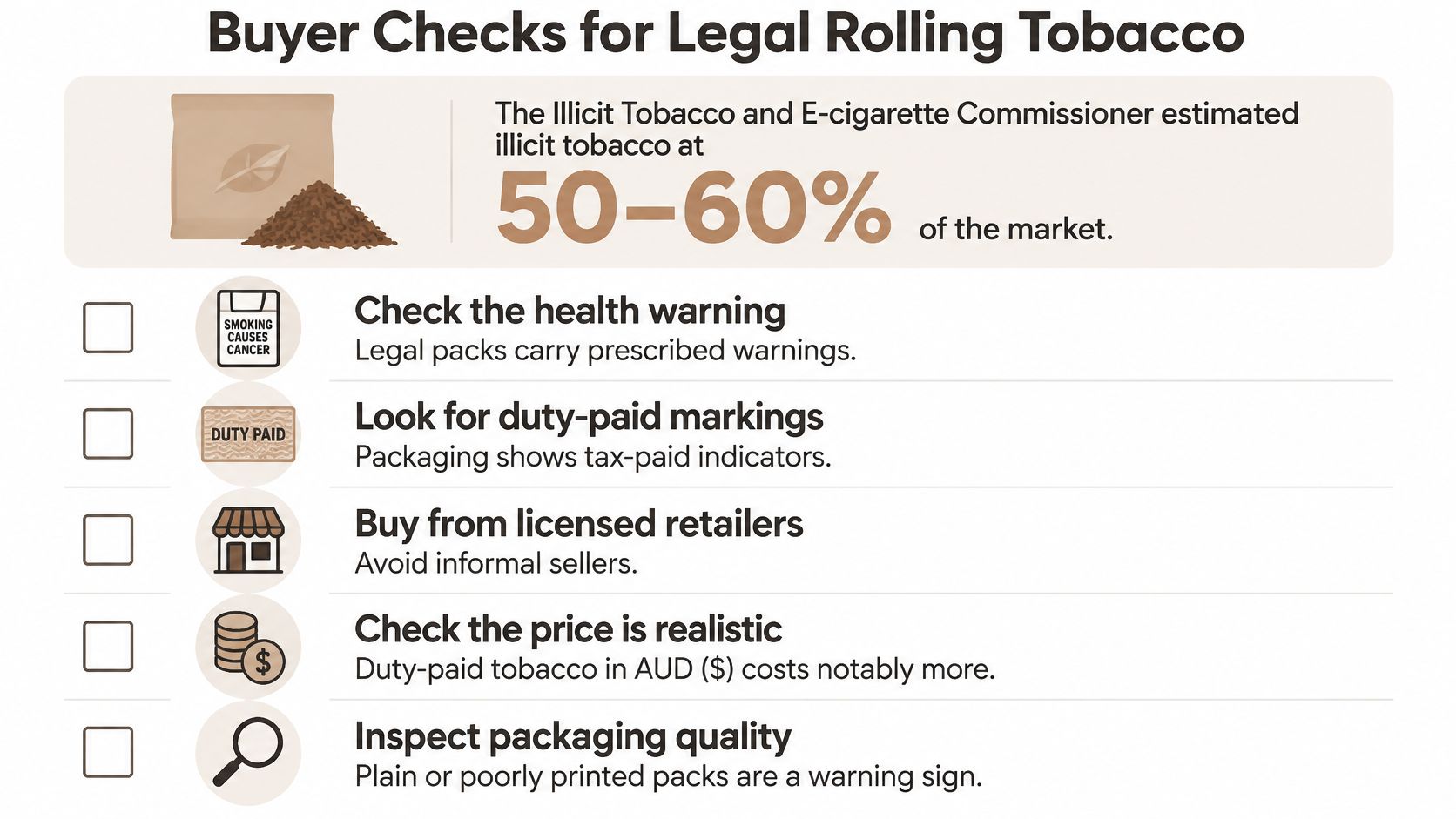
The Illicit Tobacco and E-cigarette Commissioner estimated that illicit tobacco represented 50–60% of Australia's tobacco market in 2024–25, according to material published by the Australian Parliament. That estimate makes provenance a central purchasing question, not a minor qualification after comparing brands.
A very low price can be a warning sign, but price alone can't establish legality. Neither can professional-looking photography, a familiar brand name or an age-confirmation screen.
Buyer checks for legal rolling tobacco
| Check | Compliant pack or listing shows | Warning sign |
|---|---|---|
| Packaging colour | Required plain-packaging colour and prescribed health warnings | Bright branding, logos or promotional imagery on the claimed Australian retail pack |
| Pack dimensions | Loose-tobacco packaging meeting the applicable minimum dimensions | An unusually small pouch with no way to establish compliance |
| Label text | Brand and variant names in the permitted format | Flavour, strength or health claims that aren't legally permitted |
| Price for weight | A transparent weight and price that can be assessed against applicable duty | An unusually low price without a credible explanation of lawful supply |
| Seller details | Named business, contact details and an age-verification process | Missing seller identity or no age confirmation |
| Purchase channel | Identifiable retailer, applicable licensing information, and an order record | Anonymous offers or transactions outside ordinary retail channels |
Treat warning signs as reasons to pause
Start with the seller's identity. You need a business name and a practical contact route if the goods don't match the description; an anonymous message thread isn't an adequate substitute.
Then examine the actual Australian retail packaging. Request clarification when a listing uses illustrative photographs rather than showing the presentation being supplied. Missing dimensions in an online description aren't proof of illegality, but unresolved packaging questions shouldn't be ignored.
Plain packaging is required, so plain appearance itself isn't suspicious. Poor printing, inconsistent warnings or unexplained presentation differences deserve scrutiny, but appearance alone can't authenticate a product.
Don't assume every lawful pack carries a universal duty-paid stamp. Packaging checks are useful screening tools, not conclusive evidence of tax payment, and retailer licensing requirements need to be checked for the relevant jurisdiction.
Keep verification separate from reassurance
Our purchasing process requires age verification before an online tobacco purchase. That process is necessary, but buyers should still examine product identity, packaging and order information rather than treating any single safeguard as complete authentication.
The online tobacco buying guide for Australia can help organise those transaction questions. No general guide can certify an individual pouch from a catalogue photograph.
- First, establish accountability. Confirm who is selling and which purchasing channel you're using.
- Next, resolve the product details. Check packaging information before payment and inspect the delivered retail packs.
- Then assess the price. Use the declared weight and applicable tax context rather than the discount description.
- Retain the evidence. Keep the listing, order confirmation and correspondence so discrepancies can be raised clearly.
Choose a Legal Pack Size Before You Order
A defensible choice is one you can explain from the product identity, legal-supply checks and quantity calculation. It doesn't require deciding which name sounds strongest or which photograph appears most appealing.
A storefront can help identify a listing, but it can't replace inspection of the actual product.
Use a deliberate decision sequence
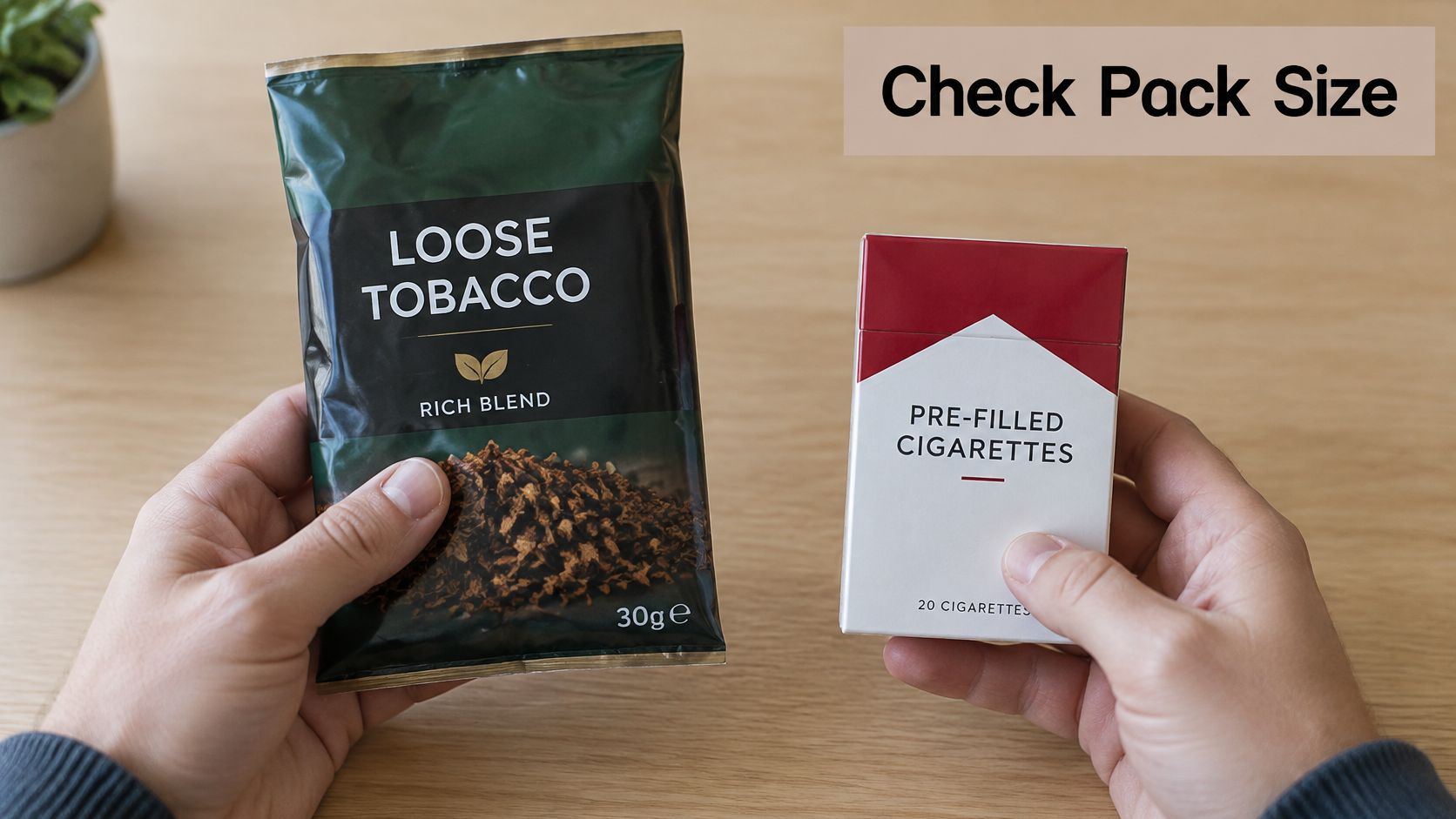
- Identify the format. Establish whether you're looking at loose tobacco, a pre-filled product or manufactured cigarettes. Reject comparisons that mix pouch weight with carton count without explaining the difference.
- Resolve the variant. Record the full product name and displayed description. If a strength is unconfirmed or its meaning isn't explained, leave it unresolved rather than filling the gap with an assumption.
- Select a manageable weight. Use your existing consumption record and storage capacity to assess the quantity. Don't increase the planned order merely to qualify for a bulk description.
- Complete the buyer checks. Establish seller identity, applicable licensing, packaging information and age verification before paying. An unresolved legal-supply concern takes priority over a favourable unit-price calculation.
- Save the transaction record. Keep the selected variant, quantity, final amount and correspondence. Check the delivered contents against that record before accepting a discrepancy as an equivalent substitution.
Decide what would stop the order
Set a clear boundary before reaching checkout. Missing product identity, contradictory weights, unclear pack configuration or an unexplained packaging mismatch are reasons to pause, not details to resolve after payment.
The same applies when a seller relies only on reassurance. A statement that a product is genuine doesn't answer a specific question about which variant, which retail pack or which quantity will arrive.
For adults who continue to purchase tobacco, the immediate task is to check the brand, variant and weight against the lookup, then complete the seller and packaging checks. A decision not to order is appropriate when essential information remains unavailable.
Our delivery service covers Australia-wide addresses, but confirm the current delivery terms and any collection arrangements before making plans. Don't infer dispatch timing from a product image, an old search result or a general service description.
The best-supported decision isn't necessarily the largest order. It's the one with no unresolved question about what is being supplied.
If your main concern is dependence, health or reducing smoking, a different pack size won't resolve it. Seek cessation support rather than treating a brand switch as a health intervention.
Cheap Smokers offers Australian and overseas tobacco brands, including loose rolling tobacco listings such as Premium Rolling Tobacco RYO and Golden Virginia. Visit Cheap Smokers to check current product descriptions and availability, and resolve the variant, weight and legal-supply questions before deciding whether to order.