
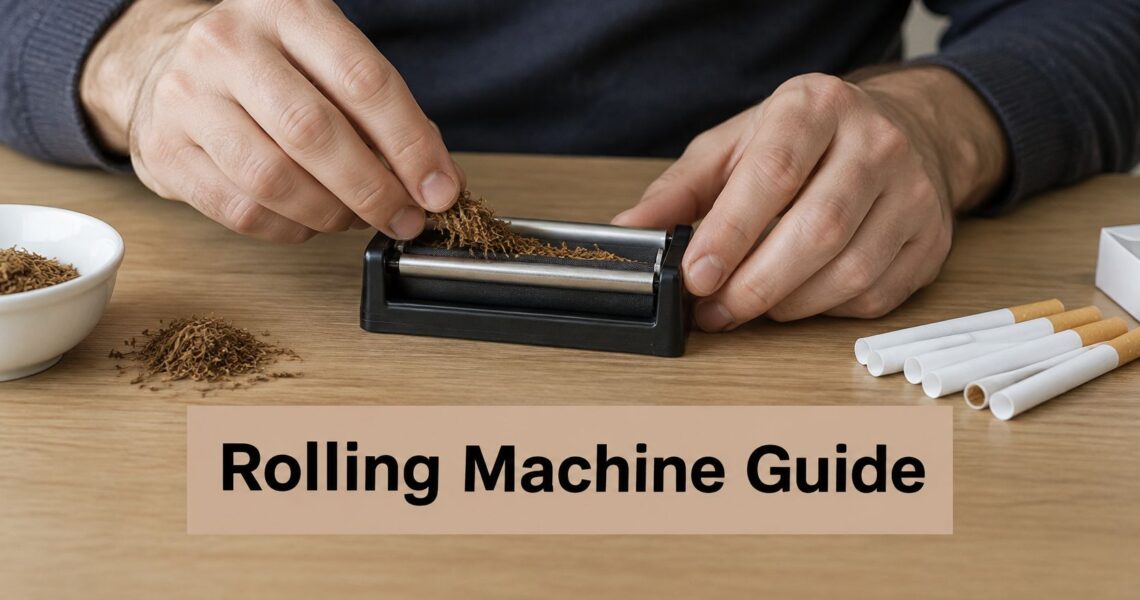
Cigarette Rolling Machine Guide for Australian Adults
November 21, 2026Is a cigarette rolling machine still cheaper if it uses more tobacco or leaves you throwing away partly filled tubes? That's the question a speed rating won't answer.
For Australian adults who already smoke, the useful comparison is cost per finished cigarette at excise-inclusive prices, not how quickly a machine moves tobacco. Choosing well means understanding the mechanism, checking compatible supplies and measuring usable output. A machine can change consistency and effort. It doesn't make smoking safer.
Table of Contents
- What a Cigarette Rolling Machine Does
- Types of Cigarette Rolling Machines Compared
- Features That Change the Final Cigarette
- Australian Rules Machine Users Must Know
- What a Machine Really Saves per Cigarette
- Choose, Use and Buy Safely
What a Cigarette Rolling Machine Does
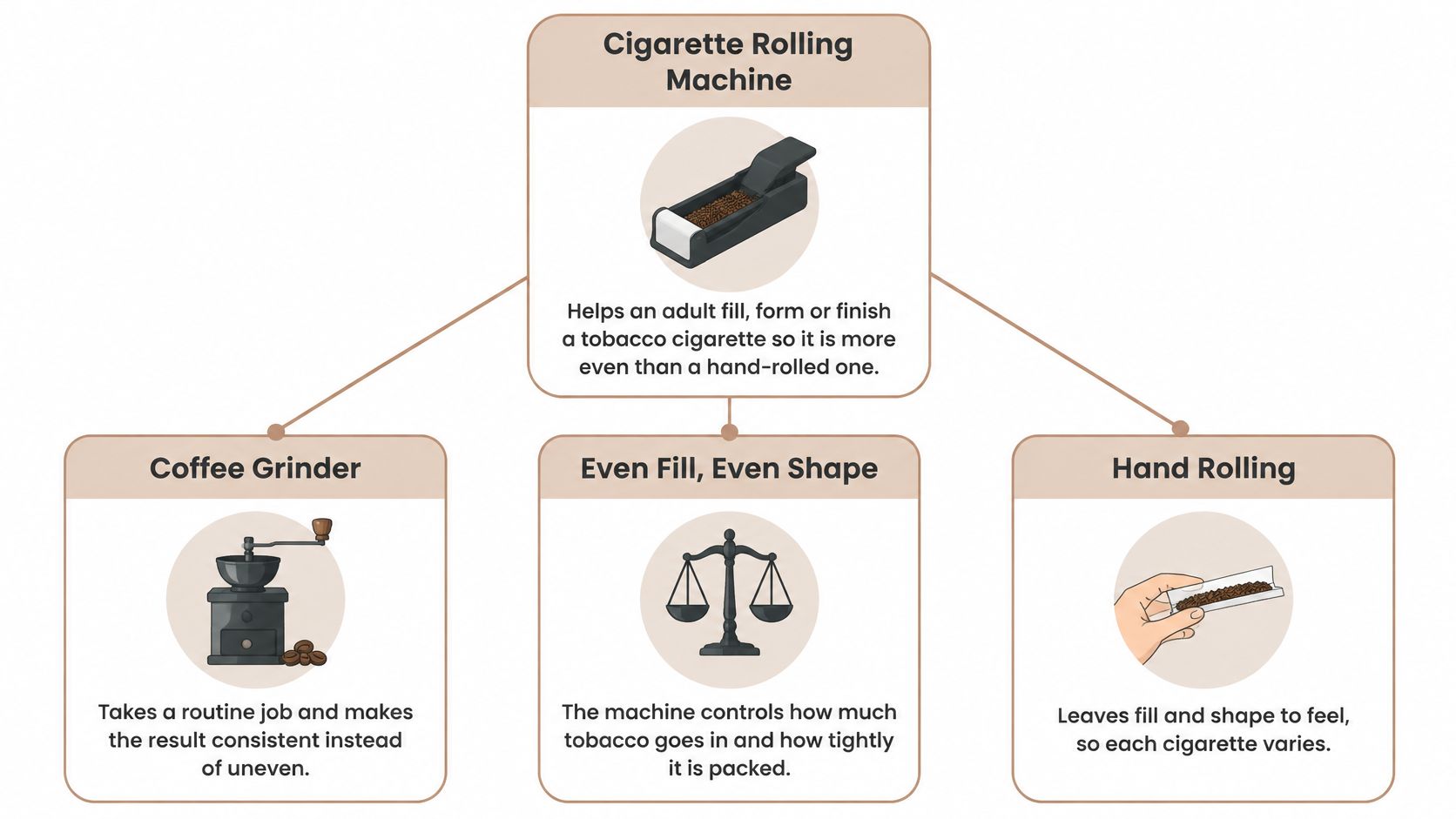
Say you're rolling by hand and the result keeps changing. One cigarette has a loose end, another feels tightly packed, and the next takes longer to shape. A cigarette rolling machine takes over part of that repetitive forming or filling work.
Think of an electric coffee grinder compared with grinding by hand. The equipment makes a routine task more repeatable, but you still choose what goes into it. Likewise, a cigarette machine doesn't choose the tobacco, paper or filter, and it doesn't guarantee an identical result regardless of what you load.
The basic relationship looks like this:
What happens inside
Most consumer devices perform some combination of these jobs:
- Hold the shape: A paper cradle or tube holder establishes the space available for tobacco.
- Move the tobacco: Rollers, a sliding mechanism or an injector distribute and compress the loaded tobacco.
- Finish the cigarette: A paper roller helps wrap the paper for sealing, while a tube filler leaves tobacco inside a ready-made paper tube.
That last distinction matters. A paper roller works with a loose sheet of cigarette paper. A tube filler works with a hollow cigarette tube, usually with a filter already attached. You can't assume the same supplies fit both.
Consumer equipment isn't factory machinery
Industrial cigarette machines automate production on a different scale. The Queen Victoria Museum and Art Gallery's history of Launceston tobacconists records that a cigarette machine in the early 1880s could produce more than 100,000 cigarettes per day, approximately the work of 60 people.
A small home device is better understood as a forming aid, not a miniature production line. If you already roll and want a more even fill, it addresses that task. If you buy finished cigarettes and don't intend to change that routine, you don't need one.
Types of Cigarette Rolling Machines Compared
Cigarette rolling machine types at a glance
| Machine type | Typical tube size | Filling method | Best suited to |
|---|---|---|---|
| Hand-operated tube filler | King size or longer tubes where supported | Manual tamping and sliding | Occasional use on a low budget |
| Electric tube filler | King size or longer tubes where supported | Motorised packing, with adjustable fill on equipped models | Regular use with less hand effort |
| Injector machine | Model-specific tubes | Plunger pushes tobacco into the tube | Batch preparation at home |
| Commercial automated pre-roll machine | Model-specific | Automated forming, filling and cutting, according to configuration | Commercial operations, not personal use |
These are equipment categories, not model-specific performance promises. The names also overlap. An injector can be hand-operated or electric, so a listing that says injector doesn't tell you whether it has a motor.
For any model, check the manufacturer's specification rather than assuming that the category guarantees a particular feature. Some devices have a fill adjustment; others rely on how you distribute tobacco in the chamber.
Match the mechanism to the job
For occasional use, a hand-operated filler avoids batteries, a power supply and motor-related maintenance. You still do the loading and operate the lever or slide, but there's less equipment to manage.
An electric model reduces repetitive hand movement. That can be useful for regular preparation, although you'll still need to load correctly, remove completed cigarettes and clear the mechanism. Electric doesn't mean unattended.
An injector pushes a prepared tobacco charge into a tube. Its appeal is repeatability when preparing a batch, provided the tube sits properly on the nozzle and the tobacco chamber isn't overloaded.
Commercial automated equipment belongs in a separate buying discussion. A machine described as a pre-roll machine may be designed for a different material or paper format altogether. Don't treat that label as proof that it's suitable for tobacco cigarettes or lawful retail production in Australia.
Buying rule: Choose a machine that accepts your intended consumables, not consumables you hope will fit a machine you've already bought.
Check the parts you'll actually handle
Look closely at the tube holder, filling chamber, lever and cleaning access. A removable tray is useful only if you can also reach the places where tobacco fragments collect.
Ask whether replacement tube holders, seals or injector parts are available for the exact model. Check how a jam is cleared and whether doing so requires tools or dismantling the housing.
A high advertised output won't compensate for incompatible tubes or an awkward cleaning process. Compare compatibility, maintenance and parts support before headline speed.
Features That Change the Final Cigarette
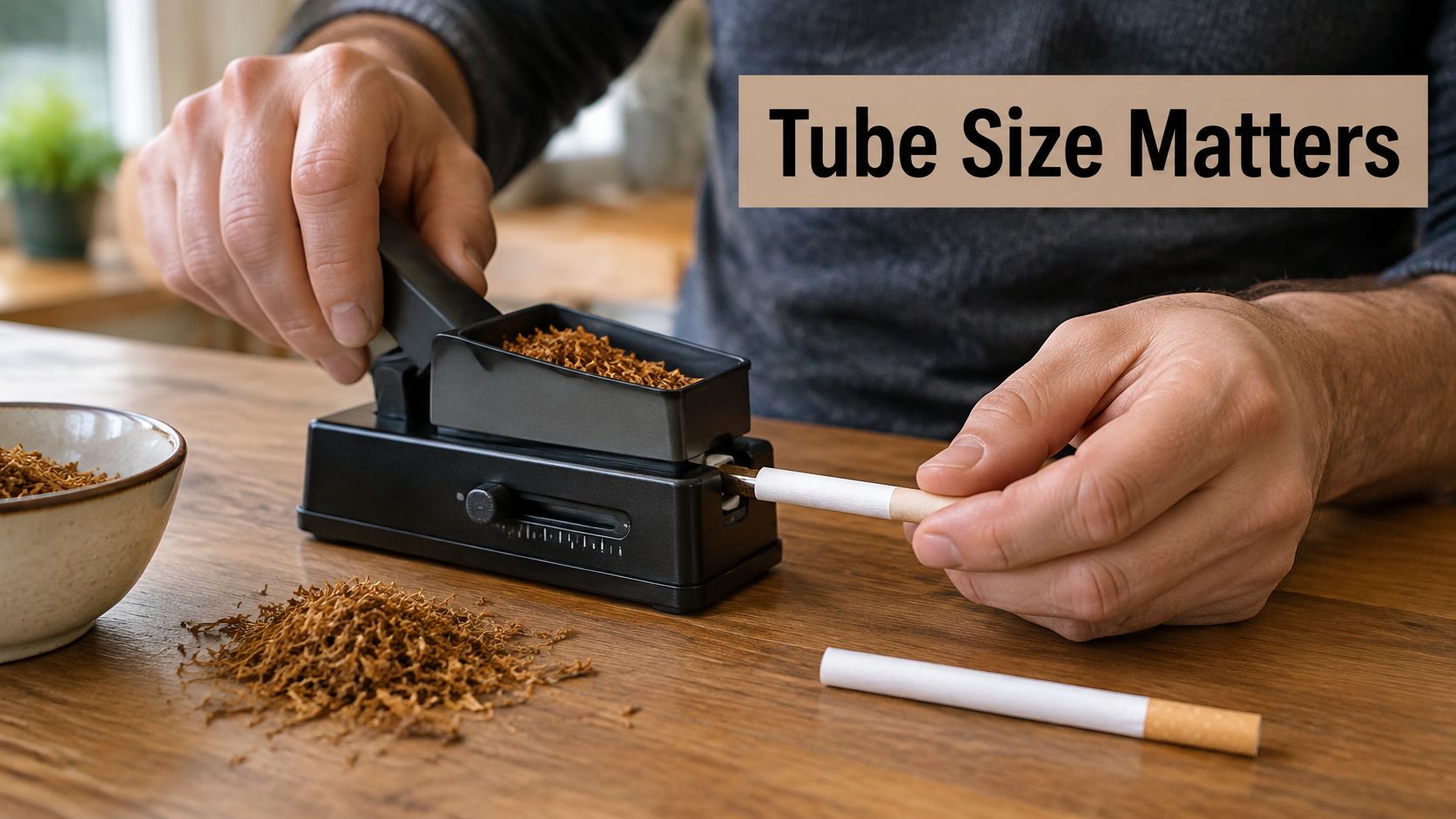
Tube size is a construction choice, not just a fit issue. A different internal space changes how much tobacco the cigarette can hold and how the machine packs it.
The Tobacco in Australia guidance on measuring emissions and exposure explains that tobacco mass, paper type, paper porosity and filter use affect nicotine and other chemical yields, and that changing tube size changes machine-measured tar delivery. That means cigarettes made from the same blend aren't necessarily equivalent when their construction differs.
The tube and filling chamber need to work together:
Separate size from tobacco charge
The tobacco charge is the amount loaded for a cigarette. An adjustable fill setting may change that amount, the packing pressure or how the mechanism delivers it. Check what the control does rather than assuming every adjustment works alike.
The compression mechanism presses the tobacco into shape. Excessive compression can make operation difficult, while uneven distribution can leave gaps. The injector or plunger must then move that charge without catching the paper or leaving tobacco behind.
Paper porosity means how readily air passes through the paper. Filter construction is another separate variable, so don't judge compatibility by the outside appearance alone. The practical guide to cigarette filter tubes helps distinguish the tube components you need to identify.
Make comparisons traceable
Keep a simple record when changing supplies or settings:
- Identify the equipment: Note the machine model and the position of any fill control.
- Record the consumables: Keep the tube dimensions, paper specification and filter description.
- Check tobacco mass: Weigh an empty tube separately from a finished cigarette so you aren't counting paper and filter as tobacco.
- Track rejects: Note torn tubes, incomplete fills and tobacco left in the chamber.
A small digital scale helps reveal inconsistent filling, but it doesn't measure smoke exposure. Avoid interpreting a lighter finished cigarette as proof of lower health risk.
For a visual demonstration, compare the mechanism shown with the instructions for your own model:
Laboratory smoking-machine tests provide a standardised way to compare construction variables. They don't predict an individual smoker's intake.
On a specification sheet, prioritise approved tube dimensions, supported filter configurations, adjustment instructions and cleaning access. Those details tell you more about controllable output than a photograph of neatly finished cigarettes.
Australian Rules Machine Users Must Know
A machine can form or fill a cigarette, but it doesn't make non-compliant tobacco, packaging or finished products lawful. Treat equipment compatibility and tobacco compliance as separate checks.
The Department of Health's plain-packaging guidance states that tobacco sold, offered for sale or supplied in Australia must use standardised plain packaging, including roll-your-own tobacco, and identifies requirements covering prohibited ingredients, product design and the mandatory reduced-fire-risk standard for cigarettes.
That distinction matters particularly in a commercial setting. Being able to make a cigarette doesn't establish that you may package or supply it. Don't assume that giving a tobacco product away avoids supply requirements.
Check the product, not just the machine
The Australian Government's tobacco changes guidance sets the following requirements from 1 July 2025, including standardised pack sizes and restrictions on flavour accessories.
Tobacco pack sizes and product rules from 1 July 2025
| Product | Standard | Status |
|---|---|---|
| Roll-your-own tobacco pouch | 30 g | Required from 1 July 2025 |
| Cigarette pack | 20 sticks | Required from 1 July 2025 |
| Carton | 10 packs | Required from 1 July 2025 |
| Flavour accessories such as crush balls | Not permitted for sale | From 1 July 2025 |
The reforms also standardise cigarette dimensions and filters and remove descriptors that could suggest reduced harm. Don't use a familiar product name or an older catalogue image as evidence that a current product complies.
If you encounter a differently sized pouch, unclear markings or a flavour accessory, resolve its status before purchasing. A low price isn't a substitute for checking the product.
Keep mechanical checks separate
A legally sold tobacco product can still feed poorly through a particular machine. Tobacco cut describes the size and shape of the strands; moisture affects how those strands move and collect inside the chamber.
If either changes, inspect and clean the injector before adjusting the machine. Don't try to solve a feeding problem by adding flavour accessories or modifying the product.
For background on unmarked loose tobacco, our explanation of why chop-chop tobacco is illegal distinguishes illicit supply from ordinary equipment choices.
Before loading, confirm:
- Retail source: Buy legally sold tobacco, not an unmarked bag offered as an equivalent.
- Packaging: Check the pouch weight, required warnings and product identification.
- Compatibility: Match the tubes to the manufacturer's approved specification.
- Condition: Clear residue and check that moving parts operate freely.
- Health expectations: Don't mistake a neat shape, filter or consistent fill for protection from tobacco-related harm.
A rolling machine doesn't reduce the health risks of smoking. Reduced-fire-risk requirements concern ignition performance, not a safer cigarette for the smoker.
What a Machine Really Saves per Cigarette
A machine can save hand work without saving money. The financial test is whether total cost divided by usable finished cigarettes is lower than your alternative.
Australian tobacco excise is indexed to average weekly ordinary-time earnings; a 2025 government statement reported $1.36623 per cigarette and $2,101.89 per kilogram of tobacco, according to the Australian Government's tobacco laws information. Using that historical tobacco rate, the calculated excise component of a standard pouch is about $63, before other price components.
That's a historical reasonableness check, not a current retail quote. A price that doesn't appear to cover applicable excise needs clarification before you use it in a savings comparison.
Count everything you spend
Cost components for cost per finished cigarette
| Cost item | What to record | Why it moves the total |
|---|---|---|
| Tobacco per cigarette | Grams used per finished cigarette across a full pouch | Fill setting and tobacco density change consumption |
| Tubes or papers | Pack price divided by usable contents | Compare unit prices rather than pack prices |
| Machine purchase | Purchase price spread over expected output | Low-volume users allocate more cost to each cigarette |
| Electricity or batteries | Running cost per batch | Recurring operating expense |
| Wastage and misfeeds | Discards and tobacco lost per batch | Paid-for materials don't always become usable cigarettes |
| Cleaning supplies | Cost allocated to each cleaning cycle | Brushes and other permitted supplies need replacement |
| Excise-inclusive retail price | Current price for a standard pouch | Tax indexation can change the starting cost |
Include separate filters where required and delivery charges. Don't add excise again if it's already included in the retail price.
Use the Drum tobacco price guide to help organise a like-for-like price comparison, rather than comparing differently described products by the headline total.
Calculate from actual output
Write the calculation as:
Cost per finished cigarette = tobacco spend + consumables + allocated equipment and running costs, divided by usable finished cigarettes.
Keep the numerator in brackets when entering it into a calculator. Multiply the result by the comparison pack quantity, and by a larger comparison quantity if useful, rather than estimating from the pouch's apparent size.
Count what you can use, not what the machine attempted to make.
Run the calculation at lighter, usual and heavier fill settings permitted by the manufacturer. Measure actual tobacco use rather than assigning an assumed weight to every cigarette.
Overfilling, discarded misfeeds and higher unit prices for supplies can remove apparent savings. Making more cigarettes because preparation is easier can also increase total spending, even when the unit cost falls. Recalculate whenever tobacco prices or your consumables change.
Choose, Use and Buy Safely
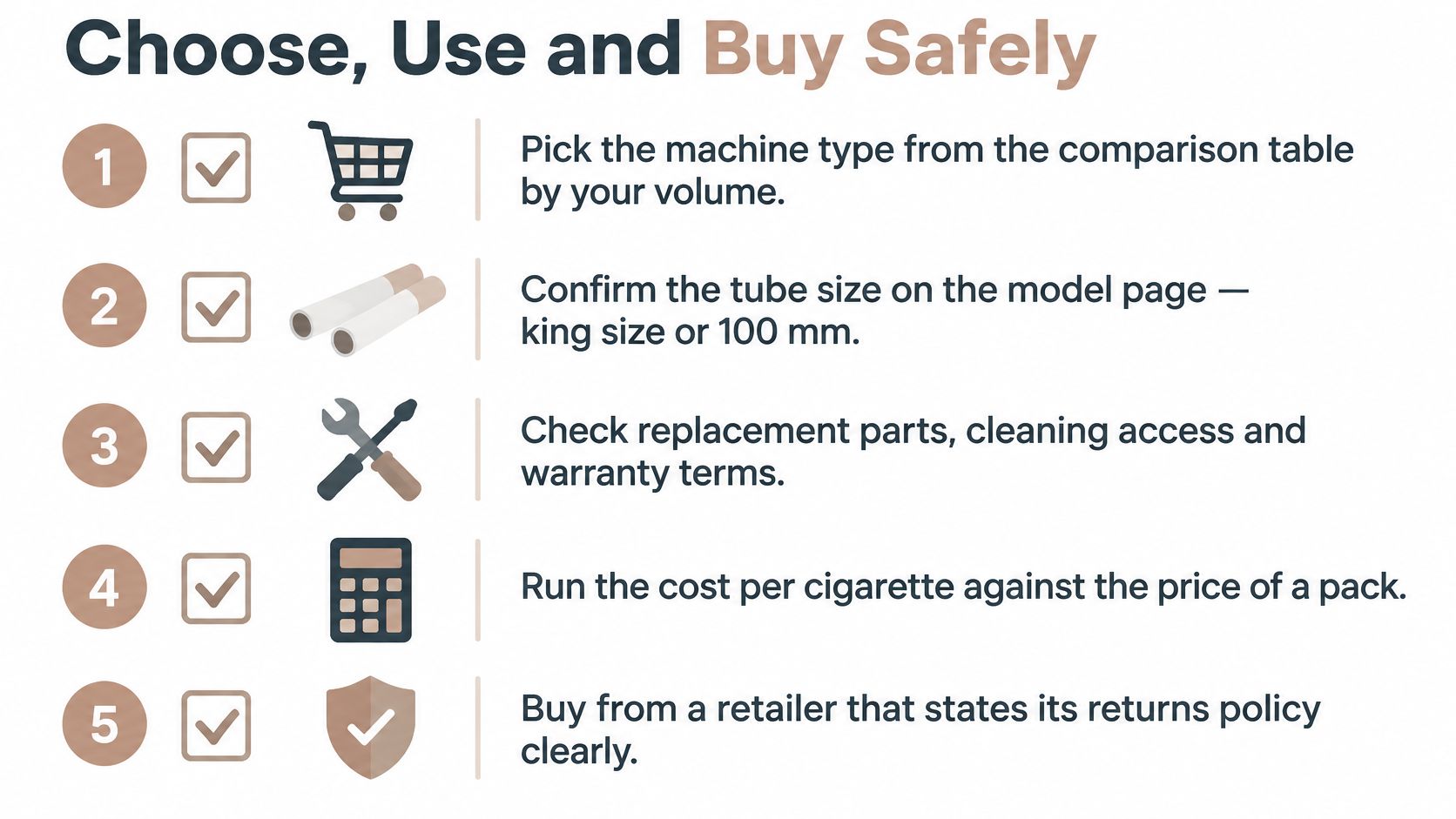
Start with a buying gate: don't order until the model, consumables and cost calculation agree. Choose the mechanism for the amount of preparation you already do, not a larger amount you might do because the machine is available.
Open the exact model page and find the supported tube format. Save the manual, check the cleaning instructions, and look for a clear parts diagram. If a listing uses several model names interchangeably, resolve which machine will arrive before paying.
Check ownership costs before checkout
Replacement parts matter because a damaged tube holder or worn injector component can make an otherwise working machine unusable. Check whether parts are sold separately and whether the warranty distinguishes manufacturing faults from wear or damage caused by jams.
Read the seller's returns conditions before opening consumables or operating the machine. Don't assume that trying an unsuitable model will leave you eligible for a change-of-mind return.
At Cheap Smokers, we sell rolling papers, pipes, grinders, philtres and other tobacco accessories. Compare any consumable by its actual specification, pack weight and excise-inclusive price, rather than treating its presence in a catalogue as proof that it suits your machine or satisfies every current requirement.
Use this checklist when assessing a purchase:
Establish a controlled routine
Work on a stable, dry surface with good lighting. Keep the manual nearby and place a tray beneath the loading area so spilled tobacco doesn't fall into switches or moving parts.
Load to the marked level. Fit the approved paper or tube without stretching it over the holder, then distribute tobacco evenly through the chamber. Don't heap extra tobacco above the loading guide.
Set the fill and compress gently. Begin with the manufacturer's recommended setting and operate the mechanism smoothly. Resistance is a reason to stop and inspect, not to press harder.
Inspect the first result. Look for gaps, a damaged paper seam or tobacco protruding where it shouldn't. You don't need to light a cigarette to check whether its shape and packing are visibly uneven.
Adjust the control rather than adding a heap. Change the setting gradually while keeping the tube and tobacco preparation unchanged. If you change several things together, you won't know which adjustment helped.
Clean the tobacco path. Empty loose material after the batch and brush the chamber, nozzle and accessible injector surfaces as the manual permits. Clean before changing tobacco cut or moisture condition so old residue doesn't confuse the result.
Let an electric mechanism stop completely before touching the filling area. Disconnect power before cleaning or clearing a blockage, and keep fingers away from the injector's travel path.
Respond to faults without forcing parts
For a jam, remove the tube only as the manual directs, clear loose tobacco and inspect for a trapped strand or damaged paper. Don't use a knife to pry against a nozzle or reach into an energised machine.
Use a soft brush for routine dry cleaning. Don't add oil, water or solvent unless the manufacturer explicitly permits it for that component, because a product suitable for the outer case may not be suitable for the tobacco path.
Stop-and-check signal: A lever that suddenly needs more force is a fault to investigate, not a new normal.
Store the machine dry, with loose tobacco removed and the power lead protected from strain. Keep equipment and tobacco away from children, and don't leave an operating electric filler unattended.
Finally, judge the purchase by a short trial batch. If the results are uneven, first check the tube specification, loading distribution, fill setting and cleanliness before blaming the blend. Keep the machine only if its usable output, upkeep and total cost suit your existing routine, without confusing mechanical consistency with reduced health risk.
Cheap Smokers offers rolling papers and other tobacco accessories for adults comparing their equipment options. Visit Cheap Smokers to review the available supplies, then check their specifications against your machine manual before ordering.