
Drum Tobacco Price Guide: Pack Sizes Compared
November 12, 2026Listed rolling tobacco runs from $0.318 to $0.524 per gram across the Cheap Smokers pack sizes, and the 1000g 12mg listing is the lowest rate. Those prices are dated, and a Drum shelf price was not among the listings, so a drum tobacco price you see elsewhere still needs a date and a tax check before you trust it.
A pouch can look cheap until you set the advertised rate next to the excise that should already sit inside a legal pack. On these listings the dearest per-gram rate is more than one and a half times the cheapest, and that spread is pack size and strength, not a Drum special. The useful test is the same for every listing: grams first, then the excise share, then the date on the page.
Table of Contents
- Drum Tobacco Prices at a Glance
- What Drives the Drum Price and the Excise Test
- Strength and Pack Size Trade-Offs
- What a Week of Smoking Costs
- Matching Pack Size to Your Smoking Pattern
- Confirm the Price Before You Buy
Drum Tobacco Prices at a Glance
The listings did not include a Drum pouch, so the table uses Premium Rolling Tobacco RYO as the closest same-format benchmark. Each row carries pack size, strength, the listed sale price and the price per gram. That last column is the one that makes unlike packs comparable.
| Pack size | Strength | Sale price (AUD) | Price per gram (AUD) |
|---|---|---|---|
| 100g | 8mg | $42.53 | $0.425 |
| 100g | 12mg | $51.03 | $0.510 |
| 250g | 8mg | $84.20 | $0.337 |
| 250g | 12mg | $93.56 | $0.374 |
| 1000g | 8mg | $336.80 | $0.337 |
| 1000g | 12mg | $318.09 | $0.318 |
| 50g Bulk Buy x5 (250g total) | Not stated | $130.98 | $0.524 |
| Drum 50g pouch | Not listed | Not listed | Not listed |
The 100g 8mg pack is $42.53, or $0.425 per gram. The 100g 12mg is $51.03 ($0.510 per gram). The 250g 8mg is $84.20 ($0.337) and the 250g 12mg is $93.56 ($0.374). The 1000g 12mg at $318.09 is $0.318 per gram, the lowest rate on the table. The 1000g 8mg at $336.80 ($0.337) sits level with the 250g 8mg, so extra weight does not always cut the gram rate.
The 50g Bulk Buy x5 totals 250g at $130.98, which is $0.524 per gram, the highest rate here. Five small pouches cost more per gram than one 250g pack of either strength. A bigger headline price can still be the cheaper tobacco.
A blank Drum row is the honest cell
A blank Drum price is an honest answer, not a hole to fill with a guess from another brand.
Take the per-gram figure from any listing you check, set it beside this table, and write down the date you saw it. Listed prices move with sales, stock and indexed excise, and an in-store ticket can differ from the page. For a wider set of pouch comparisons, see rolling tobacco prices in Australia.
What Drives the Drum Price and the Excise Test
Loose tobacco is taxed on tobacco content rather than the size printed on the pouch. The Australian Taxation Office sets the excise benchmark at AUD 2,445.26 per kilogram from 3 March to 31 August 2026, rising to AUD 2,587.90 per kilogram from 1 September 2026. Duty is indexed each March and September using average weekly ordinary time earnings, so a quoted drum tobacco price is only as good as the date beside it.
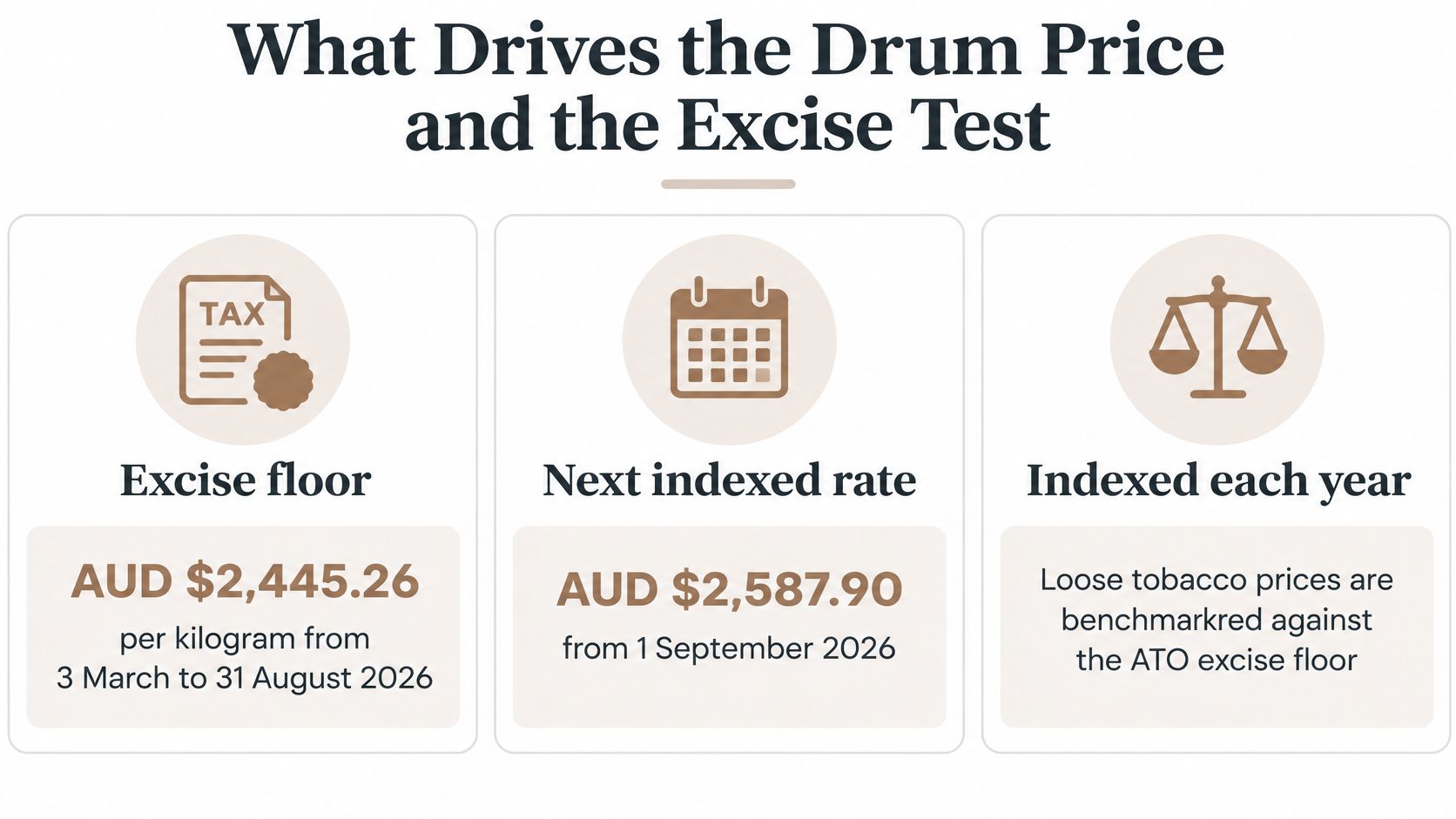
Excise is set per kilogram, so the AUD 2,587.90 rate in force from 1 September 2026 applies pro rata to any pack weight. Scaled by weight, the excise component alone comes to about $64.70 for 25 g, $129.40 for 50 g, $258.79 for 100 g, $646.98 for 250 g and $1,293.95 for 500 g, before GST, wholesale and retail margins, packaging and distribution. Anything on the shelf still has to clear that floor and then cover the rest of the chain.
Why the shelf price mostly follows the tax
Australian Government health data reported that, as of 1 March 2017, tobacco excise alone was about 60% to 62% of the recommended retail price for four leading roll-your-own brands. With the 10% goods and services tax, total tobacco taxes were about 70% to 72%. Those estimates used recommended retail prices for 50-gram packs of Champion Ruby, Winfield, Drum and White Ox. The path to that share included a 25% excise increase in April 2010 and staged annual 12.5% increases from 1 December 2013, then 1 September in 2014, 2015 and 2016. The 2017–18 Federal Budget put roll-your-own tobacco on the same broad tax treatment as manufactured cigarettes.
A Drum rise is usually an indexed excise step or a tax-policy change. A few dollars shaved off a retailer's margin moves the total far less than one excise step.
The share test
The excise test is one division: listed price divided by the excise assigned to that weight at the rate in force. On the 1 September 2026 scaling, the 100g 8mg at $42.53 is about 16% of a $258.79 excise share, the 250g 8mg at $84.20 about 13% of $646.98, and the 1000g 12mg at $318.09 about 12% of $2,587.90.
| Pack size | Excise at 1 Sep 2026 rate (AUD) | Listed price (AUD) | Listed price as share of excise |
|---|---|---|---|
| 25g | 64.70 | No listing | No listing |
| 50g Drum pouch | 129.40 | No listing | No listing |
| 100g 8mg | 258.79 | 42.53 | 16% |
| 100g 12mg | 258.79 | 51.03 | 20% |
| 250g 8mg | 646.98 | 84.20 | 13% |
| 250g 12mg | 646.98 | 93.56 | 14% |
| 50g Bulk Buy x5 (250g total) | 646.98 | 130.98 | 20% |
| 500g | 1,293.95 | No listing | No listing |
| 1000g 8mg | 2,587.90 | 336.80 | 13% |
| 1000g 12mg | 2,587.90 | 318.09 | 12% |
Read the table the other way and the point sharpens. Every listed pack sells for a fraction of the excise its weight would attract at the September 2026 rate, so the duty status behind the stock matters more than the headline saving. A price far below its share calls for verification before it is trusted. Oxford Economics modelling put illicit tobacco's estimated market share at 50–60% in 2024–25, with an estimated market value of $4.1–$6.9 billion, while the price gap between illicit cigarettes and comparable legal products widened from $11 to $47 over the past decade. The same analysis says Australian consumers are highly price-sensitive and willingness to pay is particularly low for roll-your-own tobacco. Illicit supply carries legal, health and product-quality risks, and an illicit price is not a legitimate benchmark for a legal pouch.
Four checks turn the test into a habit:
- Note the excise rate in force on the day you buy.
- Expect price movement at the March and September indexation points.
- Treat a sudden Drum price rise as tax-driven until the seller shows otherwise.
- Buy only from a seller who can state duty status and provide a receipt. If you are comparing cartons as well as pouches, start from buying smokes online in Australia and apply the same date-and-duty check.
Strength and Pack Size Trade-Offs
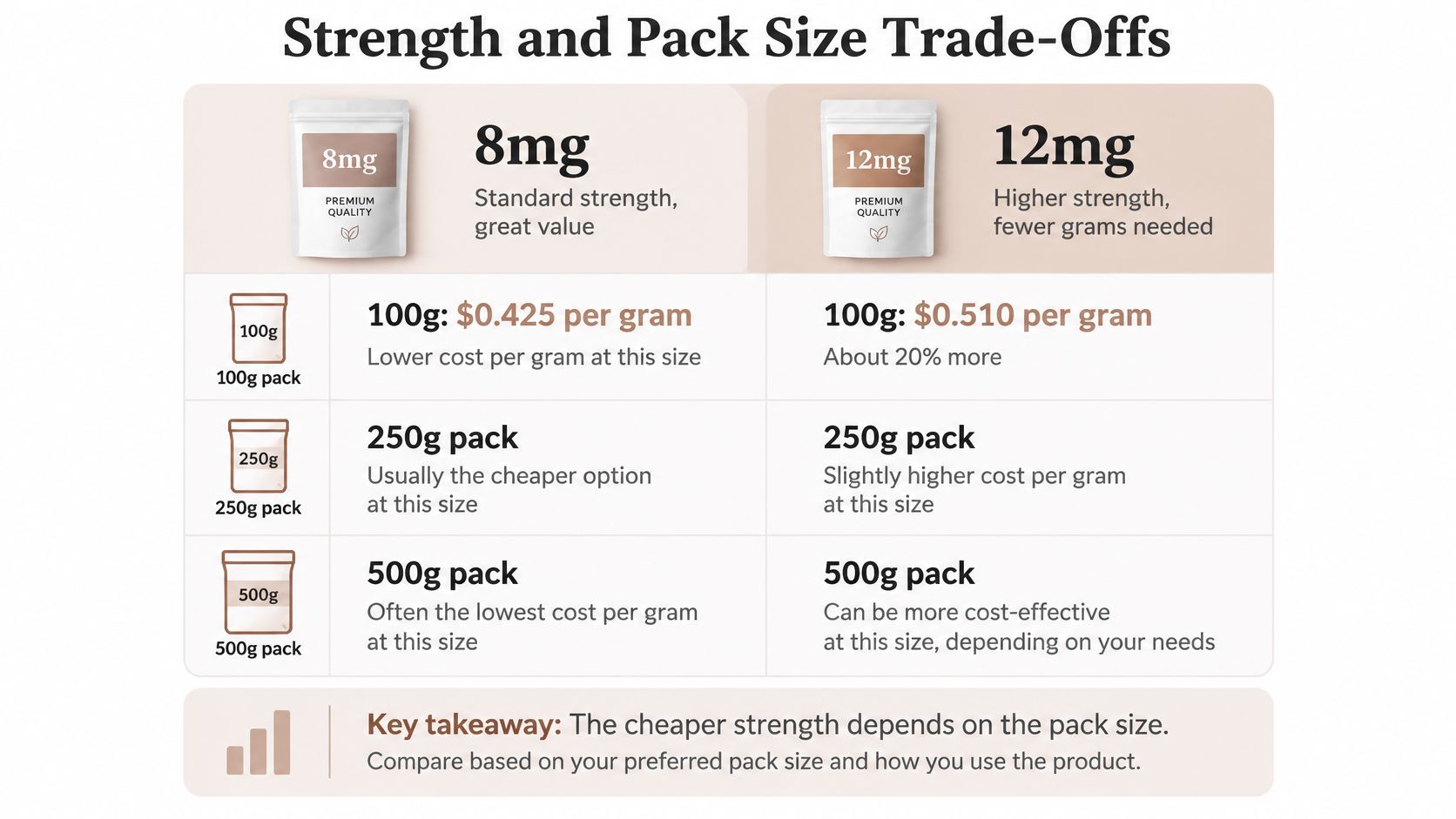
The cheaper strength flips with the pack. At 1000g the 12mg listing is $0.318 per gram against $0.337 for the 8mg, about 6% less. A heavy smoker who has already settled on 12mg should buy the big pack if storage is sorted, because that is the only size where the stronger tobacco is also the cheaper tobacco per gram.
Where the gap sits at smaller sizes
At 100g the 12mg costs $0.510 per gram against $0.425 for the 8mg, about 20% more. At 250g the gap narrows to $0.374 against $0.337, about 11% more. Someone who smokes 8mg gains nothing by stepping up to 12mg at those sizes, and someone who wants 12mg pays a clear premium until the pack reaches a kilogram.
Sale cuts against the listed original
These reductions are savings against the listed original price, not a price history.
- 250g 8mg: on sale at $84.20, down from $122.21, a $38.01 cut, about 31% off.
- 250g 12mg: on sale at $93.56, down from $133.10, a $39.54 cut, about 30% off.
- 50g Bulk Buy x5: on sale at $130.98, down from $176.66, a $45.68 cut, about 26% off.
- 100g packs: the 8mg is $42.53, down from $49.50, and the 12mg is $51.03, down from $59.40. Both cuts are about 14%.
- 1000g packs: the 8mg is $336.80, down from $416.24, and the 12mg is $318.09, down from $394.46. Both cuts are about 19%.
A 30% banner on a 250g pouch does not make it cheaper per gram than the 1000g 12mg. The sale changes the dollars you hand over today. It does not reorder the per-gram table except where strength and size already point the same way.
The cheapest per-gram price depends on strength and pack size together. Compare those two variables, not the headline price.
What a Week of Smoking Costs
Weekly spend is the figure you live with. Multiply the grams you use in a week by the price per gram on the day you buy, then allow for tobacco already open at home. A 50g pouch bought for a 25g week leaves stock that can dry out before you finish it, so the low gram rate is wasted if half the pouch goes stale.
| Weekly use | 1000g 12mg ($0.318 per gram) | 250g 8mg ($0.337 per gram) | 100g 12mg ($0.510 per gram) |
|---|---|---|---|
| 25g | $7.95 | $8.43 | $12.76 |
| 50g | $15.90 | $16.85 | $25.52 |
| 100g | $31.81 | $33.70 | $51.03 |
The tax already inside a small pouch
Australia's Drum tobacco price is shaped by per-kilogram excise rather than by the brand name alone. Tobacco in Australia reported the excise payable on a 25-gram pouch of roll-your-own tobacco in March 2025 as A$53.97, about A$107.94 for 50 grams, the size commonly associated with Drum pouches, and recorded roll-your-own excise rising 5.8-fold between August 2013 and September 2026. That component applies to loose tobacco generally, imported and domestic. A legal 25g week already carries more excise than the whole weekly tobacco bill in the cheapest column of the table above. That floor matters. A listing under it needs a duty check before it is treated as a bargain.
Rolls are only a rough guide
The same excise rules use an equivalisation weight so loose tobacco lines up with the per-stick rate on manufactured cigarettes. That weight is set in excise law and has been stepped down over time. Each reduction assigns more tax to the same pile of tobacco and pushes shelf prices up. Roll size still varies between smokers, so any cigarette-equivalent count is a rough guide rather than a promise of how many cigarettes a pouch will yield. At 25g a week, one 50g pouch is about two weeks of tobacco.
The weekly gap between the two extremes is easy to miss on a pouch label. 100g a week costs $51.03 at the 100g 12mg rate and $31.81 at the 1000g 12mg rate, more than $19 a week.
Write the weekly grams, multiply by the per-gram price on the day, and compare the result with last month's figure so a price change shows up before the next pouch.
Matching Pack Size to Your Smoking Pattern
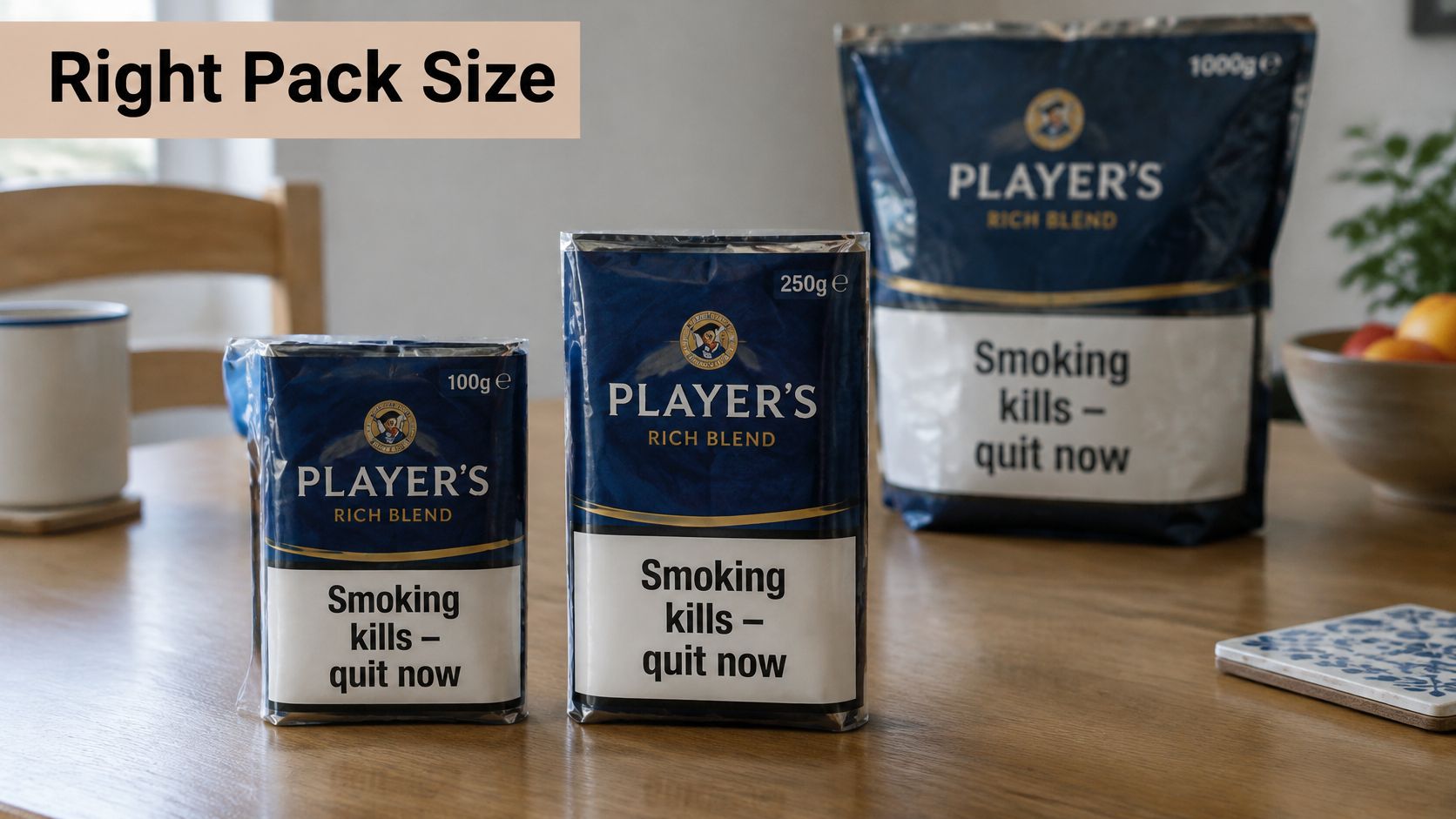
Match the pack to your weekly usage before you weigh up per-gram discounts.
Light use, about 25g a week
A 1000g bag would sit open for most of a year at that pace. Tobacco dries, and the low gram rate never reaches the cigarettes you roll. A 100g or 250g pack fits the week. At 8mg the 100g rate is $0.425 and the 250g rate is $0.337, so the mid-size pack wins if you can keep it sealed between sessions. Put in calendar terms, a 100g pack is roughly a month of tobacco and a 250g pack roughly ten weeks, which already stretches freshness for most smokers.
Regular use, 50g to 100g a week
A 250g pack earns its place here. The 8mg rate is $0.337 per gram and the 12mg rate is $0.374, both clear of the 100g premium. A 250g pouch at this pace lasts about two and a half to five weeks, short enough that storage is ordinary and long enough that you are not paying the small-pouch rate every fortnight.
Heavy use or a shared household, over 100g a week
The 1000g pack holds the lowest per-gram rate, $0.318 at 12mg and $0.337 at 8mg. We sell the 1000g 8mg for $336.80, so the upfront outlay is several times a 250g pouch. Buy it only if the tobacco can stay dry and sealed, because the saving leaks out as waste otherwise. The deeper the per-gram discount, the more the saving depends on the listing passing the excise check, since a gram rate that cannot cover duty is not a real price.
No tobacconist nearby, or you want several small packs
Buying online handles the distance problem. Confirm the delivery timeframe at checkout before you plan around it.
The 50g Bulk Buy x5 is $130.98 for 250g total. It suits someone who wants more than one pack without a kilogram commitment, and it also carries the highest per-gram rate in this range, $0.524. You are paying for portioning, not for cheaper tobacco. The trade-off has a real upside though: on a 50g week, each sealed pouch covers about a week, so unopened stock stays fresh far longer than a single opened 250g pouch.
The cheapest per gram is not always the cheapest per week once storage, waste and delivery are counted.
Under 50g a week, buy 100g or 250g. From 50g to 100g a week, buy 250g. Over 100g a week, buy 1000g only if you can store it dry and sealed.
Confirm the Price Before You Buy
Every check in this guide resolves into one habit: verify the listing before money changes hands. The procedure below takes a few minutes, and it separates a dated shelf price from a figure you can defend.
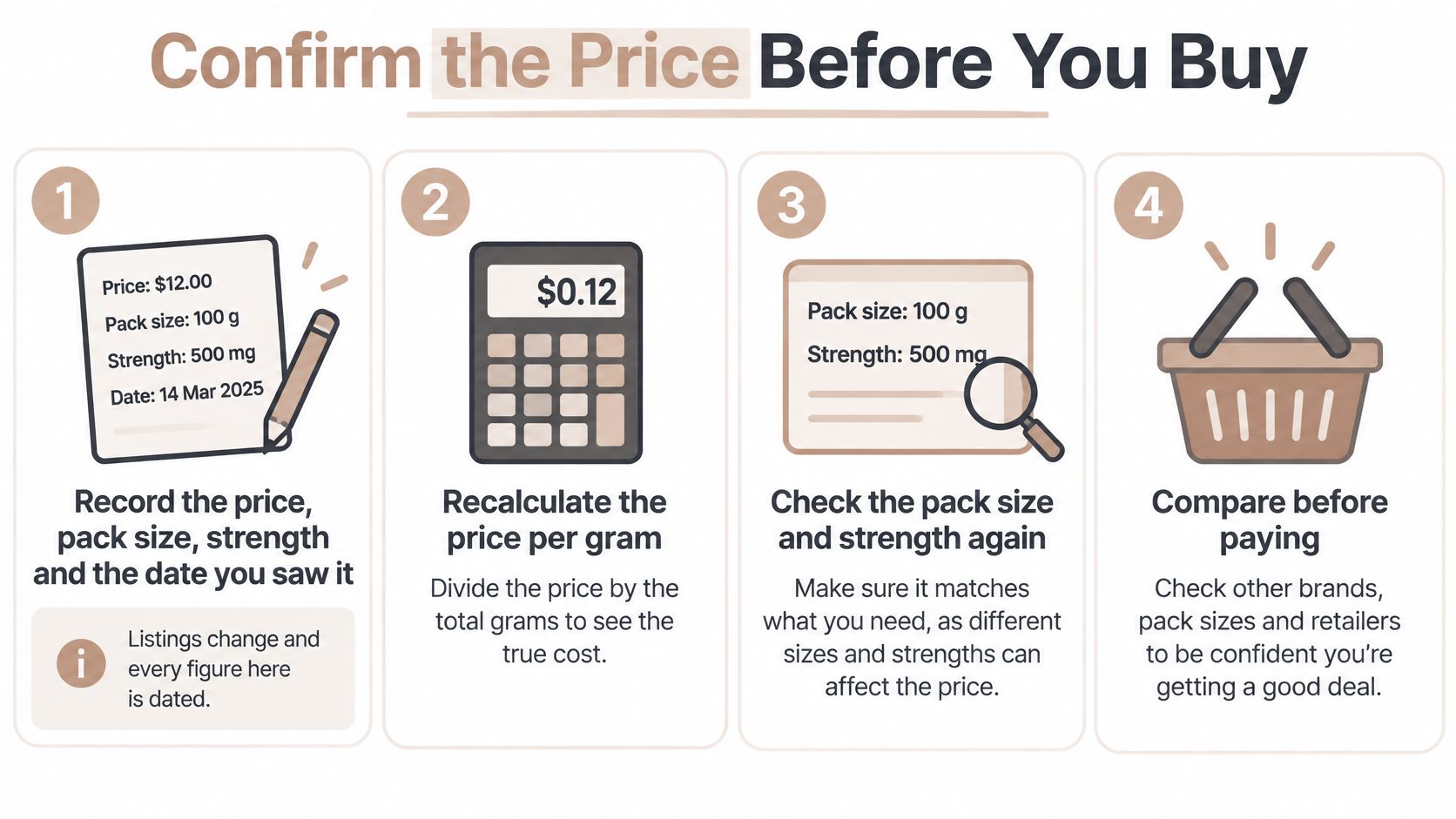
Record the listing. Write down the price, pack size, strength and the date you saw it. Listings change, and every figure in this guide is dated, so a Drum pouch with no date attached is not a price you can compare. Keep the record somewhere you can find it when the next indexation date arrives.
Recalculate the gram rate. Divide the sale price by grams of tobacco, not by the number of pouches in a bundle. Set your result beside the band the listings establish, $0.318 per gram at the low end and $0.524 at the high end. A claimed Drum special outside that band needs an explanation you can verify before you treat the price as real.
Apply the excise share test for that weight. Scale the kilogram benchmark in force on the date you recorded to the pack weight, using the March or September rate that applies. A listed price well below the excise share for its weight is a signal to confirm duty status with the seller before you buy. A low share is a reason to verify, and it does not by itself prove the product is illegal.
Confirm the indexation point. A price seen before a March or September change may already be out of date. If a price jumps on one of those dates, treat the indexation as the likely cause unless the seller can show a different one.
Ask in writing when the price sits far below its excise share. Ask whether the product is duty-paid and whether the stated weight is tobacco content. Wait for a clear written answer before you pay, because a written reply is the record a verbal "it's fine" can never be.
Read the policies and the age step. Refund, shipping and privacy policies are published on the site, and purchasing includes an age confirmation prompt and age verification. Read the policies before paying. If you would rather collect in person, find a smoke shop near you and run the same gram and duty checks at the counter.
Keep the order confirmation and the receipt. Together they give you the record needed to recheck the price against the next indexation date and to raise a dispute if the delivered weight or product differs from the listing.
A drum tobacco price earns your money when it is current, checked against excise and per gram, and matched to your weekly use. Until then it is an unverified number, and the correct response is to wait for confirmation rather than chase the discount.
Cheap Smokers lists rolling tobacco in 8mg and 12mg across 100g, 250g and 1000g packs, with original and sale prices shown so the per-gram and excise checks above can be run before ordering. Adult customers can order online with Australia-wide delivery or buy in store, with age verification during purchasing. Compare the current pouches at Cheap Smokers and note the date beside whichever price you decide to trust.

[…] hidden inside a pouch price. Pouch weights and how unit price changes with size are set out on our drum tobacco price […]