
Tobacco Prices Australia: How to Compare Brands and Packs
October 24, 2026A standard 20-stick pack carries about $30.57 of federal excise before GST, retailer margin or freight, on the rate that applied from 3 March 2026. That figure is not a shelf price. It is the statutory floor under one pack, and it is why a cheap-looking listing can fail a like-for-like test before any brand comparison starts.
Tobacco prices in Australia only become comparable once every ticket is turned into the same unit. A carton of ten 20-stick packs, a pre-filled 200-stick carton and a loose pouch are different products with different duty bases. Price per stick and price per 100 grams are the units that survive that difference. A figure well under the duty for those units is not a bargain until the seller confirms pack count, weight and whether duty is included.
The listings below are worked through that way. Where a number cannot be trusted, it stays unverified rather than being treated as a market price.
Table of Contents
- Tobacco Prices in Australia by Product Type
- Rolling Tobacco Prices by Strength and Pack Size
- Cigarette Carton Prices by Brand
- Why Excise Sets the Floor Under Every Price
- Compare Two Listings Fairly Before You Order
- What a Price Tag Does Not Tell You
Tobacco Prices in Australia by Product Type
| Product type | Typical listed price | Comparable unit | Source |
|---|---|---|---|
| Premium factory-made pack, 20 sticks | A$60.72 (average, September 2025) | A$3.04 per stick | Tobacco in Australia |
| Carton, 10 packs of 20 sticks | $133.00 to $420.00 | $0.67 to $2.10 per stick | Catalogue listings |
| Pre-filled carton, 200 sticks (Palmers, Rollo) | $59.54 to $74.84 | about $0.30 to $0.37 per stick | Catalogue listings |
| Rolling tobacco, 100g to 1000g | $42.53 to $336.80 | $31.81 to $52.39 per 100g | Catalogue listings |
The priced listings in this catalogue cover rolling tobacco and cigarettes, so every row rests on a listing that can be verified. Read the table on two units only: per stick for anything sold as cigarettes, per 100g for loose tobacco. A carton price, a pre-filled carton price and a pouch price are not interchangeable tickets.
The benchmark row is the clearest anchor. In September 2025, the average premium cigarette pack cost AUD 60.72, or AUD 3.04 per cigarette, according to Tobacco in Australia. It is an average for a premium factory-made pack, a listing you cannot order, and no guide to loose tobacco.
The carton row spans more than threefold once divided by 200 sticks. The pre-filled row looks far cheaper on the same division, and that gap is where verification starts. At about $0.30 to $0.37 per stick, a pre-filled carton does not cover the federal excise carried by a single factory-made stick. A unit price below the tax it should contain is a number the seller needs to explain before it counts as a bargain.
Rolling tobacco only lines up after the listed price is divided by weight and scaled to 100g, which is why the cheapest ticket in dollars is not the cheapest unit. Every converted figure in this set faces the same test against the duty floor for its product type, and any unit that cannot clear it stays flagged for verification rather than being read as a saving.
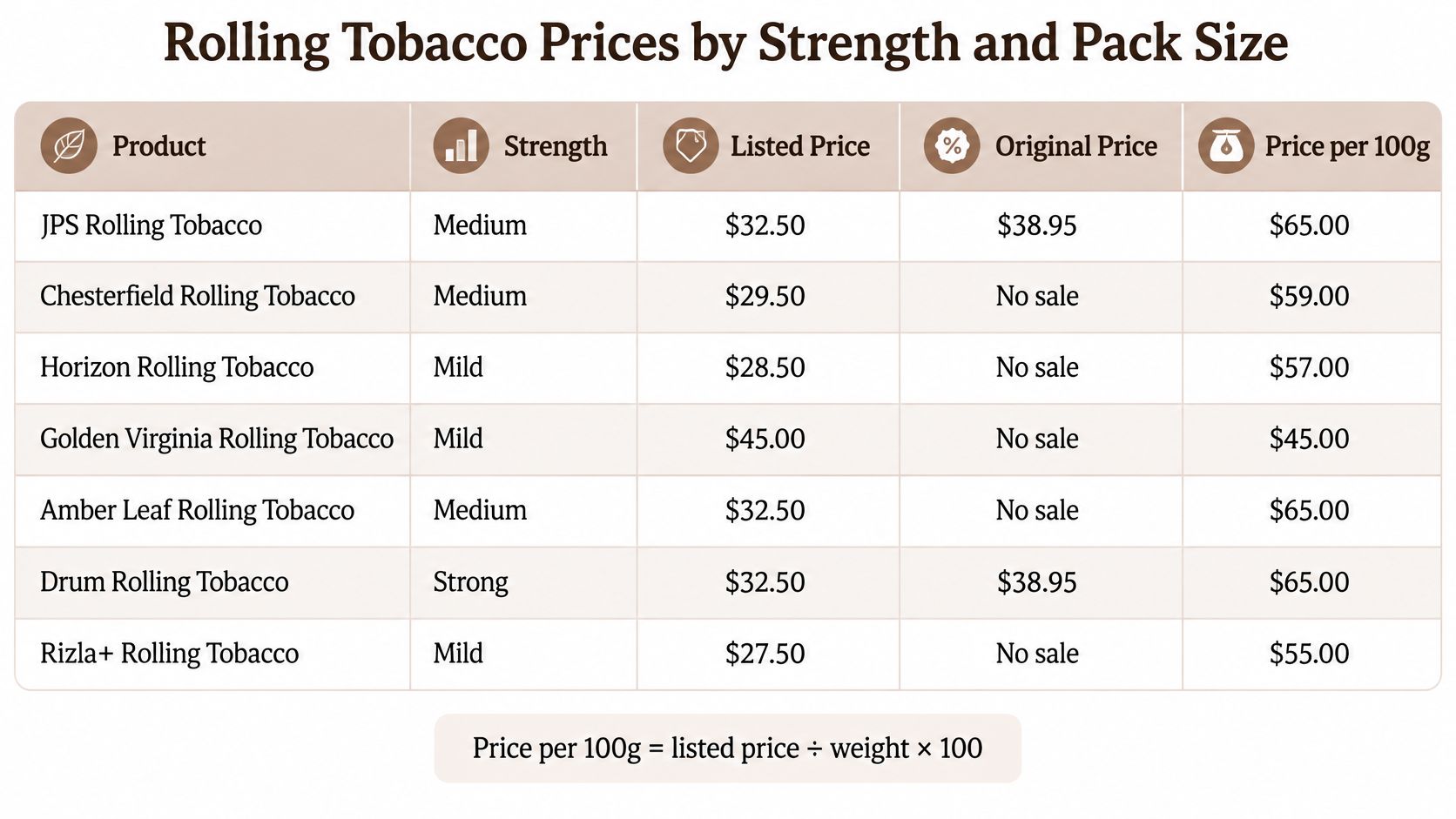
Rolling Tobacco Prices by Strength and Pack Size
| Product | Strength | Listed price | Original price | Price per 100g |
|---|---|---|---|---|
| Rolling tobacco 100g | 12mg | $51.03 | $59.40 | $51.03 |
| Rolling tobacco 100g | 8mg | $42.53 | $49.50 | $42.53 |
| Rolling tobacco 250g | 12mg | $93.56 | $133.10 | $37.42 |
| Rolling tobacco 250g | 8mg | $84.20 | $122.21 | $33.68 |
| Bulk Buy x5 (five 50g packs) | Not stated | $130.98 | $176.66 | $52.39 |
| Rolling tobacco 1000g | 12mg | $318.09 | $394.46 | $31.81 |
| Rolling tobacco 1000g | 8mg | $336.80 | $416.24 | $33.68 |
The column that matters is price per 100g. Original prices show a sale is running; they are not the benchmark. Converting every row to the same unit is also the only way to test each listing against the federal excise, which applies per weight for loose tobacco rather than per stick. A listing that looks cheap on the ticket can still sit in an odd position once that floor is priced in, so any converted figure that looks out of line deserves a second check on the product page before it is compared.
Three readings from the unit column
The 1000g 12mg pouch is the lowest unit in this set, at $31.81 per 100g. It is on sale at $318.09, down from $394.46. The largest pack undercuts every smaller 12mg row.
The 250g 8mg and the 1000g 8mg both land on $33.68 per 100g. The 250g pack is $84.20, down from $122.21. The 1000g pack is $336.80, down from $416.24. Four times the weight buys no unit saving inside the 8mg line, so anyone comparing the two tickets on dollar size alone would misread them as different deals.
The five-pack bulk buy is the dearest unit, at $52.39 per 100g, even though $130.98 is down from $176.66. That figure assumes five 50g packs make 250g, which is what the listing name implies. If the contents differ, the unit price moves with them, so this row needs verifying against the listed contents before it is compared with the 250g pouches.
Strength and the size of the sale
At 250g, the 12mg listing at $93.56 costs $9.36 more than the 8mg listing at $84.20. Strength carries a price on the same pouch size.
The discounts run in the opposite direction to the unit costs. The 250g 8mg price sits about 31% under its original figure, and the 100g 8mg price sits about 14% under, at $42.53 against $49.50. The bulk row’s discount is smaller than both suggest, about 26% off $176.66, yet it carries the highest per-100g cost in the table at $52.39. The percentage off does not determine the unit price.
Practical rule: sort rolling tobacco by price per 100g inside one strength, and only then look at the dollar discount.
Check the pouch prices for rolling tobacco alongside this table. A 50g bundle and a 1000g pouch are both loose tobacco, but pack size alone does not produce the same unit figure, and only the converted price shows whether each listing is being priced consistently against the excise underneath it.
Cigarette Carton Prices by Brand
Once ten-pack cartons are divided by 200 sticks, the spread runs from $0.67 to $2.10 per stick. That is more than threefold. The carton ticket hides it.
| Brand and listing | Carton price | Per 20-stick pack | Per stick | Against excise of $1.528 per stick |
|---|---|---|---|---|
| Ascot Blue 20s (10 Pack) | $287.85 | $28.79 | $1.44 | Below |
| Ascot Gold 20s (10 Pack) | $297.00 | $29.70 | $1.49 | Below |
| Bond Street Classic Red 20s (10 Pack), on sale, was $339.00 | $305.95 | $30.60 | $1.53 | Level |
| Benson & Hedges Blue 20s (10 Pack) | $420.00 | $42.00 | $2.10 | Above |
| Double Happiness Gold (10 packets x 20s) | $142.50 | $14.25 | $0.71 | Below |
| ESSE Menthol Super Slims (10 packets x 20s) | $133.00 | $13.30 | $0.67 | Below |
A ten-pack carton holds 200 sticks, so the per-stick figure is the only unit that lines brands up with each other and with a single 20-stick pack. Dividing by ten gives the pack equivalent. Dividing by 200 gives the stick. Both are shown so a carton is not compared with a pack by accident.
What the spread is actually saying
Benson & Hedges Blue is the only row clearly above the stick duty, at $2.10. Bond Street Classic Red sits level, at $1.53 on the sale price of $305.95, down from $339.00. The other four sit under $1.528.
Cheap Smokers offers both Australian and overseas tobacco brands, so origin on the product page is part of the comparison, not a footnote. An imported listing and a domestic listing can share a carton format and still not be the same taxed product. The brand shortlist for cigarettes is a separate read. It does not replace the unit conversion in this table.
These six cartons are the only brand listings in the supplied prices. The table is not a full market survey, and it should not be read as one. Ascot Blue, Ascot Gold, Double Happiness Gold and ESSE Menthol Super Slims are listings to verify with the seller. They are not bargains just because the converted stick price is low.
A per-stick figure under the statutory duty is a question about what the listing includes, not evidence of a lower tax.
Why Excise Sets the Floor Under Every Price
Excise works like a fixed toll on every stick and every gram. It is collected before the shop, the freight or the brand adds anything. A carton discount does not lift that toll. A cheaper rolling format does not either.

From 3 March 2026, federal excise is $1.52829 per cigarette containing no more than 0.8 g of tobacco, while loose tobacco and cigarettes over that threshold incur $2,445.26 per kilogram, on ATO excise duty rates for tobacco. The same material notes that a standard 10% GST applies on top of tobacco excise, so tax-on-tax lifts the shelf price further. Excise-equivalent customs duties use the same rates on imported tobacco, which limits any legitimate tax advantage from overseas sourcing.
| Unit | Duty before GST | Basis |
|---|---|---|
| 1 stick, 0.8g or less | $1.52829 | ATO rate from 3 March 2026 |
| 20-stick pack | $30.57 | 20 sticks at the stick rate |
| 200-stick carton | $305.66 | 200 sticks at the stick rate |
| 50g loose tobacco | $122.26 | $2,445.26 per kg |
| 250g loose tobacco | $611.32 | $2,445.26 per kg |
| 1kg loose tobacco | $2,445.26 | Statutory rate per kg |
The sanity check
Where a listed price falls below the duty for the same units, the listing cannot be a like-for-like taxed product on those numbers alone. A 200-stick carton priced far under $305.66 of stick duty, or a loose pouch far under the gram-equivalent in this table, needs the pack count, the weight and the duty treatment confirmed. Several pre-filled and loose listings in the catalogue sit well under those equivalents. Treat them as items to verify, not as deals.
Duty is indexed twice a year, in March and September, so a price captured in one month can be behind the statutory rate by the next. The Ascot Blue, Ascot Gold, Double Happiness and ESSE per-stick figures from the brand table all fall below the $1.528 floor. Present them to the seller as listings to confirm. Do not file them as bargains.
Compare Two Listings Fairly Before You Order
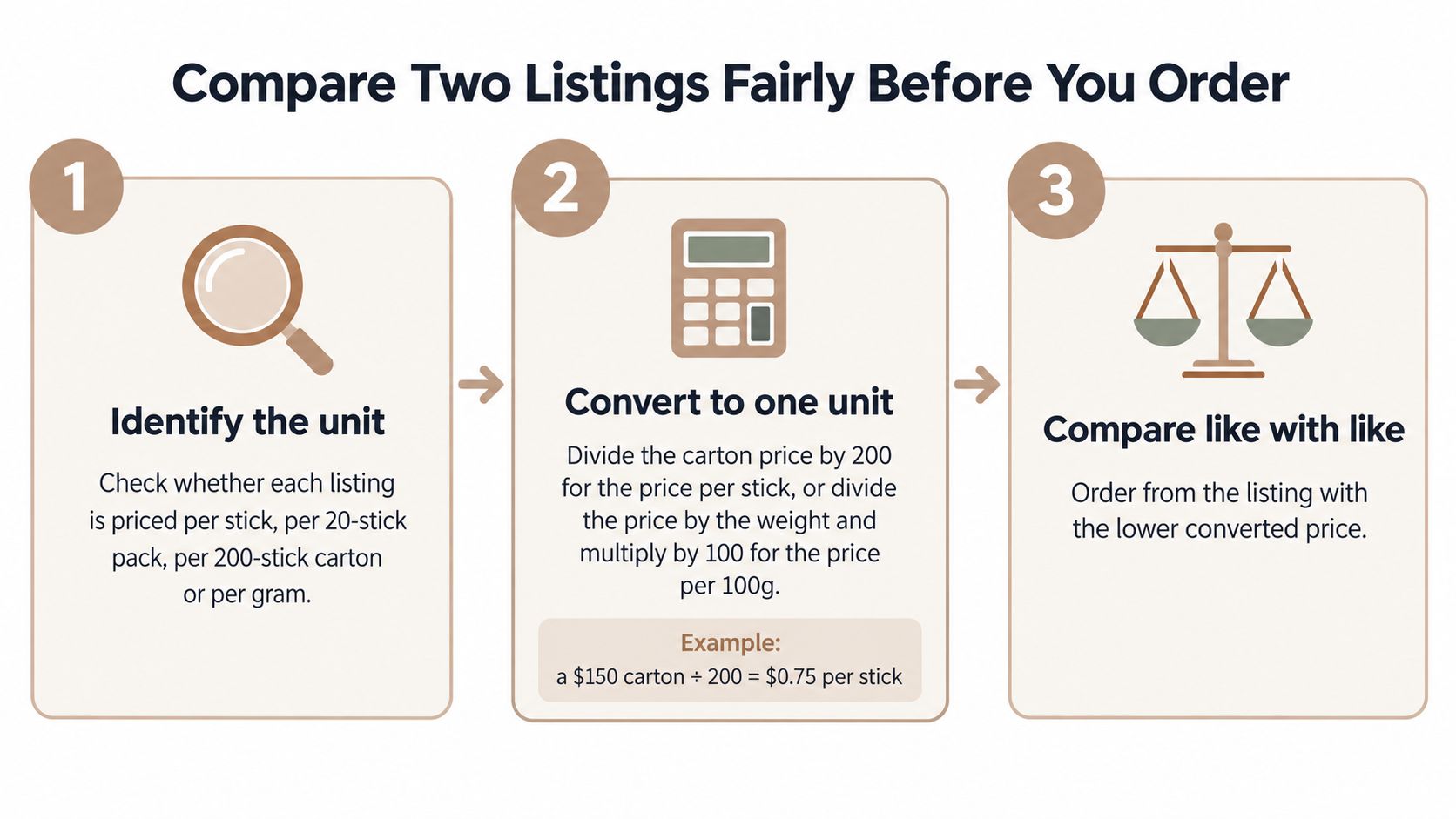
A 100g pouch of Premium Rolling Tobacco RYO 12mg lists at $51.03, and the 250g pouch of the same variant lists at $93.56. Converted to one base, that is $51.03 per 100g against $37.42 per 100g, so the larger pack is the cheaper listing by a wide margin. Neither ticket showed that until both shared a unit. The same test, run as eight steps, separates a real saving from a mismatched comparison.
- Identify the unit on each listing. A stick, a 20-stick pack, a 200-stick carton and a weight in grams are different bases. If the page does not say which one the price covers, stop there.
- Convert both listings to one unit. Divide a carton price by 200 for a per-stick figure. For loose tobacco, divide the price by the weight in grams and multiply by 100. The same conversion is what makes a 1kg tobacco price readable against a 100g or 250g pouch.
- Match strength before you rank. On the 250g rows, 12mg and 8mg differ by about $3.74 per 100g. That gap belongs to the product, not to any discount.
- Use the current listed price as the baseline. The original price only confirms that a reduction is displayed. The sale figure is what you pay and what you compare.
- Check the date against the duty. Stick duty rose from A$1.40312 to A$1.49832 per stick on 1 September 2025, about 6.8%, and reached $1.52829 on 3 March 2026, as reported alongside the March 2026 consumer price index. A listing priced for an earlier month can be accurate for its day and still sit under today’s floor.
- Compare the converted figure with the duty floor. A result under the matching duty row stays unverified until pack count, weight and duty treatment are confirmed.
- Confirm delivery before you treat the price as final. Delivery covers Australia. Check the timeframe shown on the listing or at checkout, and check whether the cost sits inside the displayed price or on top of it.
- Decide only when both listings match on unit, strength and date. If one of the three differs, you are ranking different products.
The decision rule
Pick the lowest per-stick or per-100g figure among listings that match on all three. The bulk rows show why the check matters: 50g (Bulk Buy x5) Premium Rolling Tobacco RYO at $130.98 converts to $52.39 per 100g, above the 100g pouches of either strength, and the listing states no strength at all. A bulk label and a low ticket stay marketing terms until the arithmetic agrees.
At Cheap Smokers, browse by brand or search the exact variant, run the figure through the steps above, and read the shipping and refund policies before paying. Age verification is required before purchasing tobacco online, in line with Australian law, and delivery is available anywhere in Australia.
Verdict: rank the converted figure first, then read the terms.
What a Price Tag Does Not Tell You
A$60.72 is the price of your pack. The September 2025 figure is a benchmark for a premium 20-stick pack, not a listing and not a carton. Converted, it works out to $3.036 a stick, and any ticket earns a place beside it only after the same conversion. Setting a 200-stick carton’s total against a 20-pack average ranks two different products, whatever the totals say.
A cheap pre-filled carton is a cheap cigarette. Pre-filled cigarettes carry the same per-stick duty as a factory-made pack, so a 200-stick carton converting to about 30 cents a stick sits far below the $1.52829 stick rate through a listing problem alone. The tax base is unchanged. The open questions are whether the pack count really is 200 and whether duty sits inside the ticket. Until both are confirmed, that conversion is unverified and cannot be ranked against the floor.
A listing below the duty floor is a real deal. The brand table puts Ascot Blue, Ascot Gold, Double Happiness and ESSE under the stick floor. ESSE Menthol Super Slims at $133.00 across 200 sticks converts to 66.5 cents a stick. The floor is $1.52829. A seller who confirms duty is included and the count is accurate can change the comparison. A seller who cannot leaves the row unranked.
The gap that excise rises do not fully explain
Legal shelf prices and estimated untaxed prices have not moved together. ABS analysis of illicit tobacco reports that legal tobacco prices have almost tripled since December 2016, while estimated illicit prices have stayed relatively stable. Estimates cited in that analysis put illicit tobacco at about 55% of the total market in 2024–25, with an estimated value of $5.6 billion and a possible range of $4.1–$6.9 billion.
A rising legal price widens the incentive to buy outside the taxed market, which is one reason the gap can look larger than a single year’s excise increase explains. Those estimates carry wide uncertainty bands. They describe a market, not a buying benchmark, and a far-below-duty listing is a warning sign that cannot stand in as a usable price.
Separate the legal shelf price, the tax component and any untaxed estimate. Only the first two belong in a like-for-like comparison, and only after the unit is confirmed.
Catalogue pages are built for the same check. Factory-made cartons, pre-filled cartons and rolling tobacco are listed by brand, strength and pack weight, and any sale price sits beside the original it replaced, so the conversion takes seconds. Convert the ticket, hold the figure against the matching duty row, and order the listing that survives the comparison at Cheap Smokers.