Where Can I Buy Menthol Cigarettes in Australia?
October 23, 2026Since 1 July 2025, menthol cigarettes and menthol-related accessories have been prohibited from sale in Australia, and retailers had to stop selling affected products by 30 June 2025. You therefore can’t legally buy those prohibited products through ordinary Australian retail channels.
The counterintuitive part is that finding a product online doesn’t resolve the purchasing question. A familiar pack, a functioning shopping cart and an adult-only notice can all appear on a website without establishing that a particular product complies with Australian tobacco rules.
For someone searching “where can I buy menthol cigarettes?”, the useful starting point isn’t a shop directory. It’s understanding what changed, checking the product and seller separately, and deciding whether a lawful alternative or quitting support fits the situation.
Table of Contents
- Why Menthol Cigarettes Are Hard to Buy Legally Today
- How Menthol Cigarette Buying Shifted Before the Ban
- The Menthol Phase-Out Timeline from 2024 to 2025
- What the 2025 Rules Cover and Why Labels Do Not Matter
- Checking Whether a Seller Is Lawful and Not Illicit
- Lawful Options and Support for Quitting Menthol
- Your Next Steps for Checking Current Rules
Why Menthol Cigarettes Are Hard to Buy Legally Today
This is a change in legal availability, not a stock shortage. A retailer that previously supplied a menthol brand isn’t necessarily permitted to continue selling it. Nor does moving from a supermarket to a tobacconist, or from a counter to an online checkout, change the product’s compliance requirements.
Several different situations can lead to the same search. You might remember buying a particular brand locally, have found an overseas product page, or want a less abrupt transition away from a familiar smoking routine. Those situations need different practical responses, but none makes a prohibited product lawful.
Separate the purchasing questions
A useful assessment keeps these questions distinct:
- What changed? Establish whether the product falls within the national flavouring restrictions rather than assuming your usual shop has stopped carrying it temporarily.
- What’s being offered? Identify the actual cigarette, additive or accessory. A brand name alone doesn’t describe everything relevant to compliance.
- What should you do next? Decide whether to investigate a compliant non-menthol option or seek support with stopping smoking.
The distinction matters because a seller’s identity and a product’s legality aren’t interchangeable. An established business can have an outdated catalogue entry. Equally, an unfamiliar seller doesn’t become trustworthy merely by showing a recognisable brand.
Practical rule: Check whether the product may lawfully be supplied before spending time comparing shops.
For readers who want to continue purchasing tobacco, the immediate task is to establish product compliance. For readers considering quitting, the more useful task may be arranging support rather than searching for replacement stock.
Neither response requires a moral judgement about the person searching. It requires a clear answer about what retailers may supply, followed by practical choices that don’t depend on an unlawful sale.
How Menthol Cigarette Buying Shifted Before the Ban
Before the phase-out, Australians bought tobacco through a broad network of tobacconists, supermarkets, convenience stores and other authorised channels. Someone who remembers finding menthol products through several different shops is recalling an extensive retail system.
A study of Australian tobacco purchasing patterns found that purchases from major supermarket chains fell from 50.0% in 2013 to 34.6% in 2022–23, while purchases from tobacconists rose from 17.5% to 33.1% over the same period; those figures are compared below.
Tobacco purchasing channels before the menthol ban
| Purchasing channel | 2013 | 2022–23 |
|---|---|---|
| Major supermarket chains | 50.0% | 34.6% |
| Tobacconists | 17.5% | 33.1% |
These are tobacco purchasing figures, not menthol-specific market shares. They show where smokers bought tobacco generally, so they shouldn’t be read as proof that menthol customers moved between those channels in exactly the same proportions.
The historical assessment discussed in that research estimated approximately 35,000 tobacco retail outlets, and noted that Queensland and Victoria didn’t require a tobacco-selling licence at the time. Those are historical conditions, not a description of today’s licensing requirements.
What the shift actually tells us
The figures help explain why an adult might instinctively turn to a tobacconist after failing to find a remembered product in a supermarket. Tobacconists had become a more prominent purchasing location while supermarket purchasing declined.
The old network was like a wide road with many exits. A shopper could change route without necessarily changing the product they wanted. The later flavouring restrictions changed whether the product could travel through those routes at all.
Brand and variant information serves a different purpose. Our guide to Manchester cigarette variants, types, colours and differences can help distinguish product descriptions, but a variant guide isn’t a legal availability register.
The analytical lesson is to distinguish retail-channel substitution from product withdrawal. The purchasing data describe a change in where people shopped. They don’t establish an exemption for specialist retailers, or imply that a tobacconist can supply something another retailer cannot lawfully sell.
That distinction also prevents a misleading conclusion from otherwise accurate historical information. A shop’s past importance in the tobacco market tells you little about whether a particular flavoured product complies now.
The Menthol Phase-Out Timeline from 2024 to 2025
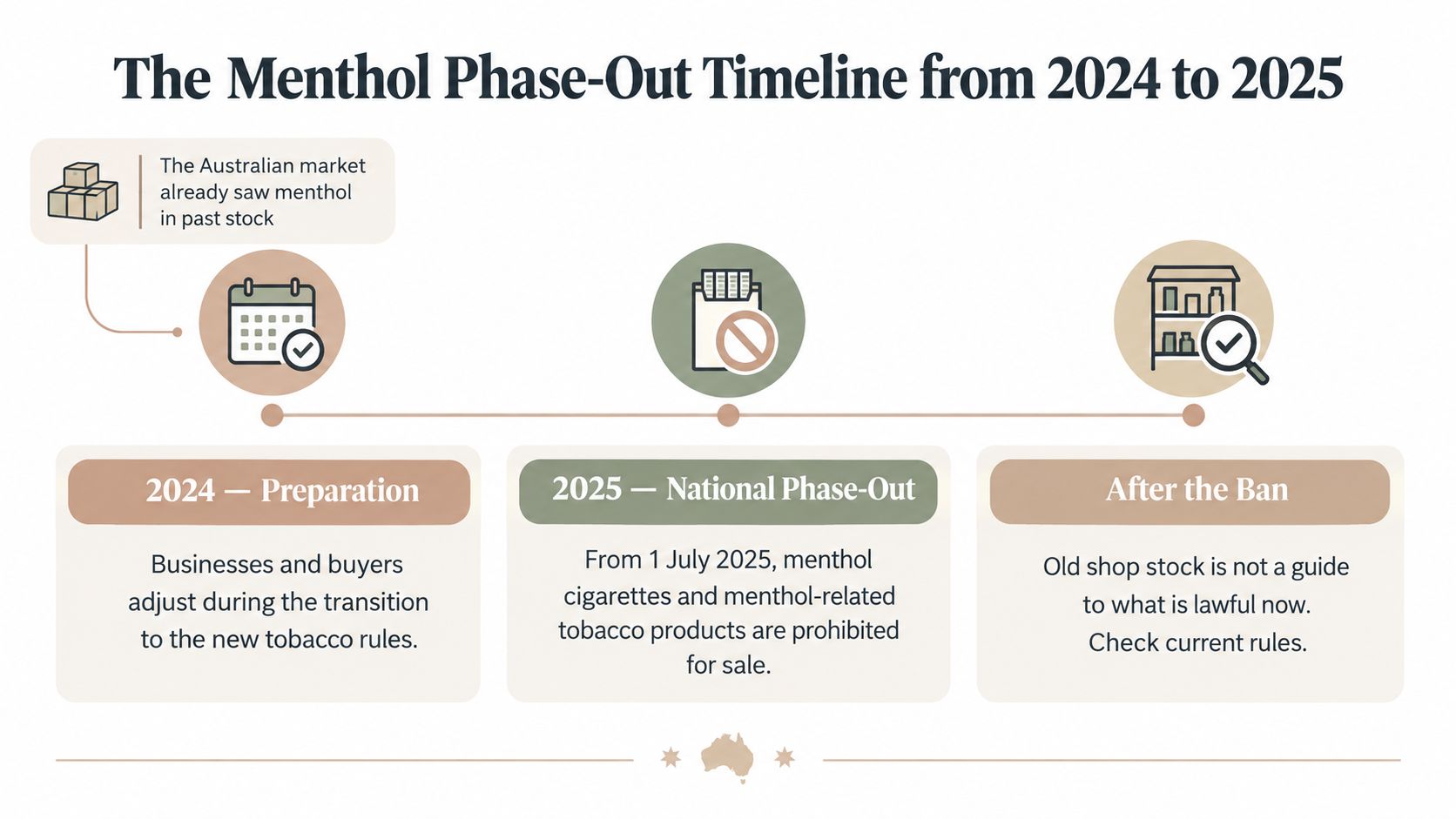
Menthol wasn’t a negligible category before the restrictions. The Australian Institute of Health and Welfare’s tobacco survey analysis and reform overview reports that 23% of Australians who smoked daily said they smoked menthol cigarettes daily in the 2022–23 survey; the staged transition allowed manufacturer compliance from 1 April 2024, required only non-menthol cigarette supplies to retailers by 31 March 2025, and gave retailers until 30 June 2025 to stop selling affected products before the prohibition from 1 July 2025.
Those stages explain why memories, receipts and older product pages can appear to conflict with present availability. Different participants had different transition deadlines. A product could have been part of a retailer’s historical range without remaining eligible for sale after the final deadline.
The timeline below provides a visual overview of that transition.
Read the stages as different obligations
- Manufacturer preparation: Businesses could begin adjusting products before the final retail prohibition.
- Supply-chain transition: The deadline for supplying retailers came before the final deadline for retail sales.
- Retail completion: The sell-through period ended. Remaining affected stock didn’t create an ongoing right to sell it.
The important difference is between a transition allowance and a permanent exception. A phased introduction gives businesses time to change what they supply; it doesn’t mean each business chooses when the restriction starts applying.
Why old availability is weak evidence
An earlier purchase proves only that a transaction happened at that time. It doesn’t establish that the same product may be supplied under the rules now in force.
The same applies to an old review describing a successful delivery. Even if the account is accurate, it can relate to an earlier regulatory position. Without a current compliance assessment, it’s a poor basis for deciding whether to order.
A past sale is evidence of past availability, not permission for a present sale.
The national change therefore needs to be understood as the end of conventional legal retail availability for affected menthol products. It wasn’t a migration from supermarkets to specialist shops, or from physical stores to websites.
What the 2025 Rules Cover and Why Labels Do Not Matter
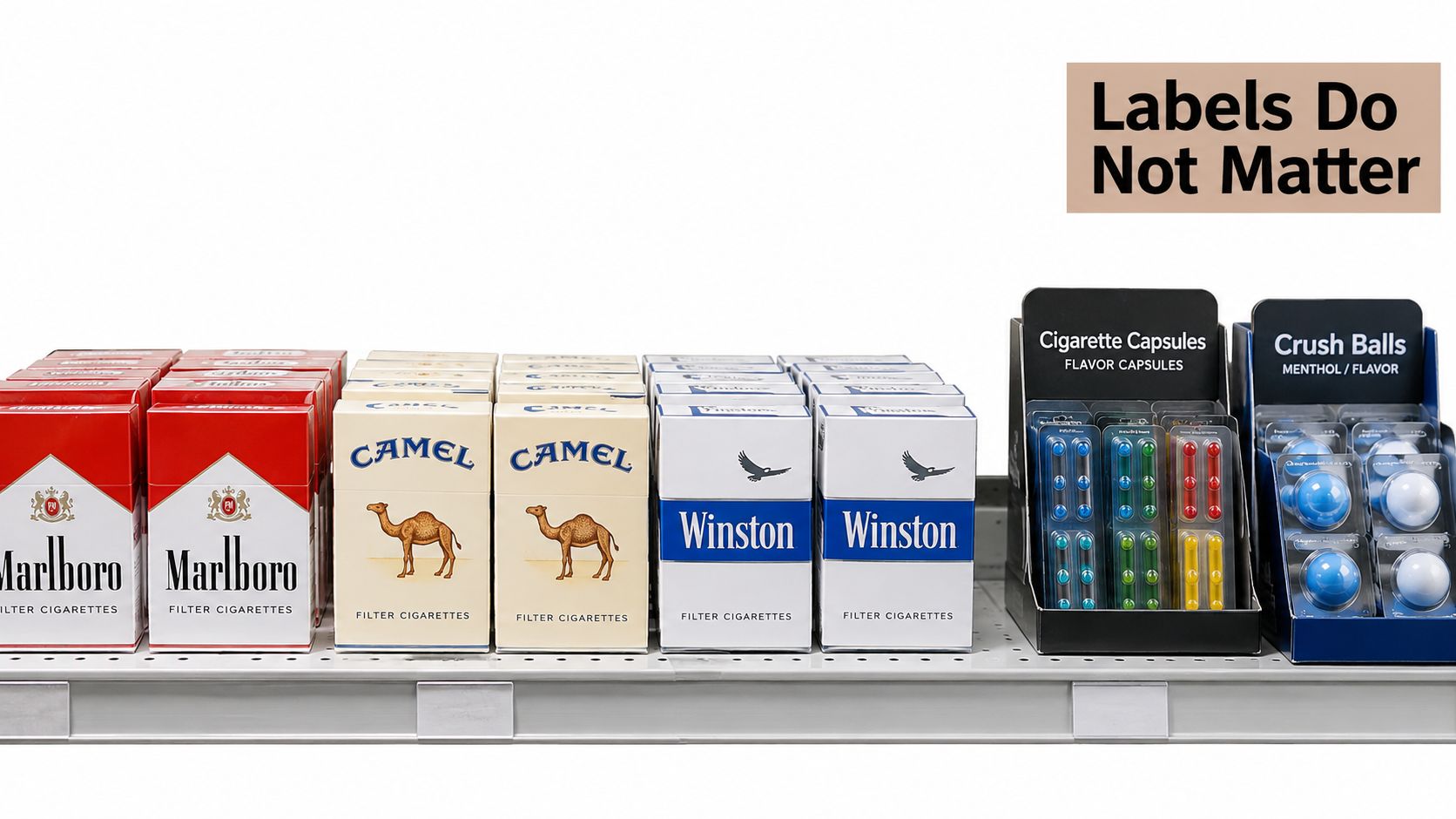
The restriction extends beyond a packet explicitly labelled menthol. The Australian Government’s tobacco product changes guidance explains the 2025 restrictions on menthol and related accessories, including crush balls, capsules and flavour beads, and the prohibition on retailers stocking, offering, selling or supplying non-compliant products across tobacco categories including cigarettes, roll-your-own tobacco, cigars and shisha tobacco.
The shelf illustration below shows the kinds of packs and separate flavouring products that require different compliance checks. It shouldn’t be read as an example of an authorised Australian retail display.
Check the substance rather than the marketing name
Names such as ice, fresh or crushball may describe features that fall within flavour restrictions. They aren’t dependable legal categories. Conversely, you shouldn’t decide a product’s status solely from an ambiguous word without establishing what the product contains or does.
Consider the distinction between these descriptions:
- A cigarette with an integrated capsule: The relevant question includes what the capsule adds, not just the cigarette’s brand.
- A separate flavour bead or crush ball: Selling the flavour component separately doesn’t remove the need to check accessory restrictions.
- An overseas-labelled pack: The country of branding doesn’t establish compliance with Australian supply requirements.
A catalogue entry can describe something accurately and still fail to establish that it may be offered locally. That’s why checking the product itself matters more than whether the listing looks polished or the name sounds familiar.
Why the rules address menthol
The policy rationale is that menthol can mask tobacco’s harshness, make smoking easier to initiate and potentially make quitting harder, as the government guidance explains. The restriction addresses those product characteristics rather than managing which brands retailers keep in stock.
That also explains why a comparison based only on flavour names can miss the point. A seller needs to establish compliance with the product rules, not find a different marketing description for an equivalent prohibited feature.
For additional viewing alongside the written guidance: https://www.youtube.com/embed/WDOd_QgDhRM
For a purchase decision, use official requirements as the reference point. A video, catalogue description or seller assurance shouldn’t substitute for checking the rules governing the specific item.
Checking Whether a Seller Is Lawful and Not Illicit
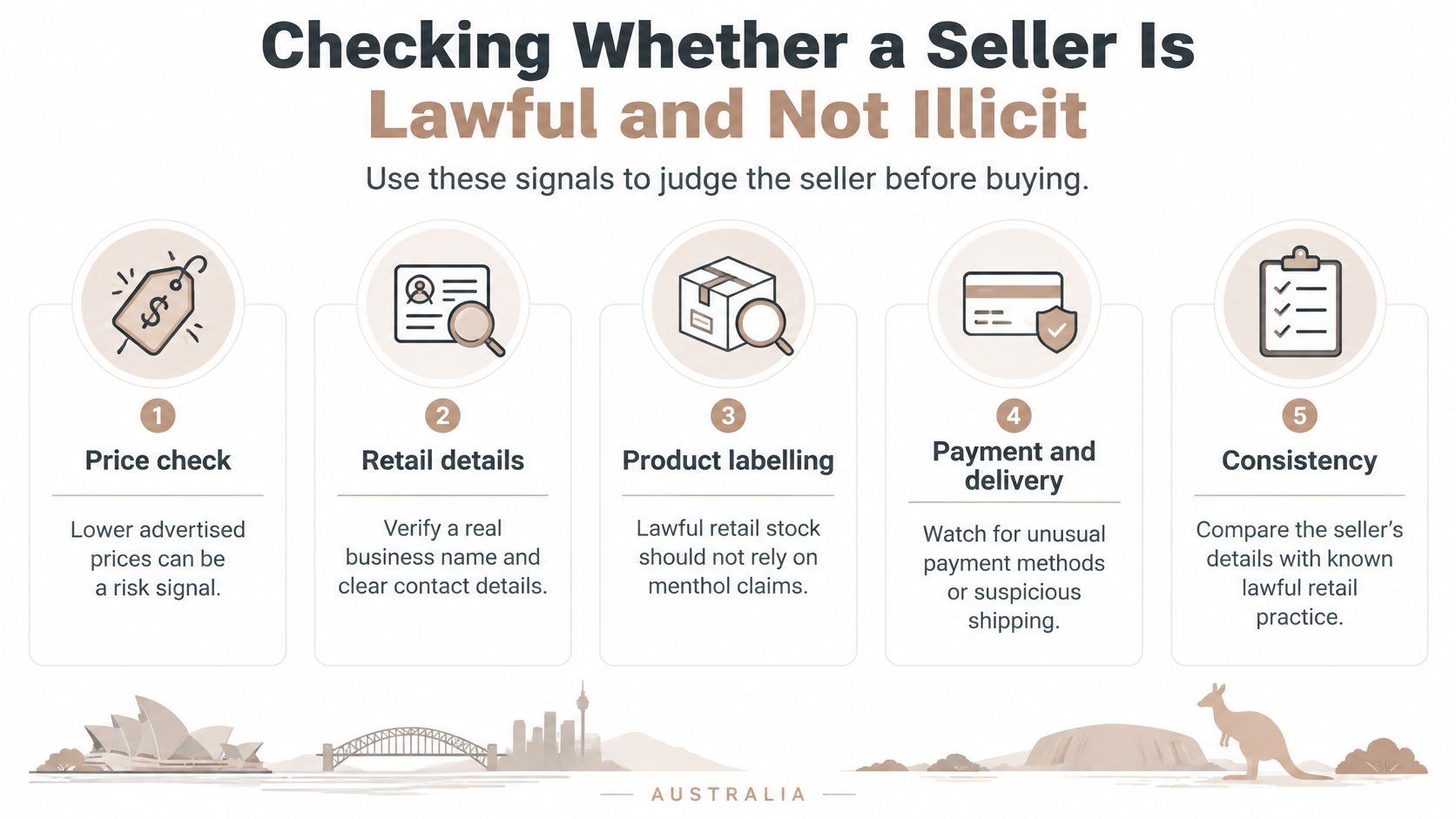
A low advertised price or overseas branding should prompt questions about supply, not an automatic assumption that you’ve found a bargain. Neither feature alone proves wrongdoing, but neither establishes that duties have been paid or that the product may lawfully be supplied.
An Australian parliamentary tobacco enforcement briefing describes estimates that illicit tobacco may represent at least 50% of the overall market, valued at approximately $4.1 billion in 2024–25, and reports that the Australian Border Force intercepted almost a kilotonne between 1 December 2025 and 31 March 2026. The briefing also describes illicit products supplied without required customs duty and the seriousness of buying and selling them as a tax offence.
Those market-level figures don’t determine whether an individual seller is lawful. They do justify checking more than price.
Compare evidence, not appearances
| Check | More useful evidence | What doesn’t establish compliance |
|---|---|---|
| Business identity | A verifiable business name and contact details | A professional-looking storefront alone |
| Authorisation | Current status under applicable jurisdictional requirements | An unsupported claim to be licensed |
| Adult purchasing controls | Clear age-verification procedures | An adult-only banner by itself |
| Product and tax compliance | Packaging and documentation consistent with current requirements | Overseas branding or a familiar pack |
| Delivery | Clear dispatch, destination and transaction information | A promise to ship anywhere |
Treat these as screening checks, not a guarantee. Age verification doesn’t legalise a prohibited product, and compliant-looking packaging alone can’t establish that every supply-chain obligation has been met.
This checklist gives a visual starting point for reviewing a seller.
Apply the same scrutiny to our catalogue
At Cheap Smokers, our range includes cigarettes, cigars, tobacco accessories, vapes, disposable e-cigarettes, and American candy and snacks. Our website presents purchases as adult-restricted, includes an age confirmation prompt and states that age verification occurs during purchasing.
Our catalogue also shows menthol-labelled pre-filled products. Those listings aren’t evidence of legal sale, and readers should check current requirements before ordering anything. The same distinction applies to information in our guide to chop-chop tobacco in Australia: a retailer’s explanatory content isn’t independent confirmation of product compliance.
Protect your records and personal information
Before submitting identification, review the stated verification process and privacy information. Avoid sending identity documents through informal social-media messages merely because someone claims to need proof of age.
For delivery across state borders, check requirements relevant to both the transaction and destination rather than assuming dispatch establishes permission. If a product arrives without apparently compliant packaging, keep the receipt, order confirmation, packaging and photographs, and seek guidance from the relevant government authority.
Report suspected unlawful supply through official channels. Don’t treat a replacement parcel or another seller’s reassurance as a substitute for resolving the compliance concern.
Lawful Options and Support for Quitting Menthol
Consider a hypothetical long-time menthol smoker who has bought the same brand for years. After learning it’s no longer legally available, they search for an imported version because keeping the familiar routine feels simpler than making another decision.
That person doesn’t necessarily need a longer list of shops. They need a realistic choice between a compliant non-menthol product and a supported attempt to stop smoking. A pharmacy or general practice appointment can provide a place to discuss that choice without relying on a seller’s product recommendations.
Distinguish intention from outcome
Research cited in the Australian Prevention Centre’s menthol-ban evidence summary found that 22% of Australian adults who smoked menthol predicted they would quit after receiving information about the ban, rising to 30% when messaging also addressed harsher taste and vaping risks.
These are predicted quitting intentions, not measured quit rates. They don’t prove that the respondents subsequently stopped smoking, or establish how any individual will respond.
The practical implication is narrower but useful: information about the change can affect how people think about their next step. A response focused exclusively on locating stock leaves out a decision that some smokers are already considering.
Quitting support can be relevant even when the original search was about buying, not stopping.
Make the next decision manageable
If you intend to continue buying tobacco, consider only non-menthol products that comply with current requirements through authorised channels. Legal availability shouldn’t be confused with a health recommendation.
If cost is part of the decision, our guide to cigarette costs in Australia provides a separate place to consider purchasing expenditure. Price comparison still comes after the legality check.
If you’re considering quitting, tell a pharmacist or GP which product you used, what you find difficult about stopping and whether you’ve tried before. Ask what support is appropriate for you rather than assuming another flavoured nicotine product is the necessary replacement.
The useful outcome is a clear next action, not pressure to decide everything immediately.
Your Next Steps for Checking Current Rules
Start with the current federal guidance, then check the relevant state or territory government health information. Use official pages to establish requirements rather than relying on a product page’s publication date, search ranking or claims about remaining stock.
Keep the legal rule, the seller assessment and your personal decision separate. They answer different questions, and a reassuring answer to one doesn’t resolve the others.
Follow a practical checking sequence
- Confirm the product’s status. Identify the exact item and check whether its ingredients or flavouring features fall within the restrictions.
- Verify the transaction. Review the seller’s identity, applicable authorisation, purchasing controls and delivery information before paying.
- Keep useful evidence. Retain order details and packaging if you need to question a transaction or report suspected unlawful supply.
- Choose your next step. Consider a compliant option or speak with a pharmacist or GP about quitting support.
Don’t use unusually cheap stock, unclear packaging or an overseas product description as a shortcut around those checks. Where information is missing, pause rather than assuming a completed checkout would establish legality.
Menthol availability in Australia is a compliance question, not a question of which shop has stock.
You don’t need to resolve every tobacco policy issue to make a sound decision. You need to establish what can lawfully be supplied, assess whether the transaction meets the applicable requirements, and choose an option that fits your circumstances.
Verify the rule, verify the seller, then choose a lawful option or arrange quitting support.
Our range includes cigarettes, cigars, tobacco accessories, and American candy and snacks, but catalogue availability doesn’t establish that a menthol product can lawfully be sold. Visit Cheap Smokers to review our catalogue and purchasing information, and check the current product rules before considering any tobacco order.